Article – How MEPS want to tackle in-work poverty in the EU

Nearly 10% of EU workers are living in poverty, with 21.7% of the population affected by poverty or social exclusion. On top of this, the pandemic risks exacerbating inequalities in the EU.

In light of this, MEPs are urging the European Commission and EU countries to include the prevention of in-work poverty in their overall goal to end poverty in the EU because the principle according to which “work is the best remedy for poverty” does not apply to low-wage sectors and those working under precarious and atypical working conditions.

In a report adopted 9 February, MEPs called for minimum wages to be set above the poverty threshold.

More on EU measures to improve workers’ rights.


ESMA CALLS FOR FUND EXPERTS TO JOIN CONSULTATIVE STAKEHOLDER GROUP

ESMA’s work relating to collective investment management covers principally the Directives on Undertakings for Collective Investment in Transferable Securities (UCITS) and Alternative Investment Fund Managers (AIFMD), as well as the Regulations on Money Market Funds, European Venture Capital Funds (EuVECA), European Social Entrepreneurship Funds (EuSEF) and European Long-term Investment Funds (ELTIFs). IMSC’s work with respect to these legal frameworks covers such issues as marketing and distribution, conduct of business, product disclosures and transparency, valuation, eligible assets, asset safekeeping and risk management.

The purpose of the CWG is to provide technical assistance to ESMA in relation to the IMSC’s work, CWG members are selected for a renewable term of two years. ESMA invites interested experts to send their application by 17 March 2021 through the EU survey.


COVID-19 chiefs of police working group meets to talk pandemic and fighting crime threats

On Friday 12 February, Europol’s Executive Director, Catherine De Bolle welcomed Vittorio Rizzi, Deputy Director-General of Police and Director of the Criminal Police in Italy, to Europol’s headquarters. Together they chaired the fourth Working Group on COVID-19 Crime Threats and Law Enforcement Responses.

As the pandemic has changed the landscape of crime, law enforcement has had to adapt their approaches to the accelerated shifts in criminal modi operandi and market focus. The COVID-19 chiefs of police working group is an important initiative for law enforcement agencies to work together in monitoring the situation and coordinating the appropriate responses.

European chiefs of police from Austria, Belgium, France, Germany, Italy, the Netherlands, Poland, Portugal, Spain, Switzerland, the United Kingdom and INTERPOL joined the virtual meeting to discuss the latest developments in criminality related to COVID-19 and the priorities of the working group.  

Some of the priority areas discussed:

  • the risks of criminals taking advantage of vaccination campaigns rolling out across the world to sell fake vaccines. Although still limited, some offers of fake vaccines have appeared on the dark web; 
  • the online sexual exploitation of minors remains a great concern given the increase in  the production and distribution online of child sexual abuse materials during the pandemic; 
  • fraud schemes are likely to proliferate and intensify due to the economic hardship imposed by the pandemic. As unprecedented financial efforts are made in the EU to boost economic recovery, law enforcement agencies remain strongly committed to preventing and fighting financial and economic crime. 

Headquartered in The Hague, the Netherlands, Europol supports the 27 EU Member States in their fight against terrorism, cybercrime and other serious and organised forms of crime. We also work with many non-EU partner states and international organisations. From its various threat assessments to its intelligence-gathering and operational activities, Europol has the tools and resources it needs to do its part in making Europe safer. In 2019, Europol supported 1 874 international operations.

Related publications:

Europol early warning notification: The illicit sales of false negative covid-19 test certificates (02/02/2021)
Europol early warning notification: Vaccine-related crime during the covid-19 pandemic (04/12/2020)
Europol report: How COVID-19-related crime infected Europe during 2020. (12/11/2020)


Virtual meeting with INPI Portugal

February 15, 2021 EU Intellectual Property Network

Virtual meeting with INPI Portugal

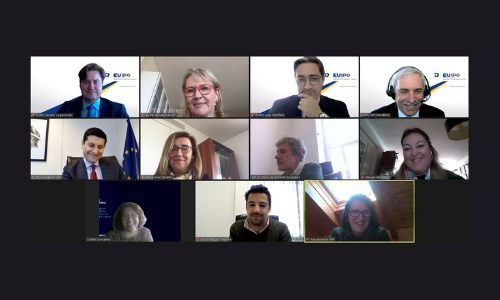
The Executive Director of the EUIPO, Christian Archambeau, held a virtual meeting with the President of the Directive Council of the Portuguese Institute of Industrial Propriety (INPI), Ana Bandeira.

During the meeting, discussions focused on the success of the cooperation activities between the EUIPO and the Portuguese office, within the scope of the European Union Intellectual Property Office (EUIPN). The virtual meeting also provided an opportunity to exchange views and to discuss about the future cooperation initiatives of both offices.

The initial results of the recently launched SME Fund and the implementation of the SME programme under the EUIPO’s Strategic Plan 2025 were also part of the agenda topics.

The Deputy Executive Director of the EUIPO, Andrea Di Carlo, the Head of Cabinet, Ursula Schildt, the Director of International Cooperation and Legal Affairs, João Negrão, and the Deputy Director of the International Cooperation Area, Sandris Laganovskis, also attended the meeting.

The exchange also addressed the needs of INPI in the context of the current Portuguese presidency of the Council of the EU, which will run until 30 June 2021.


1-year badge 2021 – accreditation is open

This badge is intended for journalists resident in Belgium and gives access, during the whole calendar year 2021, to the Council premises during summits and high-level meetings, as well as on regular working days.

NOTE TO THE ATTENTION OF UK NATIONALS
As from the 1st January 2021 media representatives with UK nationality must meet the requirement of having a permanent residence in Belgium for at least 5 consecutive years, to be able to apply for the 1-year press badge.

Application deadline: 5 March 2021 at 12.00

Procedure

Before starting the online procedure please make sure to have at hand the following piece of information and documents:
• The number of your valid identity document (national identity cards are only accepted for EU and EFTA nationals) or passport, as well as the issuing and expiry dates thereof
• A scanned copy of your EU or Belgian press card, OR of the assignment letter signed by your editor-in-chief confirming that you are covering EU affairs during the current year.
• A passport-type picture in .jpeg format (max. 500KB)
• You will also be asked to print, sign and upload a form to give your authorisation to be security screened by the Belgian authorities. You will be able to download your consent form from your account.

Collection of badges

You will receive an automatic email to inform you once your application has been validated and the badge is ready to be collected.

1-year badges can be collected, on an individual basis only, at the JL main accreditation desk on working days. Please ensure you have your ID/passport when collecting the badge.