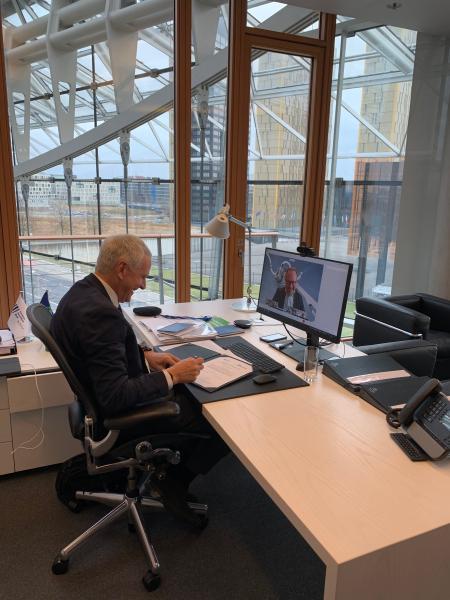
Speech of Eurogroup President, Paschal Donohoe, at the European Parliamentary Week, 22 February 2021

Thank you very much for inviting me to the Economic and Monetary Affairs Committee meeting of this Interparliamentary Conference on Stability, Economic Coordination and Governance in the EU.
It is an honour to participate in this important forum.
I am grateful to the European Parliament and the Portuguese Presidency of the EU for having organised a timely discussion on this very important topic.
In my opening remarks, I will talk about how I see the policy mix that is needed to bring about a sustainable and resilient recovery, and how the Eurogroup should contribute to this.
Economic outlook – setting the scene
I would like to set the scene and say a few words on the economic situation.
The Commission’s 2021 Winter Forecast confirmed that the Covid-19 crisis caused economic activity in the euro area to contract in 2020 by an unprecedented 6.8%. It goes without saying that without the swift and bold policy response by the member states and the European institutions, things would have been even worse. These efforts include large national fiscal stimulus enabled by flexibility in the EU rules, the agreement to establish three common safety nets, and of course, the extraordinary monetary accommodation by the ECB. The pandemic remains enormously challenging. It still is weighing on society and the economy. Nevertheless, there is reason to be cautiously optimistic. As challenging as the situation still is, recent economic data has not been as bad as feared, which suggests that the economy may be getting better at dealing with the health crisis and the containment measures. Importantly, there is the ongoing roll-out of vaccines.
There has also been other good news, such as the EU-UK trade agreement, reduced geopolitical tensions, and the prospect of RRF funds reaching member states in the second half of the year. The recovery is hence expected to get underway later this year. At the same time, we need to be mindful that the positive economic outlook faces elevated uncertainty and is predicated on a positive public health situation. In addition, the recovery is likely to be uneven across sectors and member states. It is against this background that we have to consider the fiscal-economic policy mix going forward.
Fiscal policy strategy
Let us start with fiscal policy, which played a crucial role in limiting the socio-economic fallout from the crisis by protecting incomes and jobs.
Letting automatic stabilisers work, introducing discretionary measures and providing government guarantees was undoubtedly the right response. There is an international consensus that at least this year, fiscal policy needs to remain expansionary to ensure that a solid recovery indeed takes hold. The Eurogroup subscribes to this view. We should proceed cautiously to avoid cliff-edge effects related to the risk of a premature withdrawal of fiscal stimulus.
At the same time, we have to plan ahead and start thinking about the fiscal stance in 2022 and beyond.
The Eurogroup had an initial discussion on this issue at its meeting of 15 February, and we agreed to hold more strategic discussions in the coming months. We will draw on the guidance of the Commission. We will also listen carefully to the views of the ECB. I took good note of what President Christine Lagarde said recently when she presented the ECB’s Annual Report to the European Parliament: monetary and fiscal policy should continue to work hand in hand.
When the health situation and economic outlook improves, fiscal support should increasingly be rebalanced to more targeted measures and to future-oriented reforms and investment that bolster the recovery. The aim is to develop a credible medium-term fiscal strategy that ensures a smooth transition from emergency support, in order to keep the economy going – to supporting the recovery, which in turn has to be reconciled with the sustainability of public finances.
Member states coordinated fiscal policy in the crisis, and this reinforced the credibility of the EU’s crisis response. It is essential that we maintain the consensus and coordinate policy during the recovery. The Eurogroup’s aim is to agree, by July, on a common understanding on the appropriate fiscal stance. This would feed into the draft budgetary plans for 2022, which member states will be submitting in autumn.
Priorities for fiscal and economic policies
Let me now turn to the concrete priorities that fiscal and economic policy should address.
The Eurogroup broadly agreed on these priorities already in December last year, when it discussed the recommendation on the economic policy of the euro area proposed by the Commission.
Maintaining emergency economic support
Our first priority remains to continue protecting our citizens from this pandemic while the public health emergency lasts.
There is a clear consensus among finance ministers that the best way to deal with uncertainty linked to the circulation of the virus and the emergence of new mutations, is to maintain emergency economic support measures.
Rebalancing fiscal support
As we look into the future and the recovery starts to take hold, our second priority will be to gradually shift towards more targeted fiscal support measures.
We are very aware that some sectors and citizens are hit harder by this pandemic.
There will likely be a need to continue providing them with emergency support for longer.
At the same time, we need to take advantage of the opportunities offered by the Next Generation EU programme to channel investment into the areas where it is needed the most and ultimately raise Europe’s growth potential.
Rebuilding the economy: investment and reforms
The third priority is, of course, rebuilding the economy.
To ensure the return to growth is sustained, we need to make sure that our economies emerge stronger, more resilient, and better prepared for future challenges. This will require ambitious investment and reforms.
While the pandemic upended a 7-year period of uninterrupted economic expansion, the overall growth performance after the previous crisis was modest and uneven in the euro area. Investment also never fully recovered.
The emergence from the pandemic will see an automatic growth rebound on the back of pent-up demand and the high savings accumulated during the crisis. This will be welcome but this is not the same as a sustainable recovery.
This is why member states should take advantage of the current favourable financing conditions and of course the Next Generation EU programme, to increase investment in infrastructure and human capital.
This should happen across sectors and in line with the EU priorities of the green and digital transitions.
To maximize public investment in the economy and make it a catalyst for private investment, public investment needs to be accompanied by structural reforms that will foster sustainable growth. These include reforms to improve the functioning of labour and product markets, the public administration, and thereby also the business environment, which is key for spurring innovation.
The Recovery and Resilience Facility, the centrepiece of Next Generation EU which entered into force last week, will give impetus to the much needed investment and reform effort.
Conclusion
This brings me to the conclusion of my remarks.
The pandemic plunged our societies and economies into an unprecedented crisis, which, I am confident, we will overcome. The outlook is improving, but we have a journey to complete. Sustained efforts are required from all to ensure a smooth transition to the recovery, and to consolidate it so that the economy can deliver lasting prosperity.
There is a lot at stake and we owe it to our citizens to get it right. The Eurogroup will do its part.
Initiatives like this Inter-parliamentary Conference, which bring together policymakers and representatives of the people from across the EU, will help to achieve strong democratic ownership of these policies.
Thank you for your attention. I look forward to our discussion.