Antitrust: Commission fines Mastercard €570 million for obstructing merchants’ access to cross-border card payment services

Commissioner Margrethe Vestager, in charge of competition policy, said: “European consumers use payment cards every day, when they buy food or clothes or make purchases online. By preventing merchants from shopping around for better conditions offered by banks in other Member States, Mastercard’s rules artificially raised the costs of card payments, harming consumers and retailers in the EU.”

Mastercard is the second largest card scheme in the European Economic Area (EEA) in terms of consumer card issuing and value of transactions. Under the MasterCard scheme, banks offer card payments-related services under common card brands, Mastercard and Maestro. Mastercard acts as a platform through which issuing banks provide cardholders with payment cards, ensure the completion of the card payment transaction and transfer funds to the retailer’s bank.

Card payments play a key role in the Single Market, both for domestic transactions and for payments across borders or over the internet. European consumers and businesses make more than half of their non-cash payments through cards.

When a consumer uses a debit or credit card in a shop or online, the bank of the retailer (the “acquiring bank”) pays a fee called an “interchange fee” to the cardholder’s bank (the “issuing bank”). The acquiring bank passes this fee on to the retailer who includes it, like any other cost, in the final prices for all consumers, even those who do not use cards.

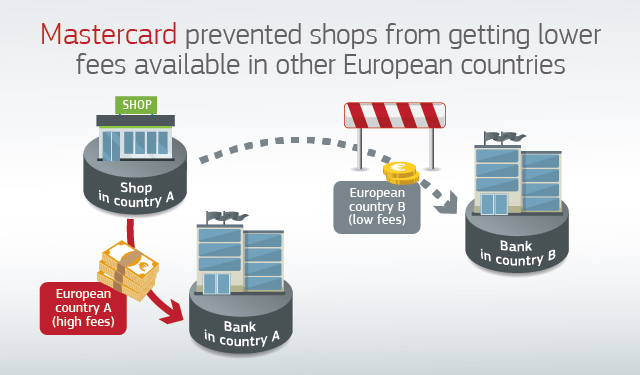
Mastercard’s rules obliged acquiring banks to apply the interchange fees of the country where the retailer was located. Prior to 9 December 2015, when the Interchange Fee Regulation introduced caps, interchange fees varied considerably from one country to another in the EEA. As a result, retailers in high-interchange fee countries could not benefit from lower interchange fees offered by an acquiring bank located in another Member State.

In April 2013, the Commission opened a formal antitrust investigation against Mastercard to assess whether these rules on ‘cross-border acquiring’ were in breach of EU antitrust rules. In July 2015, the Commission issued a Statement of Objections.

The Commission investigation found that because of Mastercard’s cross-border acquiring rules retailers paid more in bank services to receive card payments than if they had been free to shop around for lower-priced services. This led to higher prices for retailers and consumers, to limited cross-border competition and to an artificial segmentation of the Single Market.

On this basis, the Commission concluded that Mastercard’s rules prevented retailers from benefitting from lower fees and restricted competition between banks cross border, in breach of EU antitrust rules. The infringement ended when Mastercard amended its rules in view of the entry into force of the Interchange Fee Regulation.

As a result, the Commission decided to impose a fine on Mastercard.
image_EN

Cooperation with Mastercard

Mastercard cooperated with the Commission by acknowledging the facts and the infringements of EU competition rules.

The Commission granted Mastercard a 10% fine reduction in return for this cooperation.Further information on this type of cooperation can be found on the Commission’s Competition website.

Fines

The fine was set on the basis of the Commission’s 2006 Guidelines on fines (see IP/06/857 release and MEMO/06/256). In setting the level of fines, the Commission took into account several factors, including the value of sales relating to the infringement, the gravity of the infringement and its duration, as well as the fact that Mastercard cooperated with the Commission during the investigation.

The fine imposed by the Commission on Mastercard amounts to €570 566 000.

Background

The Commission concluded that Mastercard’s rules until 9 December 2015 infringed Article 101 of the Treaty on the Functioning of the European Union (TFEU), which prohibits agreements between companies or decisions by an association of undertakings that prevent, restrict or distort competition within the EU’s Single Market.

The Commission takes the view that Mastercard and its licensees (who issue Mastercard and branded cards to cardholders or acquire transactions with those cards for retailers) together form an association of undertakings.

More information on this investigation is available on the Commission’s competition website in the public case register under the case number AT.40049.


Interchange Fee Regulation

As of 9 December 2015, the Interchange Fee Regulation capped interchange fees in the European Economic Area (EEA) to a maximum of 0.2% of the transaction’s value for debit cards and 0.3% of the transaction’s value for credit cards. Before that, these fees varied considerably from one country to another in the EEA.

Since the entry into force of the Regulation, retailers pay a reduced domestic or cross-border interchange fee, which brings retailers’ costs down considerably.

Ongoing investigation concerning Mastercard

In the Statement of Objections addressed to Marstercard in 2015, the Commission also outlined its preliminary view that Mastercard’sinterchange fees applied to payments made in EEA with consumer debit and credit cards issued outside the EEA (“Inter-regional MIFs”) may breach EU antitrust rules.

The Commission is concerned that such fees applied by Mastercard may anti-competitively increase prices for European retailers accepting payments from cards issued outside the EEA and in turn lead to higher prices for consumer goods and services in the EEA. That part of the case is still pending.

In December 2018, the Commission invited comments from interested parties on commitments offered separately by Visa and Mastercard to address the Commission’s competition concerns relating to inter-regional interchange fees for card payment transactions.


Previous Commission actions

Today’s decision is the latest in a series of Commission’s actions reducing card fees for merchants:

  • In December 2007, the Commission found that Mastercard’s interchange fees on cross-border transactions in the EEA (e.g. when a Belgian citizen uses his card to pay in a shop in France) restrict competition between banks. In September 2014, the Commission’s findings were confirmed by the Court of Justice.
  • In 2009, to comply with the Commission’s 2007 decision, Mastercard reduced the (intra-EEA) cross-border interchange fees applied by its member banks to maximum weighted averages of 0.2% for debit cards and 0.3% for credit cards.
  • In December 2010 and February 2014, the Commission also adopted decisions making legally binding commitments offered by Visa Europe (the former Visa scheme association of banks in Europe) to cap at the same levels (0.2% and 0.3%) the interchange fees for all intra-EEA debit and credit card transactions. The 2014 commitments also allowed acquirers to apply a reduced cross-border interchange fee (0.2% for debit and 0.3% for credit) for cross-border clients.
  • In April 2015, the EU’s Council of Ministers and the European Parliament adopted the Interchange Fee Regulation, which from 9 December 2015 capped interchange fees for cards issued and used in Europe (maximum of 0.2% for debit cards and 0.3% for credit cards). The Interchange Fee Regulation established a level playing field for the card payments in the intra-EEA transactions market as a whole. However, the caps of the Interchange Fee Regulation do not apply to inter-regional transactions (i.e. those involving cards issued outside the EEA), as the Regulation does not apply to cards issued outside the EEA.

Action for damages

Any person or company affected by anti-competitive behaviour as described in this case may bring the matter before the courts of the Member States and seek damages. The case law of the Court and Council Regulation 1/2003 both confirm that in cases before national courts, a Commission decision constitutes binding proof that the behaviour took place and was illegal. Even though the Commission has fined the companies concerned, damages may be awarded without being reduced on account of the Commission fine.

The Antitrust Damages Directive, which Member States had to transpose into their legal systems by 27 December 2016, makes it easier for victims of anti-competitive practices to obtain damages. More information on antitrust damages actions, including a practical guide on how to quantify antitrust harm, is available here.

Whistleblower tool

The Commission has set up a tool to make it easier for individuals to alert it about anti-competitive behaviour while maintaining their anonymity. The tool protects whistleblowers’ anonymity through a specifically-designed encrypted messaging system that allows two way communications. The tool is accessible via this link.


Q&A – Eurobarometer survey on Antisemitism in Europe

How is Antisemitism defined?

Antisemitism appears in many different forms and is not always easy to define. In 2016 the International Holocaust Remembrance Alliance adopted a legally non-binding working definition of Antisemitism, which states: “Antisemitism is a certain perception of Jews, which may be expressed as hatred toward Jews. Rhetorical and physical manifestations of antisemitism are directed toward Jewish or non-Jewish individuals and/or their property, toward Jewish community institutions and religious facilities.”

The European Commission, the European Parliament and the Council all recognise this definition, as a useful guiding tool for civil society, law enforcement authorities and education facilities to effectively recognise and fight all forms of Antisemitism. The European Commission, in line with other international organisations, is actively using this definition in its work, in particular for education and training purposes. 

What has the Commission done to tackle Antisemitism?

In 2015, the first Fundamental Rights Colloquium was dedicated to combating Antisemitism and Anti-Muslim hatred and other forms of racism and intolerance. The Commission also appointed of the first European Commission Coordinator on combatting Antisemitism, as well as a Coordinator on Anti-Muslim Hatred. The key tasks of the coordinator have been to bring the concerns of the Jewish communities to the attention of the political level of the Commission, and help coordinate efforts across services in the context of the Commission’s overarching policy on racism, xenophobia and other forms of intolerance.  

The increase of Antisemitism in Europe is particularly worrying in the online sphere, as today’s study shows. Since 2016 the Commission has worked intensively to tackle this challenge with the Code of Conduct on illegal online hate speech. (see more details below)

In June 2016, the European Commission also launched the High Level Group on combating Racism, Xenophobia and other forms of Intolerance to step up cooperation and coordination, to better prevent and combat hate crime and hate speech.  It brings together all 28 EU Member States, international organisations and civil society organisations. Through this network, the Commission is working on addressing the underreporting issue by improving standards for recording hate crime.

Quarterly roundtables with Jewish umbrella organisations and visits to the EU Member States have strengthened the collaboration with Jewish communities, international organisations, Member states authorities and NGOs.

On 29 November 2018, the EU acquired a Permanent International Partnership with the International Holocaust Remembrance Alliance. The participation of the EU in this international body will allow for closer cooperation on combating Holocaust denial and preventing racism, xenophobia and Antisemitism.

Holocaust remembrance, research and education are key to understanding the history of the founding of the EU. Through Horizon 2020, the EU has set-up the European Holocaust Research Infrastructure (EHRI) in the Netherlands. Its goal is to strengthen the network of European research on the Holocaust and contribute to a European perspective on the Holocaust.

Through funding of the Europe for citizens’ programme (annually EUR 3.5 million), remembrance of the Holocaust and Antisemitism during the 20th century, is kept alive. The 50th anniversary of the antisemitic purges by the Communist regime in Poland was a priority among the funding priorities for 2018. This project shed light on antisemitism under the guise of Antizionism that led to the expulsion of thousands of Polish Jews in 1968, many of them Holocaust survivors. Through operational grants the EU supported also the structures of Holocaust Memorials in the EU such as the Memorial de la Shoah in Paris. Further support is given through EU Structural Funds to support the Memorial site Auschwitz-Birkenau.

Jewish heritage in Europe is in need of protection in places where Jewish communities have been destroyed during the Holocaust. In the framework of the European Year of Cultural Heritage 2018, EUR 1 million are spent to protect 1600 Jewish cemeteries in Central and Eastern Europe.

Under the Rights, Equality and citizenship programme, tackling Antisemitism is a key funding ground. For instance, the European Commission funded the project “Facing all the facts” to tackle hate crime and hate speech online and develop training for law enforcement and improve hate crime monitoring. 

What were the key European policy achievements in the fight against Antisemitism in the last years?

A milestone was the endorsement by the European Commission of the non-legally binding International Holocaust Remembrance Alliance (IHRA) working definition of antisemitism. Several EU Member States (7 to date), cities, student organisations and education institutions have adopted and made use of the definition. Jewish communities and organisations fighting Antisemitism regard the endorsement and use of the definition as a key benchmark.

On 1 June 2017, the European Parliament adopted a resolution on combating Antisemitism including the call for national special envoys, adopting the International Holocaust Remembrance Alliance working definition of Antisemitism and increased efforts on local, national and European level.

Member States significantly scaled up their commitment to curbing rising Antisemitism. On 6 December 2018, Justice and Home Affairs Ministers of all 28 EU Member States adopted an “EU Council Declaration on the fight against antisemitism and the development of a common security approach to better protect Jewish communities and institutions in Europe” (see Commission statement). The declaration covers a wide range of areas in which action is needed. This includes calling on Member States to:

–      adopt national strategies to prevent and fight all forms of Antisemitism within their general strategies again racism;

–      adopt the IHRA definition;

–      ensure security of Jewish communities and to provide the necessary financing;

–      implement fully existing European legislation on racism and xenophobia;

–      promote education on the Holocaust and Jewish life today, including in integration courses for newcomers, and ensuring adequate training for teachers. 

What are the main findings from the Eurobarometer survey on Antisemitism?

Today, the European Commission is publishing the results of a Eurobarometer survey on Antisemitism. Interviews were carried out face-to-face with 27,643 people in 28 Member and respondents were asked about their perception of Antisemitism.

One of the most striking findings from the Eurobarometer is that perceptions among Europeans on Antisemitism are very divided. While every other European considers Antisemitism to be a problem in their country, 4 in 10 Europeans actually do not consider it to be an issue in their country.

The results of the survey show that there is a perception gap on Antisemitism: while 89% of Jews say that Antisemitism has significantly increased over the past 5 years, only 36% of the general public consider it has increased.

There are also significant differences in perception among Member States. People saying that Antisemitism is a problem is highest in countries with significant Jewish communities, and where physical attacks against the Jewish community have taken place, including Sweden, France, Germany, the Netherlands, Italy, UK, and Belgium. Swedish (81%) and French (72%) respondents are the most likely to say that Antisemitism is a problem in their country. Both countries stand out with heightened perception throughout the survey.

Europeans with Jewish friends and acquaintances are more likely to be aware of the issues as well as increase in Antisemitism, as well as those who belong to a minority themselves.

Only 3% of Europeans feel ‘very well informed’ about Jewish history, customs and practices, and 68% say they are ‘not informed’.

The majority of Europeans (61%) know that there is a legislation criminalising incitement to violence or hatred against Jewish people in their country. Significantly less are aware of legislation criminalising Holocaust denial (42%). Holocaust denial is perceived as being a problem in their country by about half of Europeans (53%). On average, only 4 in 10 Europeans think the Holocaust is sufficiently taught in schools. Among people who finished their education earlier, this is only 3 in 10.The shorter the formal education, the more people feel it is not sufficiently taught. 

How does these results compare to the 2018 Fundamental Rights Agency’s survey on the perception and experience of Antisemitism among European Jews?

The Eurobarometer survey results show a significant discrepancy between the general public’s perceptions of Antisemitism compared with that of the Jewish community as shown by the December 2018 EU Fundamental Rights Agency’s survey on the perception and experiences of the Jewish community. Over 16,300 people responded to the Fundamental Rights Agency’s survey, which makes it the largest survey ever among Jewish communities on antisemitism, covering 12 countries which are home to 95% of European Jewish people.

Nine in 10 (89 %) Jews consider that antisemitism has increased in their country, with more than eight in 10 (85 %) considering it to be a serious problem. Jews around Europe rate Antisemitism as the biggest social or political problem where they live. Antisemitism hinders people’s ability to display freely their Jewish identity and live free from concerns for security and well-being.

The Eurobarometer results published today shows that there is clear perception gap of the problem of Antisemitism, with only 36% of the general public saying they think antisemitism has increased in the past five years. 

What does the European Union do to combat Antisemitism outside the EU?

Antisemitism also needs to be countered outside the European Union and the EU is committed to address it also in multilateral frameworks. In a joint initiative the EU, the United States, Canada and Israel organised the first United Nations (UN) High-Level seminar on combating antisemitism in 2016 and joint events have been taking place throughout the UN General Assembly. This initiative was followed-up in the 2018 United Nations General Assembly (UNGA), when the EU together with the three countries co-organised a Campaign against Antisemitism in the UNGA. In 2018, the EU presented also a resolution on Freedom of Religion or Belief at the UN General Assembly and at the Human Rights Council (March Session).

The annual High-level seminar on combating racism, xenophobia and antisemitism between the European Commission and the State of Israel is a unique forum that brings together civil servants, policymakers, academics and civil society to discuss best practices in addressing these problems.

The Commission has been working closely with the Organisation for Security and Cooperation in Europe (OSCE) and its Human Rights office (ODIHR), participating in two conferences on Antisemitism. The Commission presented together with the OSCE/ODIHR in 2017 in Brussels a policy guide which addresses the security needs of the Jewish communities.

What does the European Commission do internally to promote combatting Antisemitism?

One of the key prevention tools is training. The Commission organises every year a dedicated training on unmasking modern anti-Semitism, which gives EU officials the possibility to confront conscious and unconscious biases in the institutions and daily work.

On the occasion of Holocaust Remembrance Day, the European Commission holds annual staff trainings on the role of civil servants in bringing about the Holocaust. On that day, an exhibition highlighting certain aspects of the Holocaust is presented in Commission buildings, for instance on the Terezín concentration camp or on the Roma genocide, funded by the Europe for Citizens programme.

To celebrate Jewish life, for 13 years the Commission has been hosting an annual EuroChanukkah celebration in the Berlaymont, the European Commission headquarters.

What are the broader initiatives taken by the European Commission to tackle online hate speech and other forms of intolerance?

According to the 2018 Fundamental Rights Agency survey, Jews encounter antisemitic hate speech most often online. To counter illegal hate speech online, the European Commission concluded on 31 May 2016 a Code of Conduct with main IT-Companies (Twitter, YouTube, Facebook and Microsoft) in which they agreed to revise all relevant illegal hate speech flagged to them within 24 hours and remove it where necessary. Our third implementation report proved that significant progress has been made with a removal rate of 70% of illegal content and several more platforms joining the Code of Conduct (i.e. Instagram, Snapchat, Daily motion).

The Commission has stepped up efforts to ensure correct transposition of the Framework decision on combating certain forms and expressions of racism and xenophobia by means of criminal law. Under this legislation incitement to hatred or violence and publicly condoning, denying or grossly trivialising the Holocaust, constitutes a punishable offence.

To support Member States’ and civil society’s efforts, the European Commission created the EU the High-Level Group on racism, xenophobia and related intolerance which helps to counter hate crime, including antisemitic hate crime by developing tools: i) improving recording of hate crimes, ii) ensuring support for hate crime victims and iii) hate crime training for law enforcement.

On 12 September 2018, the Commission proposed new rules to remove terrorist content from the web within one hour of order by a competent authority.

An action plan to protect public spaces was presented by the Commission in October 2017 with a focus on religious premises. Collaboration between Jewish community security and Commission services including the EU Counter-terrorism Coordinator and Europol has been strengthened.


Commissioner Jourovà: Countering the old disease Antisemitism in Europe – ways forward

Speech by Commissioner Jourovà, in charge of Justice, Consumers and Gender Equality, at the Jewish Museum of Belgium, in Brussels

Ms Director, 

Members of the Jewish community,

Members of the press,

Ladies and Gentlemen,

We could not have chosen a better place than the Jewish Museum here in Brussels for celebrating Jewish life, remembering the Shoah. Thank you, Ms. Director, for hosting us.

I am fully aware of the threat Antisemitism poses still today. While remembering the dead, we must also focus on the living.

We may take the presence of the Jewish communities in Europe for granted, as they ‘blend in’. But 74 years after the end of the Shoah, we know it is not a given. Your museum shows that the vibrant Jewish life we see in many European cities today comes close to a miracle. On a recent visit to Vienna, I was again struck by just how much the Jewish community formed the nucleus of the political, intellectual and artistic avant-garde in several European countries before the Second World War.

And I am pleased to learn that following the Austrian EU Presidency, the Romanian government will also place the fight against Antisemitism high on the agenda. After all, Romania, together with Poland, Hungary and my own country – Czechia – used to be hubs for Ashkenazi Jews.

The Nazis and their collaborators tried to extinguish Jewish life across Europe, by systematically killing six million members of the community. This is what we commemorate on Holocaust Memorial Day on 27 January, the day of liberation of the Auschwitz concentration camp.

It is thus not surprising that for almost all European Jews (95% to be precise), saying “the Holocaust is a myth or is being exaggerated” is seen as antisemitic. 

The Eurobarometer which we release today, reveals that of all the antisemitic expressions, denying the Holocaust is seen also by the general public as the most problematic, albeit by a significantly lower number, namely only one in two (53%).

The lower the education level, the lower the awareness. Education is key to not only understanding the Shoah as the abyss of humanity, but also to increasing awareness of Antisemitism and how it is still very much alive in Europe today. We need to be vigilant and recall the words of Primo Levi, the famous author and Holocaust survivor: “Those who deny Auschwitz would be ready to remake it”.

The fact that 9 out of 10 Jews in Europe today again perceive a rise in Antisemitism, as recently stated in a Fundamental Rights Agency (FRA) survey, is Europe’s shame. And it stands in stark contrast to the perception of the problem among general public where two thirds do not perceive an increase of Antisemitism. Generally speaking, awareness is higher in countries with a large Jewish communities (Sweden, France, Germany, The Netherlands, Italy, United Kingdom, Belgium), where many people state that they have Jewish friends (like in Sweden 45%) or where attacks on the Jewish community have taken place that have been reported in the media.

In fact, 4 in 10 Jews (once again!) think about leaving Europe. When Jews have left Europe in the past, it has never been a good sign of the state of Europe. And I am – we are at the European Commission – determined to ensure a future for Jewish people on this continent; for the sake of the Jewish people and for the sake of Europe.

The European Community has translated “Never again” into law, into equality before the law, into non-discrimination, into criminalisation of incitement to hatred and violence and into the right to make life choices according to each of our traditions and beliefs. This is our Europe. This is the Europe I want to defend. 

I believe we all feel that the tone is generally becoming more cruel in public discourse. Over the past years we have initiated policies to address incitement to hatred and violence, including antisemitism.


Code of Conduct

Many internet users perceive an increase of hatred in social media. According to the FRA survey, Jews encounter antisemitic hate speech most often online. Hate crime often starts with hate speech. To counter illegal cyberhate, in May 2016 I concluded a Code of Conduct with main IT-Companies (Twitter, YouTube, Facebook and Microsoft). In two weeks (4th February), I will present the results of our fourth monitoring exercise, which will show that the Code is working in terms of removal rates and speed of removal. I am also pleased that more and more platforms are joining the Code of Conduct (Instagram, Snapchat, Daily motion).

New rules to remove terrorist content on-line

In September 2018, the Commission also proposed new rules to remove terrorist content from the web within one hour of order by a competent authority. I hope this legislation will be adopted swiftly by Parliament and Council.

Action Plan to protect public spaces

Security is a major issue for the Jewish community and, in fact, only one in two respondents of the FRA survey believe their governments respond adequately to the security needs of the Jewish community. I have said repeatedly that ensuring the security of all its citizens is the primary responsibility of the state and the costs for it must not be borne by individual communities. The Commission presented a dedicated action plan to protect public spaces in October 2017 with a focus on religious premises. Collaboration between Jewish community security and Commission services including the EU Counter-terrorism Coordinator and Europol have also been strengthened to improve the situation.

High Level Group on Racism and Xenophobia

Finally, we created the EU High-Level Group on racism and xenophobia in May 2016, which helps to counter hate crime, including antisemitic hate crime, by developing tools such as: i) improving recording of hate crimes, ii) ensuring support for hate crime victims and iii) hate crime training for law enforcement.

Beyond these measures in the context of our general strategy countering racism and xenophobia, we have taken concrete steps to counter antisemitism and we are continuously taking them further.

Appointment of Coordinator on combatting Antisemitism

Following the Fundamental Rights Colloquium in 2015, First Vice-President Timmermans and I appointed a Coordinator on combatting Antisemitism; to be a dedicated contact point for the Jewish communities and to help translate our determination into a meaningful fight against Antisemitism. Over the past years, several EU member states have appointed special envoys and in Germany even several regions (Länder) have done so. This is useful, given that many of the areas that we need to tackle are national or regional responsibilities.

Support to the International Holocaust Remembrance Alliance (IHRA) definition

I am convinced that Antisemitism cannot be defeated if it cannot be defined. Therefore, already in January 2017 I endorsed the IHRA working definition as a basis for our work on countering Antisemitism. The definition outlines the wide variety of ways in which antisemitism is expressed today: from traditional racist ideology, to conspiracy theories, left, right and centre, to antisemitism coming from within the Muslim community or hiding behind anti-Zionism. The FRA survey confirms that these examples are congruent with what the vast majority of respondents see as antisemitic.

I am pleased to see that the European Parliament adopted the definition in its Resolution on antisemitism in May 2017 and recommended its adoption to Member States. By now, seven Member States (United Kingdom, Germany, Austria, Lithuania, Slovakia, Romania, Bulgaria) have adopted it, as well as many universities, city councils and political parties. The working definition, though non-legally binding in its nature, is very helpful in public discourse as well as training for media, educators and public authorities, without impeding the legal right to freedom of speech. It can support those at the forefront, like law enforcement agencies and teachers, to discern the potentially antisemitic nature of an incident and thus improve victim support. 

All these activities provide us with an excellent basis to continue our work. However, it is no time for complacency and we should plan ahead. I strongly believe that combatting anti-Semitism should remain high on the political agenda.

This past December, Member States unanimously agreed a Council declaration to step up their fight against Antisemitism and to improve the security for Jewish communities across Europe. This is an important step forward.

This declaration must not remain an empty shell. It should rather become our guiding manual and a solid basis for concrete action. In order for change to happen on the ground, we must all work together on European, national and regional level. My hope would be that by joining all our forces, we will see a decrease of Antisemitism among European Jews when FRA next surveys their views, some 5 or 6 years down the road.

Creation of an expert group

In the declaration, I see four key areas that we should tackle together with member states:

1) security of Jewish communities and premises,

2) education and Holocaust remembrance,

3) increasing the awareness of Antisemitism as a problem by making use of the IHRA definition and better data collection of Antisemitic incidents, also beyond hate crime and

4) supporting the development of national strategies.

We already have good practices in several member states, and the Commission can – and should – be instrumental in ensuring that that these practices are shared to encourage and inspire more action on the ground.

With the High-level Member States expert group against racism and xenophobia which I mentioned earlier, we already have a platform that brings all countries together. There is an urgent need to step up our action on antisemitism within this group, in view of the recent data available at EU level.

Therefore I want to announce today that I will ask my services to set up a working group focused on the ‘Implementation of the Declaration on Antisemitism’ as part of this forum. This will provide a mechanism to provide active support to Member States to make concrete progress in this area.

We hope to harness the informal network of national special envoys to help us with this task. I would like to see concrete results from the work of this group by the end of 2020 with a view to adopting  national action plans against antisemitism. My intention is to propose this idea at the next meeting of the High-level group on Racism and Xenophobia in March.

IHRA PIP status

As said earlier, learning from the Holocaust and remembering the victims is at the core of the European project. I am pleased that the European Union acquired Permanent International Partnership with International Holocaust Remembrance Alliance this past November. This will allow the European institutions to liaise even closer with one of the most important European organisation on Holocaust remembrance.

The Commission will actively participate, contribute and benefit from this new status with IHRA. To this end we will create within the European Commission a network of colleagues from relevant Commission services in the course of 2019.

Stimulating more projects to tackle antisemitism

I also believe that we need to put our money where our mouth is. So, for 2019 within the Rights, Citizenship and Equality Programme we have made projects a priority that tackle antisemitism and anti-Muslim hatred in innovative ways, that foster Jewish life or engage in coalition building with other communities. I encourage you to keep an eye out for this call, which will be launched on 31 January by DG JUSTICE.

Youth report

Finally, I believe we need to understand better how young people perceive Antisemitism. I have heard more than once from Jewish people of my generation ‘I will stay, but I tell my children leave’. We have cooperated with the European Union of Jewish Students (EUJS) to ensure a solid response rate among people 16-25 years of age to the Fundamental Rights Agency’s (FRA) survey. I would like to thank the EUJS for their support and am pleased to let you know that in the coming months we will issue an analysis focusing on the perception of Antisemitism among young European Jews.

Ladies and Gentlemen, 

The European Union was built on the values of respect for human dignity, human rights, freedom, democracy, equality and the rule of law. We have the obligation to protect and strengthen the richness of Jewish culture and diversity and its contribution to Europe. With all these initiatives, I sincerely hope that the efforts countering Antisemitism advanced by this Commission will become a turning point for the Jewish people in Europe.

Jewish people should never again have to ask themselves whether they or their children have a future in Europe. They should never have to question whether the authorities will stand on their side to guarantee their safety. Nobody should ever be afraid to go to a synagogue or wear a kippah in the European Union.


4/2019 : 22 January 2019 – Judgment of the Court of Justice in Case C-193/17

Download PDF


Syria: EU adds eleven businessmen and five entities to sanctions list

The Council added eleven prominent businessmen and five entities to the list of those subject to restrictive measures against the Syrian regime and its supporters. These businessmen and companies are involved in luxury estate development and other regime-backed projects, and as such support and/or benefit from the Syrian regime.

The sanctions list now includes 270 persons and 72 entities targeted by a travel ban and an asset freeze. EU sanctions currently in place against Syria also include an oil embargo, restrictions on certain investments, a freeze of the assets of the Syrian central bank held in the EU, and export restrictions on equipment and technology that might be used for internal repression as well as on equipment and technology for the monitoring or interception of internet or telephone communications. The sanctions on Syria were originally imposed in 2011. They are reviewed on an annual basis, the next review being due by 1st June.

The EU remains committed to finding a lasting and credible political solution to the conflict in Syria as defined in the UN Security Council resolution 2254 and in the 2012 Geneva Communiqué. As stated in the EU strategy on Syria adopted in April 2017, as reaffirmed in the Council conclusions of 16 April 2018, the EU believes that there can be no military solution to the conflict and strongly supports the work of the UN Special Envoy and the intra-Syrian talks in Geneva.

The legal acts, including the names of the persons and entities concerned, will be available in the EU Official Journal of 21 January 2019.