Connecting Europe Facility: informal agreement with European Parliament on the post-2020 programme

Today, negotiators from the Council and the European Parliament reached a provisional agreement on the second edition of the EU’s flagship programme the Connecting Europe Facility (CEF). CEF 2.0 will continue to fund key projects in the areas of transport, digital and energy. It will run from 2021 to 2027, with a significant overall budget of €33.71 billion (in current prices).

Pedro Nuno Santos, Portuguese Minister for Infrastructure and Housing, President of the Council

We are very happy with the provisional deal reached today, as it is fully in line with the European Council conclusions of July last year. Having reached a deal with the Parliament today allows the first calls under the Connecting Europe Facility to be launched before the Summer break. Thanks to this programme, we have better transport connections and energy networks, as well as better digital services and connectivity in Europe. And this substantial funding must and will continue. It is especially important for overcoming COVID-19-related challenges and tackling climate change.

Pedro Nuno Santos, Portuguese Minister for Infrastructure and Housing, President of the Council

The budgets for each sector will be (in current prices):

  • transport: €25.81 billion (including €11.29 billion for cohesion countries)
  • energy: €5.84 billion
  • digital: €2.06 billion

In the field of transport, CEF 2.0 will promote interconnected and multimodal networks to develop and modernise railway, road, inland waterway and maritime infrastructure, as well as safe and secure mobility. Priority will be given to further development of the trans-European transport networks (TEN-T), focusing on missing links and cross-border projects with an EU added value. €1.56 billion of the transport budget will finance major rail projects between cohesion countries.

CEF 2.0 will also ensure that when infrastructure is adapted to improve military mobility within the EU, it is dual-use compatible, meeting both civilian and military needs. Military mobility will have a separate budget within the transport envelope, of €1.69 billion.

In the energy sector, the programme aims to contribute to further integration of the European energy market, improving the interoperability of energy networks across borders and sectors, facilitating decarbonisation, and ensuring security of supply. Funding will also be available for cross-border projects in the field of renewable energy generation. When defining award criteria, consistency with EU and national energy and climate plans, including the principle of ‘energy efficiency first’, will be taken into account.

In the area of digital connectivity, the scope of the programme has been broadened to reflect the fact that the digital transformation of the economy and society at large depends on universal access to reliable and affordable high and very high capacity networks. Digital connectivity is also a decisive factor in closing economic, social and territorial divides. To qualify for support from CEF 2.0, a project will have to contribute to the digital single market and EU connectivity targets. Priority will be given to projects which generate additional area coverage, including for households.

CEF 2.0 emphasises synergies between the transport, energy and digital sectors, to enhance the effectiveness of EU action and minimise implementation costs. It will promote cross-sectoral work in areas such as connected and automated mobility and alternative fuels.

The programme also aims to mainstream climate action, taking into account the EU’s long-term decarbonisation commitments such as the Paris Agreement.

Next steps

The provisional agreement reached today is subject to approval by the Council. It will now be submitted to the Council’s Permanent Representatives Committee (Coreper) for endorsement.

Once adopted by both the Council and the European Parliament, the CEF regulation will enter into force the day after its publication in the EU Official Journal. It will apply retroactively from 1 January 2021.



Press release – MEPs express concerns over attacks on media in Poland, Hungary and Slovenia

In the debate on Wednesday with Commissioner Jourová and Portuguese Secretary of State Zacarias, most MEPs highlighted the importance of free media for democracy and democratic societies and insisted that their independence from political interference must be guaranteed. They called on the Commission to do more to protect journalists in Europe and stop governments acting with impunity, and on the Council to conclude the Article 7 procedures in relation to Hungary and Poland. Some also affirmed that the rule of law conditionality mechanism should be activated.

Several MEPs dismissed the debate as politically biased and lacking in information regarding the situation in the member states concerned, arguing that some were showing intolerance towards views different to their own.

You can catch up with the debate here.

Background

The debate was organised in the wake of concerns raised after Klubradio in Hungary was taken off the air, the proposed new levy on media advertising revenue in Poland, and emerging reports of political interference in Slovenian media.

In November 2020, Parliament adopted the Resolution on Strengthening Media Freedom: the Protection of Journalists in Europe, Hate Speech, Disinformation and the Role of Platforms.


Press release – Human rights breaches in the Democratic Republic of the Congo, Bahrain and Cambodia

The situation in eastern Democratic Republic of Congo (DRC) and the assassination of the Italian ambassador Luca Attanasio and two of his staff

The European Parliament condemns in the strongest terms the killing of Italian Ambassador to the DRC Luca Attanasio, his driver Mustapha Milambo, and Vittorio Iacovacci, an Italian military police officer, during an attack on their convoy in the eastern part of the country on 22 February.

Gunmen ambushed the ambassador and his staff whilst they were travelling in a UN vehicle from Goma to visit a UN World Food Programme (WFP) school project in Rutshuru.

MEPs call for a thorough, independent and transparent investigation into the circumstances surrounding the murders. They welcome the DRC President Félix Tshisekedi’s commitment to launch an inquiry and call for full cooperation with the Italian authorities and the United Nations.

Persistent and serious human rights abuses and international humanitarian law violations against civilians in the eastern DRC are of serious concern, MEPs say. These include summary executions, sexual and gender-based violence, and the large-scale recruitment and use of children by armed groups, as well as the killing of civilians by members of the DRC security forces.

For all the details, the resolution will be available in full here (11.03.2021). It was adopted by 669 votes in favour, 4 against with 17 abstentions.

The human rights situation in the Kingdom of Bahrain, in particular the cases of death row inmates and human rights defenders

MEPs are deeply concerned that ten years after the Bahraini ‘Arab Spring’ uprising, in 2011, the human rights situation in the country continues to worsen. Arbitrary arrests continue, the death penalty is still being applied, human rights defenders are prosecuted and harassed, and civil and political rights and freedoms of association, assembly, and expression continue to be denied.

The resolution strongly condemns the sentencing to death of Mohammed Ramadan and Husain Ali Moosa, and urges the Bahraini authorities, and in particular His Majesty Sheikh Hamad bin Isa Al Khalifa, to halt their execution immediately. Their sentences must also be commuted and there must be a retrial that fully complies with international fair trial standards and excludes evidence obtained under torture, MEPs say.

The European Parliament further strongly deplores the lifting of the de facto moratorium on the use of the death penalty in Bahrain and calls on the authorities to introduce immediately a new moratorium on the use of capital punishment as a step towards its abolition. MEPs also demand that all human rights defenders and prisoners of conscience in the country be immediately and unconditionally released.

The Bahraini government must stop harassing human rights defenders and immediately lift the travel ban on them, MEPs stress. The country’s authorities must also guarantee that human rights defenders are able to carry out their legitimate activities under all circumstances.

For a complete overview, the resolution will be available in full here (11.03.2021). It was adopted by 633 votes in favour, 11 against with 45 abstentions.

The mass trials against the opposition and civil society in Cambodia

Parliament calls on the Cambodian government to stop harassing, intimidating and charging members of the political opposition, trade unionists, human rights defenders, the media and civil society actors with crimes for politically motivated reasons. It also urges the country’s security forces to refrain from unnecessary and excessive force against those engaged in peaceful protests.

The resolution demands that the Cambodian authorities release, without delay, all persons who have been detained for exercising their human rights, and demands that all charges against these people be dropped. The authorities must also immediately and unconditionally annul the sentences against prominent members of the opposition, such as Sam Rainsy, and all those arbitrarily sentenced alongside him.

MEPs are appalled by the escalating violations of human rights in Cambodia, including violence against peaceful protesters, the adoption of new repressive laws and the arrest of human rights defenders, journalists, opposition party activists, environmentalists, students and ordinary citizens for peacefully expressing their opinions.

They also state that targeted EU sanctions, including travel bans and asset freezes, against Cambodian leaders and their economic interests are overdue, and urge the Council to adopt restrictive measures against the political leaders and leaders of the security forces responsible for serious human rights violations under the EU global human rights sanctions regime.

For all the details, the resolution will be available in full here (11.03.2021). It was adopted by 610 votes in favour, 43 against with 37 abstentions.


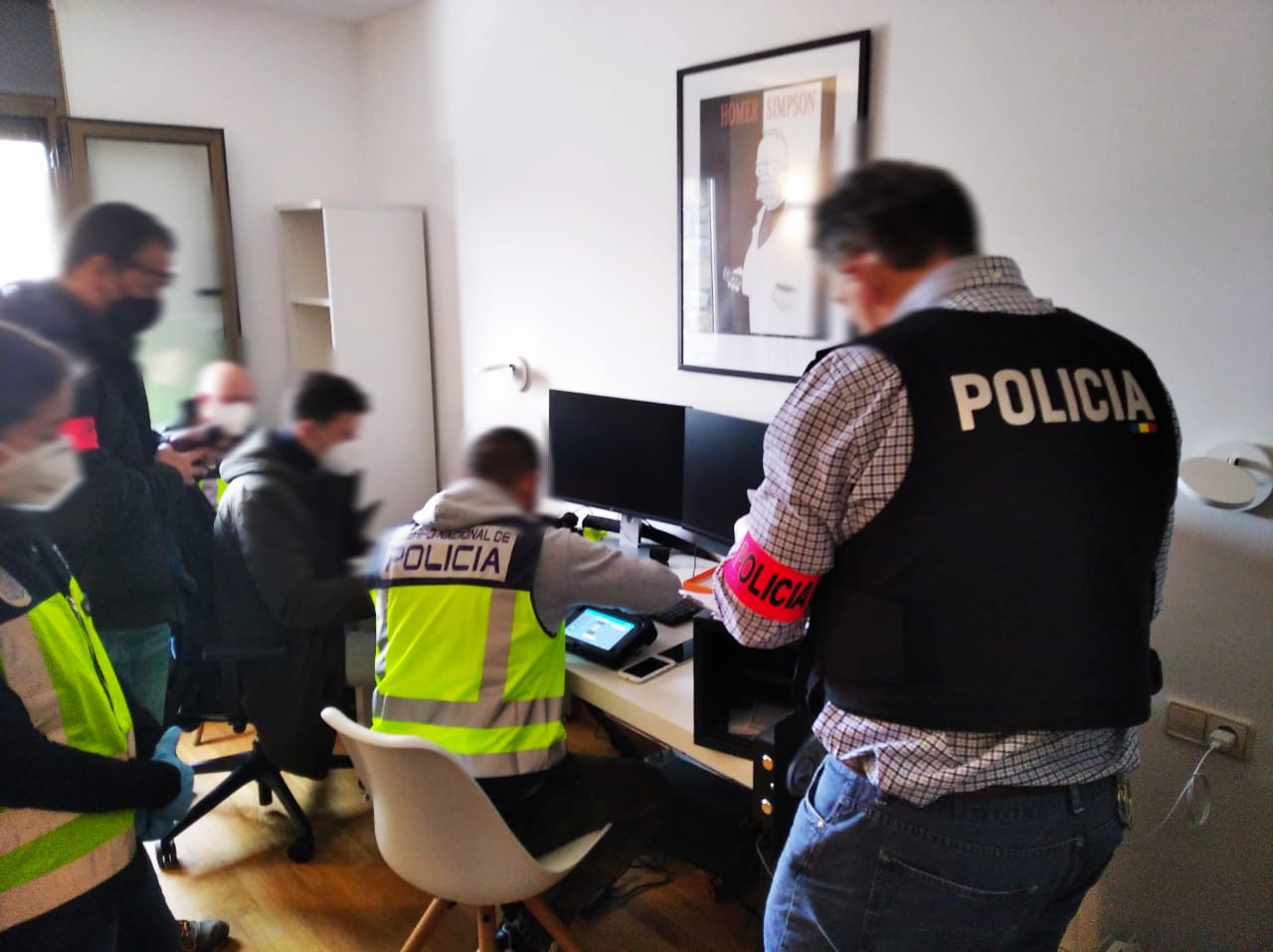
Illegal mobile application with more than 100 million users taken down in Spain

The application, available on several websites and platforms, was streaming videos and TV channels

Europol supported the Spanish National Police (Policía Nacional) to dismantle a criminal group distributing illegal video streams. The investigation also involved law enforcement authorities from Andorra and Portugal.

The investigation started in October 2018 when the Spanish National Police received complaint reports from the Motion Pictures Associations, Football Association Pretoria, the Premier League and the Spanish Football League (La Liga Espanola de Fútbol) about a mobile application illegally distributing video streams. The application, downloaded by more than 100 million users via different websites, illegally offered the streaming of videos and TV channels. 

The investigation identified a number of connected websites and platforms located in Spain and Portugal with connections to servers in Czechia. The Spanish company behind the illegal activity earned its profits through advertisements. Through the computer infrastructure and power, they were able to sell user information to a company related to botnet and DDoS attacks. Investigators estimate the overall illegal profits at more than €5 million.

Results

  • 3 house searches (2 in Spain and 1 in Andorra)
  • 4 court orders to take down domains
  • 20 web domains and servers blocked
  • 4 arrests (3 in Spain and 1 in Andorra) 
  • Bank accounts frozen 
  • 1 server taken down in Portugal and another one under investigation in Czechia

Europol supported the investigation with operational coordination and analysis. Europol supported the action day with the deployment of a virtual command post. This enabled operational coordination, also supported by Eurojust. During the action day, Europol’s experts cross-checked operational information in real-time and provide support to the investigators in the field. 
Europol’s IPC3 (Intellectual Property Crime Coordinated Coalition) which supported the investigation is a project co-funded by the EUIPO to combat intellectual property crime.


Press release – Fishing rules: Compulsory CCTV for certain vessels to counter infractions

By 401 votes in favour, 247 against and 47 abstentions, MEPs agreed to use new technologies to better enforce fishing rules and improve security and transparency. They also insist that consumers must know when, where and how the products they buy are caught.

The use of on-board cameras (CCTV) to carry out checks on landing obligations should be compulsory for a “minimum percentage” of vessels longer than 12 meters and which have been identified as “posing a serious risk of non-compliance”. The equipment will also be imposed as an accompanying sanction for all vessels that commit two or more serious infringements. Vessels that are willing to adopt CCTV on a voluntary basis should be offered incentives such as additional allocation of quotas or having their infringement points removed.

MEPs back the proposal to harmonise sanctions and demand that a “European Union Register” of infringements be set up to centralise information from all member states. They also call for an “appropriate system of sanctions” for infringements committed by recreational fishermen.

Reduce waste, increase security and transparency

In line with the EU’s Farm-to-Fork Strategy, Parliament demands that the origin of fishery and aquaculture products must be traceable throughout the whole food chain, including processed and imported products. Data on the species of fish, the location, date and time it was caught, and the type of gear used should be made available.

In an effort to reduce marine litter, MEPs agree that all vessels should be obliged to notify national authorities when they lose fishing gear and to carry on board the necessary equipment to retrieve it.

All vessels should also be equipped with a geolocation device allowing them to be automatically located and identified, a measure deemed necessary to improve security at sea, according to the adopted text.

Parliament also proposes to increase the margin of error accepted on the weight of some species estimated by fishermen on board (margin of tolerance).

Quote

Clara AGUILERA (S&D, ES), rapporteur, stated: “We took important steps towards having common rules. Inspections on fisheries in Spain must not differ from those in Denmark, Poland or Italy. They must be harmonised and more efficient, without resulting in more red tape for the sector.”

Next Steps

With today’s vote, Parliament is now ready to start negotiations with Council. According to the current proposal, operators would have four years following the entry into force of the rules to equip vessels with the new technologies required.

Background

On 5 February, the Committee on Fisheries adopted its position regarding the EU’s Fisheries Control system. The proposal updates five existing regulations and harmonise control and inspection systems, as well as sanctions, across EU countries.