Press release: Call for anglers to submit their salmon and trout catch returns

The Environment Agency are calling upon all migratory salmon and sea trout rod licence holders to submit their catch return records by 1 January 2018.

The submission of angler’s reports plays a vital role in the assessment and management of salmon and sea trout stocks in England. The information submitted forms part of the wider Environment Agency’s Salmon 5 Point Approach, which aims to conserve and enhance England’s salmon populations.

The submission is a legal requirement for all salmon and sea trout anglers, and each submission will go towards securing the future of the sport.

Lawrence Talks, National Senior Advisor for Salmonid Management, said:

Salmon are a highly valued fish in the world of angling and we ask all migratory salmon and sea trout rod licence holders to complete a ‘catch return’ in order to help us secure the future of this sport.

The Environment Agency, Government and partners are committed to taking action to conserve and enhance England’s salmon populations. We use the catch return data to assess and manage salmon and sea trout stocks in a sustainable way.

Catch returns can be completed online at GOV.UK/catch-return and need to be submitted by 1st January 2018.

Anglers can fill in their catch returns online: www.gov.uk/catch-return


Press release: Clean-up takes place following heavy rainfall

The Environment Agency has removed a large amount of debris from a County Durham dam following rain and high river flows.

Prolonged heavy rain saw river levels rise across the north east leading to Environment Agency field teams working through the night to keep the region’s rivers flowing.

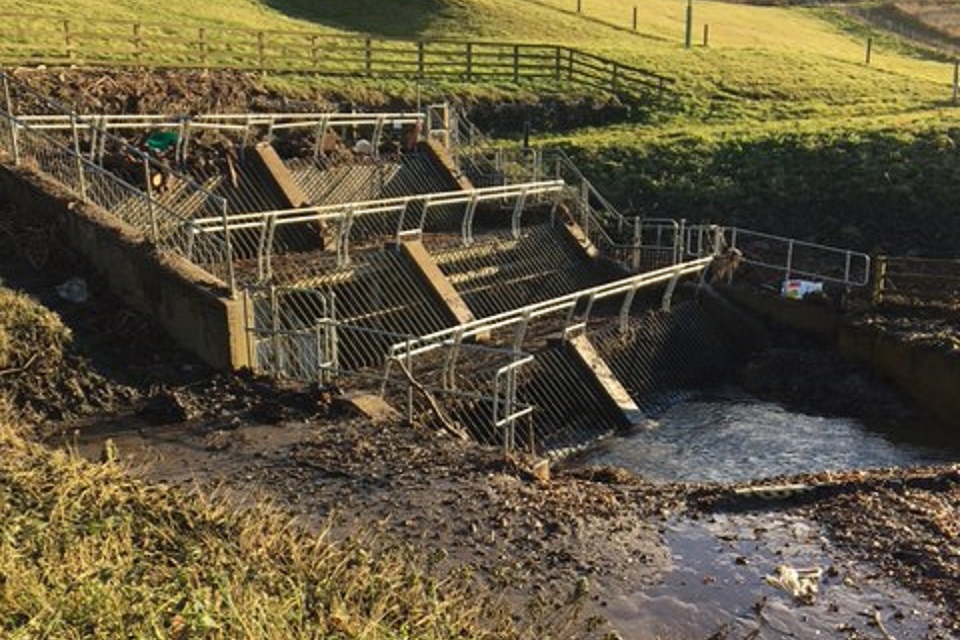
Spring Gardens dam – which reduces the risk of flooding to West Auckland from the River Gaunless – prevented large amounts of debris from causing blockages further downstream.

This week the field team has been back out clearing up after the heavy rain resulted in 12 Flood Alerts being issued across the region.

Image hsows the cleared spring gardens dam

Alex Murray, Field Team Leader, said:

The dam is designed to hold back flood water during high flows, and then slowly release it once the threat has passed.

While it wasn’t necessary for it to operate during the heavy rain last week, it prevented debris from reaching downstream and creating blockages, which is equally important and helps reduce the risk of flooding to the town.

It resulted in a large build-up of debris so this week we’ve been clearing it up, along with our other flood defence assets, to ensure they are clear and in working order ready to do their job again.

Our Field Teams regularly carry out work to check and maintain our rivers right across the north east to make sure anything which is deemed a potential flood risk is removed.

Spring Gardens dam was built after West Auckland and South Church were badly affected by floods in 2000.


Press release: Clean-up takes place following heavy rainfall

The Environment Agency has removed a large amount of debris from a County Durham dam following rain and high river flows.

Prolonged heavy rain saw river levels rise across the north east leading to Environment Agency field teams working through the night to keep the region’s rivers flowing.

Spring Gardens dam – which reduces the risk of flooding to West Auckland from the River Gaunless – prevented large amounts of debris from causing blockages further downstream.

This week the field team has been back out clearing up after the heavy rain resulted in 12 Flood Alerts being issued across the region.

Image hsows the cleared spring gardens dam

Alex Murray, Field Team Leader, said:

The dam is designed to hold back flood water during high flows, and then slowly release it once the threat has passed.

While it wasn’t necessary for it to operate during the heavy rain last week, it prevented debris from reaching downstream and creating blockages, which is equally important and helps reduce the risk of flooding to the town.

It resulted in a large build-up of debris so this week we’ve been clearing it up, along with our other flood defence assets, to ensure they are clear and in working order ready to do their job again.

Our Field Teams regularly carry out work to check and maintain our rivers right across the north east to make sure anything which is deemed a potential flood risk is removed.

Spring Gardens dam was built after West Auckland and South Church were badly affected by floods in 2000.


Policy paper: Shoreham Adur tidal walls scheme: construction

Updated: Update to data 15 December 2017.

Issues that may arise during construction of the Shoreham Adur tidal walls scheme.


Climate through time online

Climate through time (CTT) online is an interactive version of the popular poster map, but includes examples of where you might find some of the rock types in the UK and Ireland.