Press release: Environment Agency saves thousands of fish in Ampthill Reservoir

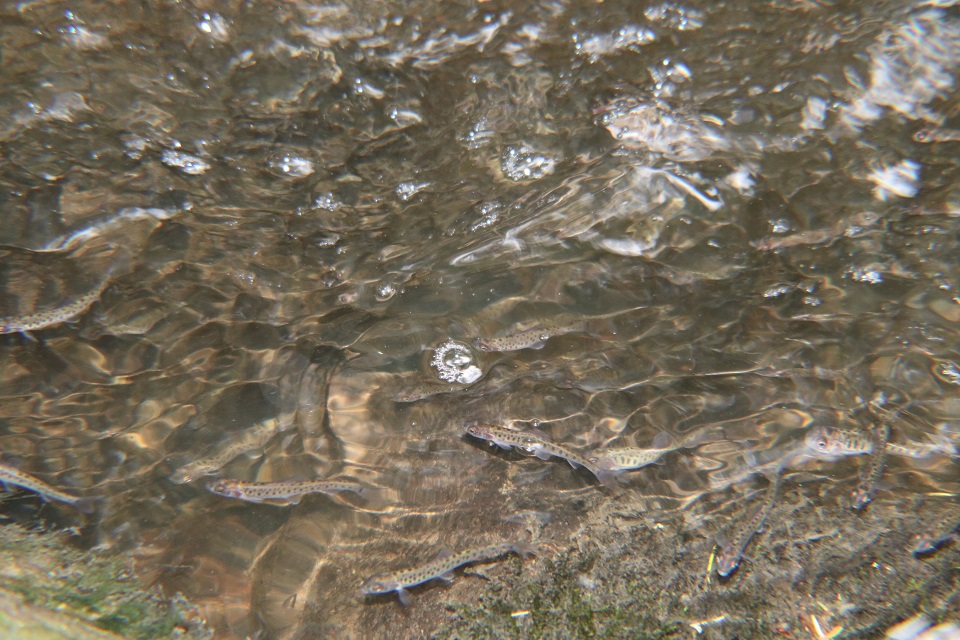
Over the hot weekend of 17 to 18 June, Environment Agency teams saved thousands of carp, roach and rudd from Ampthill Reservoir Lake, an amenity fishery in Bedfordshire.

The angling club reported seeing huge shoals of fish gasping at the water’s surface throughout the fishery. A dedicated Fisheries Incident Officer was in touch within the hour and quickly on-site to monitor oxygen levels.

Recent hot weather and very high water temperatures encouraged algae blooms which had reduced oxygen levels in the fishery to a potentially fatal level for fish. Environment Agency fisheries officers dosed the lake with hydrogen peroxide into the early hours of Monday (19 June). They were then back on the scene first thing to monitor recovery. There are now no fish in distress, and the huge shoals of fish seen gasping have returned to normal behaviour.

Kye Jerrom, Fisheries Officer said:

Specialist officers are on duty 24 hours a day to respond to fish kills and fish in distress, all funded by rod licence income. Our team was able to respond quickly and we’d like to thank the angling club for knowing what to do.

The club suffered a similar incident 30 years ago and lost every fish in the lake. The scene when I arrived was very worrying and I am sure that our efforts have saved the fishery from a huge fish kill, which is great news for such a hardworking club, and for those who fish it.

We have provided advice and management options and will continue to work with the club to prevent a similar, and potentially devastating, event in the future. If anyone spots fish in distress then please call our incident helpline on 0800 80 70 60.

Summer can see Environment Agency staff responding to many reports of ‘fish in distress’ due to naturally occurring environmental changes causing lower oxygen levels in the water. Hot, sunny weather can lead to low flows in rivers and stillwater fisheries (ponds and lakes) starting to warm up. Small stillwaters are particularly susceptible.

As well as encouraging people to call them on 0800 80 70 60, the Environment Agency is encouraging private fishery owners to manage fish stocks to appropriate levels and install aerators.

Media enquiries: For East Anglia press office please contact (24 hours): 0800 917 9250


Press release: Fish stocks boost for north east rivers

Thousands of fish were released into the River Pont at Ponteland and Matfen as well as tributaries of the rivers Wear and Tees.

It’s part of the Environment Agency’s ongoing plans to develop and restore rivers in the region.

The fish were reared at the Environment Agency’s fish farm near Calverton, Nottinghamshire, using funding from rod licence sales.

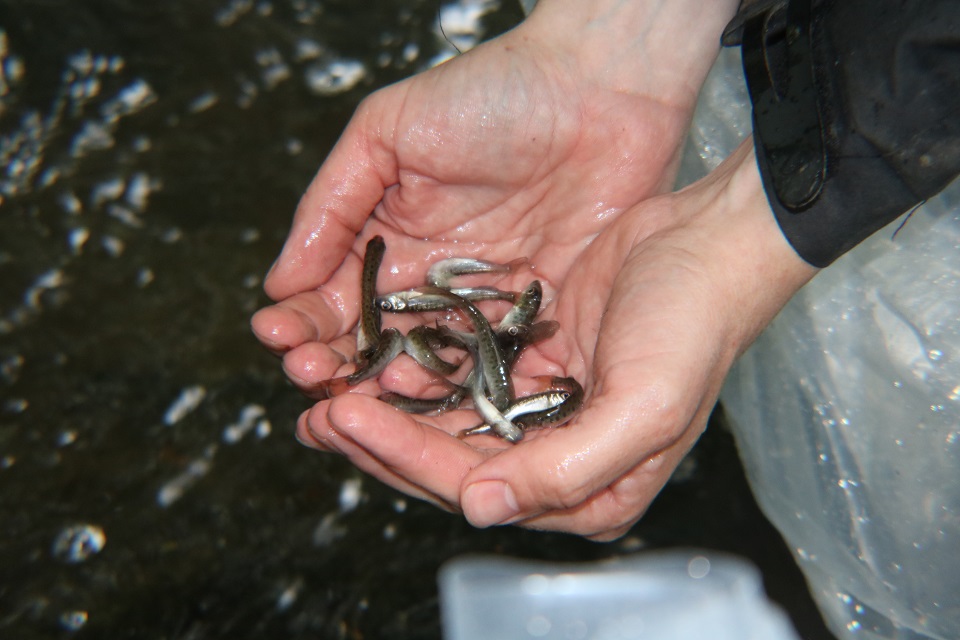
Image shows fish for stocking

Fisheries Technical Specialist Phil Rippon was out releasing some of the grayling in the south of the region today. He said:

We’re pleased we can provide these fish for restocking as part of our commitment to rod licence paying anglers and to help the process of natural recovery in impacted waters.

While it’s a really important aspect of our work, it’s one of many things we do together with our partners to develop fisheries, including reducing the effects of pollution, improving habitat and removing barriers to migration.

Image shows fish for stocking

Rivers have improved dramatically

The Environment Agency releases fish into our waterways annually. Fisheries officers target fish stocking activity in response to impacts on local rivers and using data from national fish surveys to identify where there are problems with poor breeding and survival.

Many of our industrialised rivers have improved dramatically in water quality in the last 30 years and targeted and appropriate restocking has helped the restoration of natural fish stocks and viable fisheries.

Angling is a great way for everyone to keep healthy and enjoy the natural environment. All rod licence income is used to fund work to protect and improve fish stocks and fisheries.


Press release: Oxford flood alleviation scheme online consultation opens up

The Environment Agency is calling on communities to have their say on benefits and features that will make up the £120 million project to reduce flood risk to all homes and businesses in Oxford.

The consultation will be open from 22 June to 20 July 2017, and will allow the public to input into design features; ranging from the 7 bridges along the route of the scheme, to options for benches and cycle racks on footpaths. The scheme is a major project which will involve lowering parts of Oxford’s floodplain to increase capacity for floodwater, as well as widening and deepening some of the rivers and streams that run through it.

Speaking ahead of the launch of the consultation, Emma Howard Boyd, Chair of the Environment Agency, said:

The Oxford flood alleviation scheme will be a major feat of engineering and is one of the biggest projects we are working on across the country. I am very proud of our partnership approach, which is so important to building the scheme and keeping this iconic city moving during times of flood, for businesses, commuters and communities of Oxford.

Cllr Yvonne Constance, Oxfordshire County Council’s Cabinet Member for Environment, added:

This is a really important issue for people in Oxford and beyond. The plans for the flood alleviation scheme are now very advanced and we want to hear what our residents think.

As the lead local flood authority, Oxfordshire County Council strongly supports the Oxford flood alleviation scheme and we encourage local communities, residents and businesses to take this opportunity to get involved in the consultation.

The project team spoke to over 200 members of the public at drop-in events throughout Oxford in May, where they shared information about the progress of the scheme and the many benefits it will bring. You can go online from 22 June to 20 July to view this information, see how they’ve been progressing with the scheme and to complete the consultation.

The project team will be available to help members of the public who don’t have access to the internet to complete the online consultation at the following libraries:

  • Kennington Library, OX1 5PG: 2pm to 7pm on Friday 30 June
  • Oxford Central Library, OX1 1AY: 12pm to 6pm on Thursday 6 July
  • Botley Library, OX2 9LP: 9:30am to 2pm on Tuesday 11 July

The Environment Agency is working with local partners: Oxfordshire County Council, Oxford City Council, Vale of White Horse District Council, Thames Water, the Oxford Flood Alliance, Oxfordshire Local Enterprise Partnership, Thames Regional Flood and Coastal Committee, and the University of Oxford, on the scheme to reduce flood risk to all homes and businesses in Oxford, as well as to major transport routes into the city.

Further information and contact details

For further information please visit:

Oxford FAS web page

Facebook

Twitter

or contact the project team at oxfordscheme@environment-agency.gov.uk.


Press release: 8,000 young fish released into the River Rother

The Environment Agency has today released 8,000 young grayling into the River Rother at Chesterfield to help fish populations recover from historical pollution.

This release is part of a five-year restocking programme that is helping to restore the river’s ecology to how it was before the industrial revolution.

The baby fish were reared at the Environment Agency’s fish farm near Calverton using funding from rod licence sales.

Dr Jerome Masters, fisheries officer at the Environment Agency, said:

The River Rother was once one of the most polluted rivers in Europe. Grayling were wiped out as a result, and weirs in the river makes their natural recolonisation highly unlikely.

But life is returning to the River Rother. Water quality has improved, and the re-stocking programme will see grayling returning to live alongside species such as brown trout, chub and roach which are already resident in Chesterfield’s rivers.

Anyone who wants to help improve Chesterfield’s rivers and the health of fish stocks could contribute by getting involved with the Wild Trout Trust’s ‘Trout in the Town’ scheme.

Paul Gaskell, at the Wild Trout Trust, said:

We have a programme to help urban communities engage with and care for their local streams and rivers, called ‘Trout in the Town’. In addition to caring generally for the river, groups often carry out invertebrate monitoring, and habitat improvement work. We can help out with training for that habitat improvement work and provide support with fundraising.

Anyone who is interested in becoming a founder member of a Chesterfield Trout in the Town group are invited to contact Dr Jerome Masters at jerome.masters@environment-agency.gov.uk.

More information on Trout in the Town projects can be found at www.wildtrout.org/content/trout-town and www.wildtrout.org/tint.


Press release: Fish kill costs Frome farmer Michael Aylesbury more than £22,000

A farmer was told to pay more than £22,000 for polluting a river in Frome, Somerset, killing nearly 2,000 fish.

Dairy farmer Michael Aylesbury, a director in Cross Keys Farm Ltd, pleaded guilty to causing an unpermitted water discharge which turned the river in Frome brown and smelly in May 2016, killing 1,700 fish, probably many more.

The pollution came from a slurry lagoon at Bollow Farm, Silver Lane, East Woodlands where it was overflowing into a ditch from an underground chamber that had not been fully sealed off. Making matters worse, a spillage from a slurry pumping operation days before also entered the same ditch, meant only to carry rainwater.

The reduced water quality and the river’s polluted appearance hit local groups, like anglers, kayakers and swimmers, who had to suspend activities. Residents were also upset by the sight of distressed and dying fish.

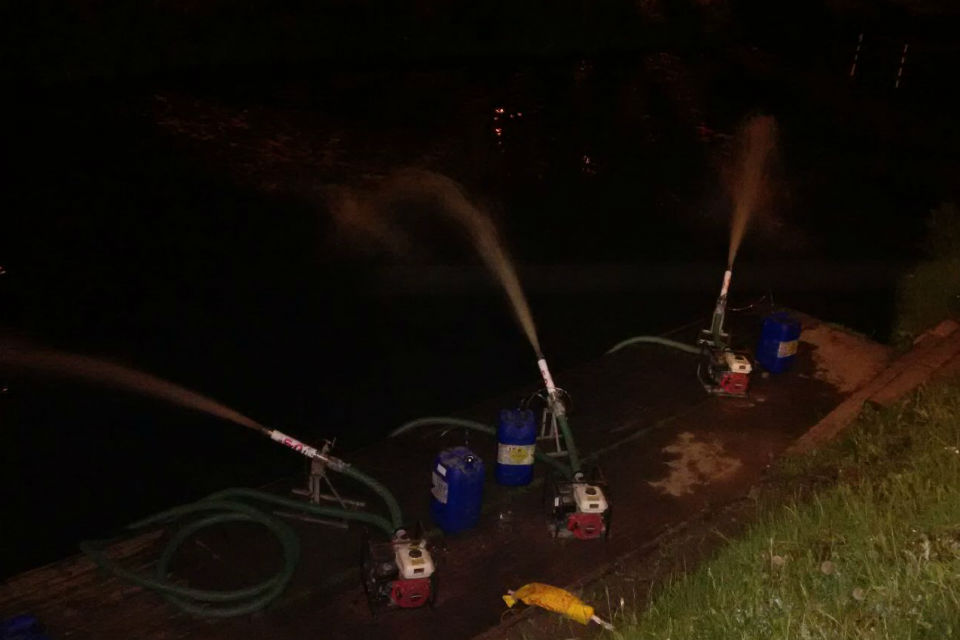
The Environment Agency was alerted to the incident on 12 May 2016 and attempted to save the fish population by spraying hydrogen peroxide to restore dissolved oxygen levels in the water. The pollution was traced back to Bollow Farm the next day.

Hydrogen peroxide being sprayed into the water at night from three sprayers on the riverbank
To save the fish, hydrogen peroxide was sprayed to restore the dissolved oxygen levels

Tasked with protecting water, land and biodiversity, the Environment Agency classified the incident as category one – the worst kind – which affected the watercourse for more than 6km and was obvious to the naked eye.
The defendant told investigating officers “he had nothing to hide and held his hands up to the pollution incident” and that he was sorry it had happened.

Bath Magistrates’ Court found Aylesbury to be negligent for not informing the Environment Agency about the initial spillage and fined him £3,000, a victim surcharge of £170 and ordered him to pay costs of £19,306.69 on 5 June 2017.

Environment officer Andy Grant said:

Our role as a regulator is to protect people and the environment and support sustainable growth. We work with business owners to create better places but when avoidable incidents like this happen, we take action.

Informing us of the initial spillage and keeping an eye on nearby watercourses are two simple actions the farmer could have taken which would have sped up our investigation and stopped the cause of the pollution sooner.

Last November we restocked 5,500 fish including chub, roach and bream at two locations in Frome and we continue working with our partners including the Bristol Avon Rivers Trust, Frome Town Council, farmers and landowners to identify opportunities to enhance and protect the River Frome.