Press release: Worcestershire man sentenced for waste offences

Yesterday (16 August 2017), Mark Smyth, aged 40, from Pershore, Worcestershire was sentenced to 12 months imprisonment suspended for 18 months, with 200 hours unpaid work following a prosecution brought by the Environment Agency at Worcester Crown Court. He was also ordered to pay £10,000 compensation to the landowner and disqualified from acting as a company director for 7 years.

Mr Smyth, who was the sole director of Arrow Gypsum Recycling Ltd, pleaded guilty to breaching the company’s environmental permit condition and was found guilty of failing to comply with an enforcement notice served by the Environment Agency,

Events leading to the prosecution

During early 2015, the Environment Agency received a report that gypsum waste was being stored outside the building on the site. The conditions of the environmental permit stipulated that waste must be stored within the building, to avoid any risk to the environment.

Further investigations established that Mr Smyth had abandoned the site, leaving 29 tonnes of gypsum plasterboard outside the building and in excess of 5,000 tonnes inside the building. Attempts were made by Environment Agency officers to speak to Mr Smyth about the permit breach and clearance of the material outside. When Mr Smyth failed to respond, a formal enforcement notice was served, requiring him to clear the waste he abandoned on the site he rented at Crucible Business Park in Norton, Worcester. Mr Smyth ignored the enforcement notice.

Comments during the court hearing

During the trial the defendant claimed not to have received the enforcement notice. This was not accepted by the Magistrates, who found the defendant did receive the notice, but chose to bury his head in the sand and ignore it.

Environment Agency officers have worked with an agent of the landowner to clear the site, at a cost of £450,000. At Worcester Crown Court, His Honour Judge Cole, found that the substantial clean up costs was a serious aggravating feature of the case. It was clear to the court that once the processing of the gypsum waste ceased and the building became full, Mr Smyth should have stopped accepting the waste, but he did not. He deliberately continued accepting waste, leading to the breach of the permit; waste being stored outside. Mr Smyth ignored his responsibilities as the director of the company and left the waste on the site at considerable cost to the landowner.

In mitigation the court heard that Mr Smyth intended to operate the business in line with the permit when he took over the business in 2013, but when the processing of the waste stopped, he had contracts that had to be honoured, so he carried on accepting the waste.

HHJ Cole suspended the term of imprisonment, taking into consideration the potential impact on Mr Smyth’s 12 year daughter and her mother, along with Mr Smyth’s previous good character.

Speaking after the case, an Environment Agency officer in charge of the investigation said:

Waste crime is a serious offence with tough penalties as it can damage the environment, blight local communities and undermine those who operate legally. This case sends out a clear message that we will not hesitate to take action against anyone that fails to comply.

You can call the Environment Agency on 0370 850 6506 to find out how to responsibly manage any waste your business produces or visit the manage your waste GOV.UK pages.

Press release: Angler arrested and fined after obstructing a water bailiff

James Jones, 21, of Blodwen Road, New Inn, Pontypool was caught with a rod and line but no licence on the River Severn at Worcester on 18 February. Initially he gave a false name and was arrested by the bailiff, but after giving his correct details was issued with a ticket.

Jones was summoned to appear in court on 3 August but he did not attend, so the magistrates issued a warrant for his arrest. He was then arrested by West Mercia Police and brought to court.

After pleading guilty he was fined £120 for obstructing the bailiff and ordered to pay costs of £172 and a victim surcharge of £30. This offence is reportable to the Police National Computer and has been reported to the ACRO Criminal Records Office.

Andrew Eardley of the Environment Agency said:

Water bailiffs have the powers of police constables, including the power to arrest. This case demonstrates that we won’t give up on tracking down offenders who obstruct our officers, and the police are willing to support us by executing arrest warrants.

Most anglers enjoying the sport fish legally, but there continues to be small number of anglers who fail to buy a fishing licence. These few are cheating their fellow anglers and the future of the sport.

An annual licence costs from just £30. It seems ridiculous that anglers risk significant fines and costs, a criminal conviction and the loss of their fishing equipment for such a small fee.

Speaking for West Mercia Police, Alexa Neville said:

British conservation-based angling law is in place for a very good reason and we can, and do, take action to support the Environment Agency in its duty of fishing enforcement.

West Mercia Police and our partners also have Operation Leviathan in place to raise awareness of fish theft, illegal angling and anti-social behaviour around waterways.

Money from fishing licence sales is invested in England’s fisheries and is used to fund a wide range of projects to improve facilities for anglers including protecting stocks from illegal fishing, pollution and disease; restoring fish stocks through re-stocking; eradicating invasive species; and fish habitat improvements. Licence money is also used to fund the Angling Trust to provide information about fishing and to encourage participation in the sport.

You need a valid Environment Agency fishing licence to fish for salmon, trout, freshwater fish, smelt or eel in England. Buying a rod licence is easy. A licence lasts 365 days from the day you buy it.

Anyone witnessing illegal fishing incidents in progress can report it directly to the Environment Agency hotline on 0800 80 70 60. Information on illegal fishing and environmental crime can also be reported anonymously to Crime stoppers on 0800 555 111.


Press release: Enjoy our excellent bathing waters this summer

The school holidays are well underway – even if summer isn’t – so grab your bucket and spade and visit one of our brilliant bathing waters this month.

There are 34 bathing waters in the North East. All are classed as either an ‘excellent’ or ‘good’, and every one of them has passed high standards for water quality.

The results are based on regular water sampling by specially trained officers from the Environment Agency.

!!n Environment Agency officers visit each bathing water beach from May to September every year to see what levels of bacteria are present in the water. Officers use results to maintain and improve bathing water quality. They were out taking water samples from beaches along the coastline from Blyth to Roker on Monday 14 August.

Mick Donkin, Sampling and Collections Team Leader, said:

Sun or no sun, the beach is a great day out for the kids during the school holidays. Our bathing waters are the cleanest they’ve ever been – not just here but across the country.

Samples are taken regularly throughout the bathing water season and this enables us to check they are safe for people to enjoy. We know how much people like going to the beach and the great benefit this has on the local economy. We will continue our work to ensure these standards are upheld.

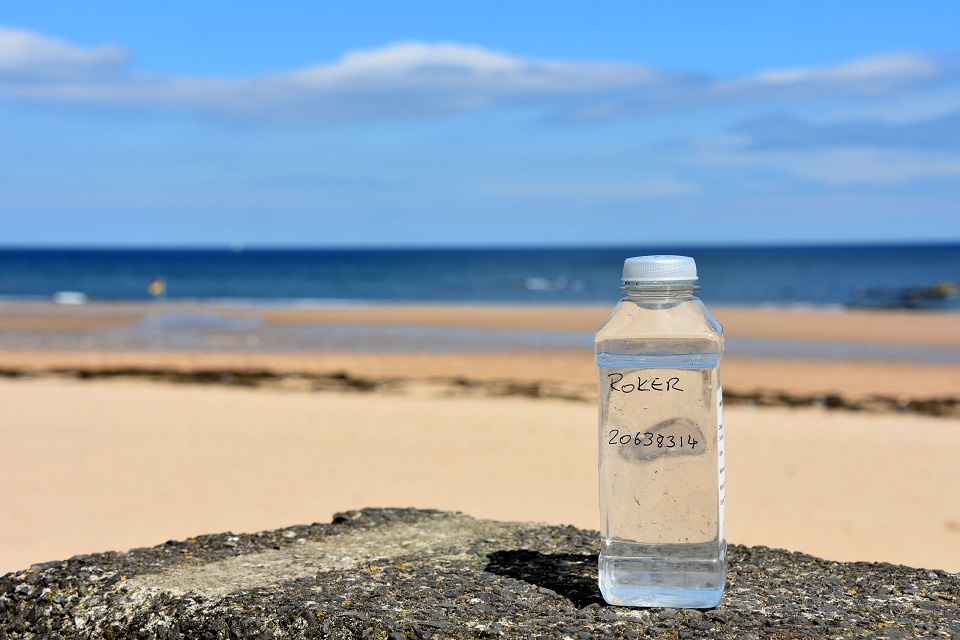
EA Sample bottle from Roker beach
A sample of bathing water taken from Roker, Sunderland.

Huge strides have been made to improve water quality, helping to make our beaches even more attractive for the increasing numbers of tourists who visit from around the world. Northumbrian Water has invested £1bn over 20 years in enhancing the quality of water on the region’s coastline.

Richard Murray, Head of Wastewater Treatment and Bioresources for Northumbrian Water, said:

Two decades of investment have seen significant improvements to the North East bathing waters and this is something we are extremely proud of. Back in 2000, only four of the region’s beaches met requirements and now all 34 meet the high standards.

We know there is more work to be done, by ourselves and our partners, as great bathing water relies on constant attention to detail. To ensure our beaches are a great place to visit we continually look for new ways of working to help protect and improve our environment.

The public can also do their bit to keep our beaches clean. On Monday 14 August, the Environment Agency and partners launched the #binit4beaches campaign to raise awareness of the importance of only flushing the 3P’s down the toilet: pee, poo and (toilet) paper, and always putting wet wipes in the bin.

While many wet wipes claim to be ‘flushable’, they may not break down quickly once they’ve been flushed. This can add to the risk of blockages. Millions of wipes are wrongly flushed down the toilet each year which means some of them reach our much loved beaches and seas after sewers are overloaded by heavy rain or flooding.

The Marine Conservation Society’s annual beach litter survey shows that the number of wet wipes found on UK beaches have echoed this trend, increasing by 700% over the last decade.

All of the latest information and advice about bathing waters can be found online: https://environment.data.gov.uk/bwq/profiles/

The Environment Agency works 24 hours a day to protect people and wildlife from pollution incidents and we encourage people to report such incidents to our Incident Hotline on 0800 807060.


News story: Environment Agency chair visits Grogley and Coverack

Emma Howard Boyd met residents of Coverack to see the progress of recovery work 3 weeks after flash flooding hit the Cornish village.

The chair of the Environment Agency spent 2 days in Cornwall, where she also visited a project to boost fish numbers.

On Wednesday 9 August Emma travelled by bike using the Camel trail to Grogley, where she was shown the Water for Growth project – a £2.2 million project to restore freshwater fish habitats to the Camel and Fowey rivers.

The project is a partnership with the Environment Agency, Westcountry Rivers Trust, Natural England and South West Water to remove obstructions to fish migration, making it easier for salmon and trout to spawn in Cornwall. The river restoration project will create an improved environment for people and wildlife while adding value for local businesses that depend on sustainable fisheries. The Camel trail itself is a very popular tourist destination all year round providing an important contribution to the local economy.

During the trip Emma met a staff member inspired to learn to cycle by her visit. Gitty Ankers is an Environment Agency catchment co-ordinator who has worked on the project since its inception in 2015 and was very pleased the chair would be visiting.

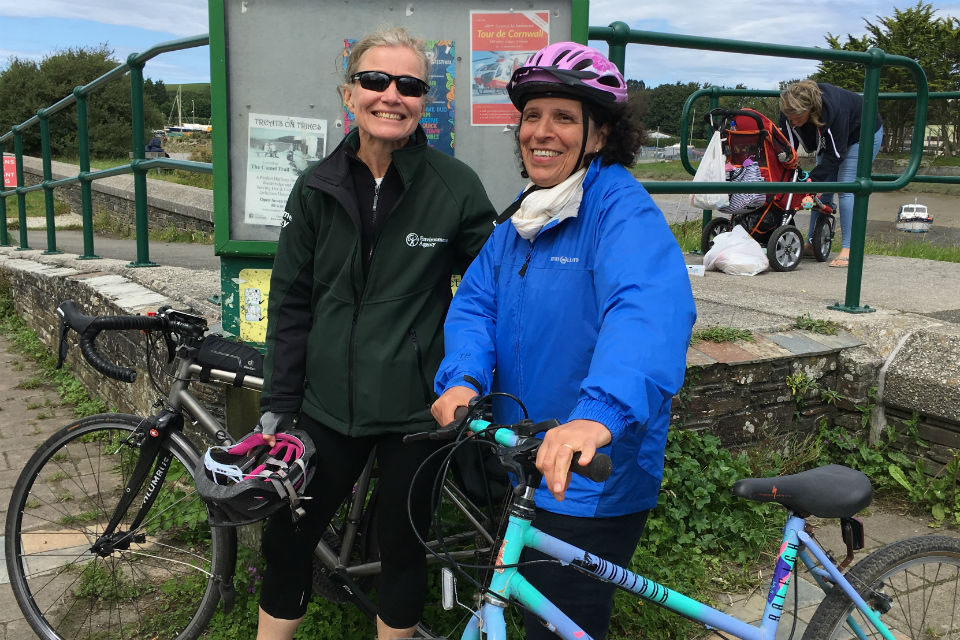
Emma Howard Boyd stood next to Gitty Ankers
Emma Howard Boyd’s visit inspired Gitty Ankers to learn to cycle

But when Gitty learned Emma was a keen cyclist and would be making the trip by bicycle, a cultural barrier from Gitty’s childhood threatened to spoil the visit.

Gitty said:

My parents wanted me out of Iran during the revolution in 1979, so I came over to the UK to do my master’s degree. But in my native country they don’t teach girls two things: swimming and cycling. And those two things have been on my wish list ever since.

When area director Richard Stockdale said Emma Howard Boyd wanted to come and look at Grogley, I was so pleased as I had really worked hard on this project. But when he said it would be part of a cycling trip my heart sank. I thought it would be too difficult to keep up with everyone. So I gave myself a week to learn to cycle.

Borrowing a colleague’s bicycle, bought for his daughter 5 years ago for £5, Gitty began to learn, which is not without its own unique difficulty in hilly Cornwall.

Gitty said:

Learning to cycle is the scariest thing I have ever done. The worst is the speed coming downhill. And finding somewhere flat in Cornwall is challenging. But I found a quiet residential street and every morning I would go up and down that road. Since then I have cycled from Bodmin to Grogley and from Grogley to Wadebridge and back. That’s 7 miles each way.

If I don’t learn to cycle now, then there will be no other opportunities. You always need someone to inspire you to do something, no matter how old you are.

Gitty’s next goal is to learn to swim. Emma and Gitty have committed to swimming together next year so watch this space.

On Thursday 10 August Emma Howard Boyd visited Coverack to see how the village has recovered since flash flooding.

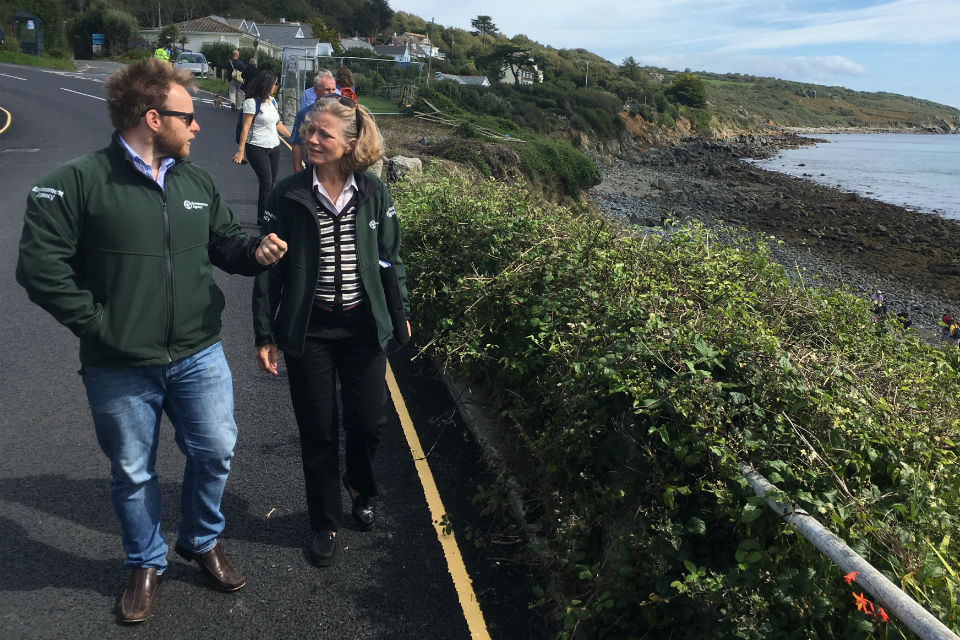
Emma and staff walk along coastal path in Coverack with scaffolding in background
Area director Richard Stockdale shows Emma Howard Boyd around Coverack

Cornwall Council declared a major incident at 5.40pm on 18 July when flash flooding affected about 50 properties in Coverack. More than 105mm of rainfall fell within 3 hours. The recovery effort saw Environment Agency staff:

  • transport 100 tons of silt from a river bed and take it 50m upstream
  • remove 50 tons of debris from the beach
  • dispose of 40 tons of green waste blocking watercourses
  • remove 30 tons of silt, fallen trees and other blockages
  • clear blockages from culverts

One of these culverts threatened to flood the home next door. Environment Agency staff cleared the watercourse that flowed within yards of the kitchen window and dug family possessions out of the silt by hand.


Press release: ‘Nameless’ Bournemouth angler fined for fishing without licence

A Bournemouth man has been fined £336 for fishing without a licence and failing to state his name and address when asked to do so by the water bailiff.

Lewis Pudwell of Queens Park West Drive, Bournemouth was also ordered to pay £127 costs plus a victim surcharge of £30 following a prosecution by the Environment Agency.

The offence took place on 24 February 2017 at Little Canford Ponds, Wimborne in a place where fishing is regulated for freshwater fish or eels. In addition, contrary to section 35(3) of the Salmon and Freshwater Fisheries Act 1975, Pudwell failed to state his name and address to the water bailiff.

The case was heard by Salisbury magistrates on 20 July. Pudwell pleaded guilty to both offences.

Richard Battersby of the Environment Agency said:

The majority of anglers fish legally. The minority of anglers that fail to buy a fishing licence are cheating their fellow anglers and the future of the sport.

An annual licence costs just £30. Anglers risk significant fines and costs, a criminal conviction and the loss of their fishing equipment for such a small fee that gets used to enhance angling and fisheries habitat improvement works.

Money from fishing licence sales is invested in England’s fisheries and is used to fund a wide range of projects to improve facilities for anglers, including protecting stocks from illegal fishing, pollution and disease; restoring fish stocks through re-stocking; eradicating invasive species; and fish habitat improvements.

Licence money is also used to fund the Angling Trust to provide information about fishing and to encourage participation in the sport.

You need a valid Environment Agency rod licence to fish for salmon, trout, freshwater fish, smelt or eel in England. Buying a rod licence is easy, simply visit www.gov.uk/fishing-licences/buy-a-fishing-licence.

Anyone witnessing illegal fishing incidents in progress can report it directly to the Environment Agency hotline on 0800 80 70 60. Information on illegal fishing and environmental crime can also be reported anonymously to Crime stoppers on 0800 555 111.

Notes to editors: