Press release: Stoneferry students face the facts of flooding

Pupils at a primary school in Hull are a step closer to understanding what to do in a flood following a visit from the Environment Agency.

Year five students at Stoneferry Primary School took part in an interactive workshop where they engaged in a range of flood-related activities where they were taught which household objects can be the most useful in a flood and saw them using a geographic model to better understand how rivers flow.

The sessions were led by staff from the Environment Agency, which provides Hull with flood warnings and alerts when the risk of flooding from rivers and the Humber Estuary is high.

Ninety-five per cent of Hull stands on a flood plain and it has the highest number of properties at risk of flooding in a single urban area outside London.

Over the years the city has been affected by numerous significant river and coastal flood events and on 25 June, 2007, Hull City Council reported more than 9,000 homes and businesses were flooded when heavy rains covered the city. The floods resulting from this caused many millions of pounds of damage and 95 of the city’s 98 schools were closed.

Jo Harrison, head teacher at Stoneferry Primary School said:

We’re very grateful to the Environment Agency for coming to see us. The children thought it was great fun and it taught them valuable lessons that they’ll hopefully pass onto their parents.

Thankfully ours was one of the luckier schools to have escaped the floods of 2007, however, we couldn’t overlook the damage it caused.

We believe it is important for our students to fully appreciate their environment and understand that nature has the potential to be both beautiful and dangerous.

Through government funding and partnership contributions, the Environment Agency is investing more than £200million in Hull and the East Riding of Yorkshire to help reduce the likelihood of flooding for thousands of properties by 2021. Part of this investment includes £35.5million of remedial works on the River Hull’s flood defences, which will see the repair and replacement of 39 sections of river defence identified as being at the greatest risk of failure.

Brendan Sharkey, Environment Agency project manager on the River Hull Defences Scheme said:

Over the years we have seen how destructive flooding in Hull can be. While we are investing a lot into the city, much of the devastation caused by flooding can be prevented by making sure people are prepared.

We’re working closely with schools in the area as we believe the next generation will be key to making Hull one of the world’s most flood resilient cities and we have loved the enthusiasm shown by the students of Stoneferry Primary School.

Work on the River Hull Defences Scheme started in April this year and is being delivered by contractor BMM JV – a joint venture between BAM Nuttall and Mott MacDonald.

Varying levels of improvements to the River Hull defences are needed across the sites and work at different locations across the city is likely to progress at the same time.

Brendan continued:

While we are progressing the work along the river as smoothly and efficiently as we can, due to limited access at some of the sites, traffic from some roads and public pathways may need to be re-directed for short periods of time.

Any road closures will not happen until the New Year and we are doing our utmost to reduce the level of inconvenience caused to the public.

A quarter of the total length of works is now complete, and the Environment Agency expects a substantial amount of the work to be underway by the end of the year.

If you are a teacher who is interested in working with the Environment Agency, please email york.flood@environment-agency.gov.uk. To learn more about the effects of flooding and to find out where you can sign up to Flood Warnings, please visit: floodsdestroy.campaign.gov.uk.


Press release: Are you aware of what you’re burning this Guy Fawkes night?

Updated: Image added

Burning certain types of waste and setting fire to treated wood, tyres, plastics, rubber and oil can seriously harm health and pollute the environment.

Every year on November 5, bits of old furniture are used to build up bonfires and stuff the Guy with scraps of used foam or old clothing.

Organisers are being asked to be vigilant about the materials deposited on their bonfire, while preventing others from dumping illegal waste on them by keeping the location secure. People will also use Bonfire night as an excuse to burn old furniture, mattresses or even household rubbish.

Organisers and households should only burn clean, non-commercial waste, so if you’re organising a bonfire night make sure you know where the bonfire material has come from and that it is suitable.

People face a fine of up to £50,000 for illegally managing waste. More information and guidance on materials which are safe to burn on a bonfire and further information for organisers of bonfire and firework events can be found on the GOV.UK website.

If the Environment Agency suspects illegal waste is to be burnt at an event, or there is a harm to the environment, they are able to issue a stop notice which will prevent an event from taking place.

Marc Lidderth, Environment Manager in the West Midlands, said:

We want people to enjoy themselves but the uncontrolled and excessive burning of the wrong waste can cause pollution and damage people’s health.

We encourage people to make sure they dispose of their waste legally and safely, and be aware that their community bonfire could be targeted by unscrupulous waste businesses who want to find somewhere to dispose of waste, resulting in the illegal burning of commercial waste.

Organisers should ensure that they know where the bonfire material has come from and it is suitable. If anyone sees any suspicious activities they should contact us on 0800 807060 or report it anonymously to Crimestoppers.


Press release: Enforcement Undertaking agreed with vegetable company

An enforcement undertaking (EU) has been agreed with a vegetable processing company after it grossly polluted Brook Drain in Wormegay, King’s Lynn, Norfolk with water used to wash carrots.

The Environment Agency accepted the offer by Alfred G Pearce Ltd to put right any damage caused by the pollution and to donate to an environmental charity.

As part of the EU, the company has donated £12,000 to the Norfolk Rivers Trust to benefit the local environment and also paid the Environment Agency’s costs.

Helen Blower, Environment Agency officer said:

Enforcement undertakings allow those who commit offences to restore the environment and to take steps to prevent a recurrence.

When appropriate, they allow a quicker resolution than a prosecution and help offenders who are prepared to take responsibility for their actions to put things right voluntarily working with their local communities.

Formal sample results taken after the incident in February 2016 revealed a gross pollution of the water course.

The company told the Environment Agency that an inspection chamber which also acted as an overflow tank had been damaged by a reversing lorry and there had been no system in place to alert them of the damage and no procedure for checking the Brook Drain on a regular basis. This had led to a delay in rectifying the problem.

Since then the damage has been repaired, bollards placed to prevent a recurrence of the damage, installing bunded areas to contain spills and installing a new treatment plant.

The EU was offered in relation to an offence of pollution under regulation 38 of the Environmental Permitting (England and Wales) Regulations 2010.

The EU was completed in July 2017.


Press release: Be prepared and protect your property against risk of flooding

Be prepared for the unexpected is the stark warning from volunteer flood wardens in Calderdale.

Katie Kimber is one of two Environment Agency flood wardens in a newly formed group set up to help protect residents and businesses in Luddenden Foot and they are looking to recruit more this Autumn.

She lives a row of houses at the bottom of the Calder Valley that has a canal running at the front and a river behind them, with their gardens protected by a high wall. Until Boxing Day 2015 they had never been flooded.

Katie said:

I was completely unprepared. I had only just moved to the area and even though the damage I suffered was minimal compared to houses just a stone throw away it made me determined to be ready for the next time.

The mother of two children, aged 12 and 15, now has a flood plan for her own property and has helped set up a flood container for her local community kitted out with sandbags, Floodsax, brushes, spades, gulley cleaners, wheelbarrows, gloves and hand hygiene gel – all the provisions needed for clean-up operations.

Katie has recently attended a sessions with Calder Valley Search and Rescue where the team demonstrated the dangers of water and how to keep safe during a flood event. She has worked with her husband to develop an app called Flood Aware for tracking water levels in the local area. Her role is to work with the Environment Agency to provide them with valuable local knowledge about what is happening on the ground and to support her community in the event of a flood – particularly older and vulnerable people living in the hamlet.

Her advice to all residents is to make sure they have measures in place to protect their own property, sign up for the Environment Agency weather warnings and flood alerts available by email, text and phone, check what the warnings mean and what they should do, keep a close eye on the weather outside and the levels of nearby rivers, particularly during prolonged, heavy rain.

Katie, whose day job is working for Watermark Flood Fund Calderdale, a Community Foundation For Calderdale project which raises money to provide grants in case of future flooding and provides public relations support for Landlines and Watermarks – a unique community arts project with a water theme – said:

Expect the unexpected, have FloodSax or something similar ready under your sink and an emergency bag full of essentials such as a change of clothes, wellies, mobile phone, snacks. Even if you feel silly knock on your neighbour’s door if you have any concerns.

A positive to come out of the recent flooding incident is we have become a very close-knit community, we know and look out for each other.

Karl Boggis, father of two young boys, joined the Mytholmroyd flood group shortly after there were two flood events just two weeks apart in his village in 2012. The group has developed from being a small local pressure group to being the ‘eyes and ears’ of organisations such as the Environment Agency (EA) with 22 active volunteer wardens covering eight zones. The flood wardens receive early warnings of bad weather on the horizon from the EA’s duty officer and one of group’s first tasks is to set up a communications cell in one of their living rooms to provide people of Mytholmroyd with regular updates using their Facebook Group about all flood related activity.

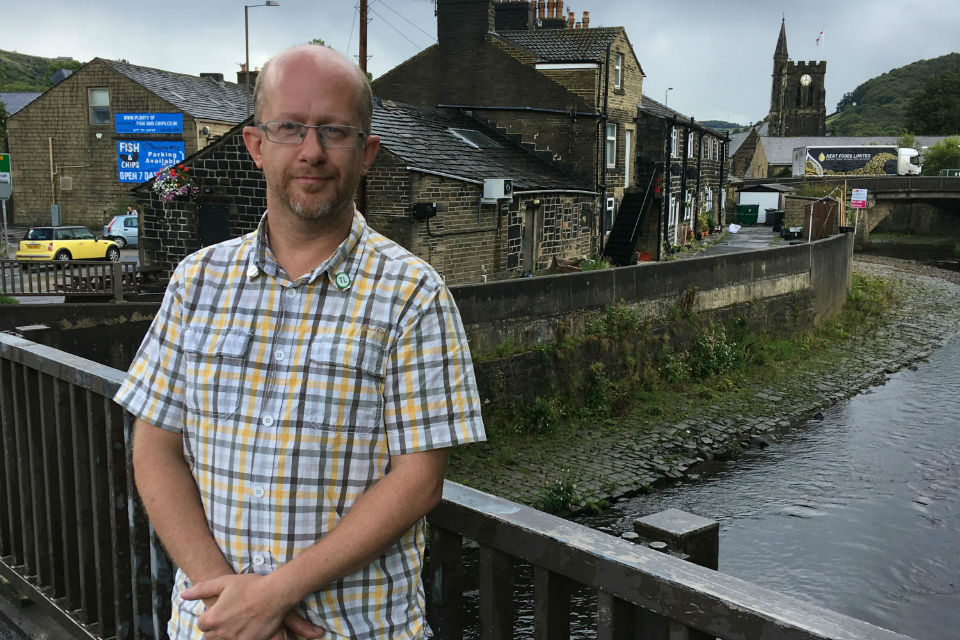
Karl Boggis
Karl is part of the Mytholmroyd flood group

They communicate with each other using radios, visit neighbours to ask them to move any cars at risk and move property upstairs to safety, help evacuate local schools if necessary and will direct traffic to keep it out of flood water.

Karl, a town councillor and former town Mayor, said:

We know all the hot spots now, which areas are more at risk of flooding so we visit them first to check everything is OK and make them aware of the likelihood of bad weather. We have evacuation plans for some houses, check drains and gullies to make sure they are not blocked. When necessary, we will open up the cabin store in Mytholmroyd for people to collect sandbags.

A lot of our work is through effective communications and making sure people don’t panic. We ask people to stay at home, turn their radios on and if they have elderly neighbours please check on them.

As part of my role I visit people in my local community to introduce myself as their flood warden so they know who to contact if they have a problem. Most of our hard work is actually to help people clear up after a flood.

Karl, a property developer who also works part-time in a utility warehouse distributor, had six of his seven properties badly damaged during the Boxing Day floods with water reaching 10ft in his own house. He said:

Sometimes we do get alerted to bad weather and it doesn’t materialise which does make people complacent. However, the effects of floods are so devastating it is much better to be warned and be safe than sorry.

All flood wardens in Calderdale are being encouraged to take part in an exercise to test their flood plans on the 20th October to coincide with the Upper Calder flood sirens being sounded as part an annual test.

When asked what qualities you need to be a flood warden Karl said:

You need plenty of community spirit, a desire to help and good local knowledge helps.

Jon Follows, flood resilience officer with the Environment Agency, said:

The local knowledge flood wardens can provide on the ground is invaluable. They complement our work by implementing their community action plans and offer a key point of contact for us to be able to warn and inform people.

These days with climate change our weather is becoming even more unpredictable and so it’s vital for communities at risk to protect themselves by signing up for free flood warnings, and prepare a flood plan.

1 in 6 properties in England are at risk of flooding – that’s almost 5 million people. A big worry is that only about half of the people who are in a flood risk area, actually know about it.

Jon’s advice is to start by taking three simple steps to help protect you, your family and home from the devastating effects flooding:

If you are interested in becoming a flood warden or would like to ask questions, please email the flood resilience team at yorkshiresw.fim@environment-agency.gov.uk.

For the latest information on current flood warnings and the local weather forecast, Calderdale residents can visit the ‘Eye on Calderdale’ website – www.eyeoncalderdale.com

You can also stay up to date by following @EnvAgencyYNE and #floodaware on Twitter.

On Boxing Day 2015 around 370 properties were flooded in Mytholmroyd as extreme rainfall affected the upper Calder Valley. Since then, Environment Agency teams have carried out thousands of inspections, made crucial repairs and constructed temporary defences. A flood action plan for the town was published in May 2016 setting out plans for permanent improvements to flood protection.


News story: Flood risk this weekend

This is likely to cause large waves and spray which could lead to coastal flooding along the south and south-west coast.

Ben Lukey , National Flood Duty Manager for the Environment Agency, said:

Environment Agency teams are on the ground, checking defences and taking precautionary action to close tidal gates and put up temporary barriers. We’re working with the Met Office and local authorities and are ready to respond as necessary.

We urge people to stay safe along the coast and warn against putting yourself in unnecessary danger by taking ‘storm selfies’ or driving through flood water – just 30cm is enough to move your car.

You can check whether you’re affected at www.gov.uk/flood. We will issue flood alerts and warnings as needed, so please sign up to receive them for free online or by calling 0345 988 1188.