Press release: Environment Agency staff win National Lifesaver Award

Marcus Fry and Rob Nichols travelled to London at the weekend to collect their award from SADS UK, a national charity that campaigns to prevent loss of life from Sudden Arrhythmic Death Syndrome.

The pair swung into action after a colleague collapsed at the Environment Agency’s head office in Horizon House, Bristol. The victim, a woman, was unresponsive and struggling to breathe.

First-aider Marcus started administering cardio-pulmonary resuscitation (CPR), then realised he could also deploy an automatic external defibrillator to prevent the risk of brain damage until an ambulance arrived. Software contractor Rob Nichols took over CPR while Marcus powered up the defibrillator.

Project manager Marcus, 55, of Thornbury, said:

These things work on a fluttering heart, so while Rob, a volunteer with West Midlands Ambulance Service, continued the CPR, I put the pads on the patient. The machine did an analysis and instructed us to continue mouth-to-mouth and CPR. After 2 to 3 minutes the paramedics arrived, followed by an ambulance carrying larger equipment, and then a doctor by helicopter.

After 20 minutes the medics stabilised the patient before taking her to hospital, where she was slowly awakened and treated for her heart condition.

Richard Houghton, Deputy Director, Health, Safety and Wellbeing at the Environment Agency said:

We are very proud and grateful of our quick-thinking colleagues whose calmness and first aid knowledge saved their workmate’s life. The health, safety and wellbeing of our workforce is paramount for the Environment Agency, and I congratulate Marcus and Rob on winning this award.

Rapid treatment is essential when someone suffers Sudden Cardiac Arrest (SCA) and the heart suddenly and unexpectedly stops beating. If this happens, blood stops flowing to the brain and other vital organs.

A defibrillator sends an electric shock to the heart to restore its normal rhythm. Prompt treatment increases a victim’s chances of survival and reduces the risk of brain damage. Without rapid treatment only around 8% of people survive without neurological damage so every minute counts.

The Environment Agency colleague, after her recovery, said:

I feel like the luckiest person in the world. Marcus and Rob provided the assistance I needed with minimum delay. Their actions were impeccable. I was in hospital for 2 days in an induced coma and thankfully hadn’t suffered any neurological damage when I came around.

In a statement read out at Saturday’s awards ceremony the colleague said, “There are no words in any language that can express the feeling of being resuscitated. They just didn’t give up on me. Gratitude is massive. But yet ‘gratitude’ feels like such a small word.”

Anne Jolly MBE, founder of SADS UK, said:

SADS UK commend the lifesaving action taken by Rob and Marcus. It is good to know there was a defibrillator on the premises and that the Environment Agency has installed more at other offices since this incident.

The introduction of the automatic external defibrillator to the Environment Agency’s Bristol office can be credited to the experience of former Bolton Wanderers’ Fabrice Muamba. When he was aged 23, Fabrice suffered cardiac arrest during a match against Tottenham Hotspurs and was resuscitated after his heart stopped beating for 7 minutes.

Marcus was presented with a Lifepak defibrillator that he is donating to Yatton Keynell Village Hall, Wiltshire.


Press release: Harron Homes fined £120,000 over construction pollution

A Leeds-based house building company has been fined £120,000 for illegally polluting a watercourse from a Huddersfield construction site.

Harron Homes Limited was sentenced yesterday (20 November) at Leeds Magistrates’ Court after admitting one charge of causing illegal discharges from its Farriers Croft estate in 2015.

The Environment Agency prosecuted the firm after investigating reports of contaminated run-off which was entering a tributary of Grimescar Dyke.

Rosalind Emsley-Smith, prosecuting for the Environment Agency, told the court that an officer visited the site on 20 November 2015 and saw polluted water flowing out of the entrance of the construction site. The company was also pumping silt contaminated water from site excavations which also entered the watercourse.

Following the Environment Agency’s visit, Harron Homes attempted to control the silt run-off by setting up settlement tanks. However, further incidents of pollution were reported in November and December 2015 and subsequent inspections revealed that this system was inadequate. Silty water was found to be discharging, resulting in further pollution.

Samples taken from the discharges showed that they were having a significant impact on the water quality in the watercourse up to three kilometres further downstream. Some samples showed there to be nearly 35,000 milligrams of suspended solids per litre of water, whereas a healthy watercourse is expected to have a concentration lower than 30 milligrams per litre.

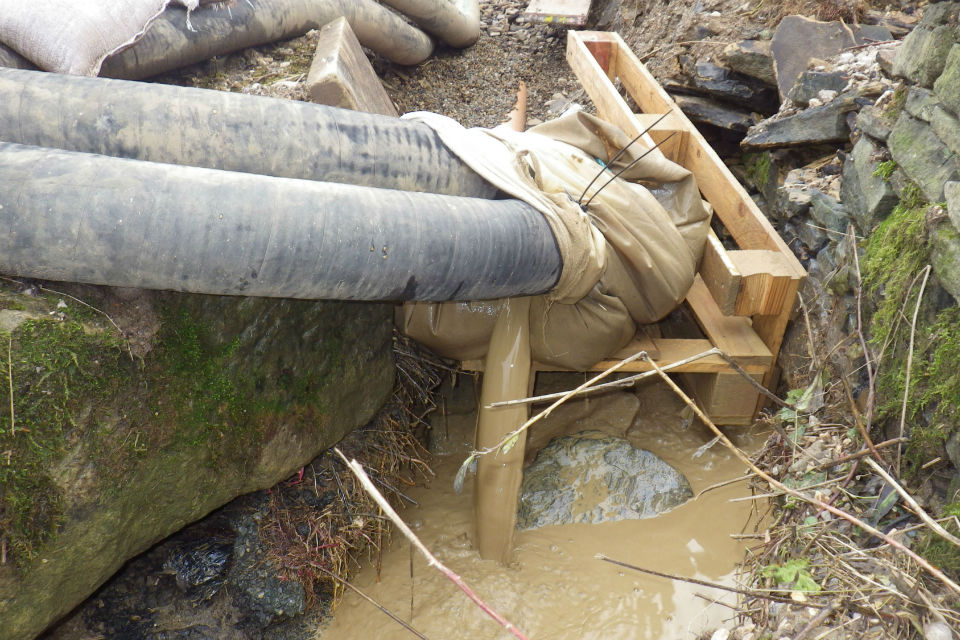
Silt water running from the site
The firm’s attempt to contain the muddy water was inadequate; silt was seen flowing off the site

Mark West, environment management team leader at the Environment Agency, said:

These pollution incidents had a significant impact on the water environment over a number of weeks, and were entirely avoidable. In West Yorkshire there has been a worrying increase in the number of pollutions incidents reported to us that on investigation are attributable to the construction sector.

Construction companies should consider the potential environmental impact of developments they undertake at the initial planning stage and must adhere to environmental permitting rules and invest in appropriate management systems to prevent their activities from affecting the local environment.

If anyone spots pollution of this kind, they are urged to contact the Environment Agency’s incident hotline on 0800 807060 so we can investigate.

In mitigation, Harron Homes told the court that it had now put procedures in place to prevent future pollution incidents.

In addition to the fine, the company was ordered to pay £8,706.71 in legal costs and a £120 victim surcharge.


Press release: Flood defences put to the test in Bewdley

Environment Agency along with Hereford & Worcester Fire and Rescue Service, Wyre Forest Council and the community flood group have conducted a successful barrier deployment exercise on the Stourport Road, Bewdley, Worcestershire.

The exercise, which ran from 9am to 3pm, tested the barrier deployment plan and procedures, and working arrangements with partners and the local Community Flood Group. This ensures barriers can be quickly and safely erected when needed during a flood with minimum disruption to residents and businesses.

Environment agency staff were on hand to talk to members of the public about the work they do during flooding and other times of the year and also how people can better protect themselves and their properties during times of flood. Students from the local school were given a tour of the barriers and shown how they are assembled, they also discussed the issues of flooding in the local area.

Mark Bowers, Flood Risk Manager said:

This exercise allowed us to practice and test our barrier deployment plan for Bewdley, gaining valuable training experience with our partners as well as the opportunity to identify ways in which we can further refine our plans. This in turn will enable us to better respond during floods.

Temporary barriers are just one of the ways we aim to better protect people and properties. It’s important to remember we can never fully protect against flooding, which is why we encourage people to go online at https://flood-warning-information.service.gov.uk/long-term-flood-risk , check their flood risk by entering their postcode, and find out what they can do to protect themselves and their property when flooding hits.

Nick Farress, Bewdley Town Council Clerk added:

The exercise was an opportunity to test the community flood plan and prepare our group of volunteers for the real thing. We are very grateful to the Environment Agency for organising the event and continuing to support the use of the temporary barrier. The community flood group, managed by the Town Council, is a vital resource in a flood event and is always in need of new volunteers, so I would encourage anyone who can help to get in touch with the Town Council.

Wyre Forest Station Commander, Daryl Justice, said:

Our involvement with the Bewdley Flood Barrier response is a new arrangement that will see our firefighters add even more value to the Wyre Forest community.

When flooding is predicted our on-call firefighters will be given a period of notice which will minimise the impact on their primary employment and, although deployed under the direction of the Environment Agency, they will remain available for life threatening emergencies.

This is one of the first initiatives of its type in the UK and is a great example of how fire crews can add value in other areas. It also supports Hereford & Worcester Fire and Rescue Service’s wider vision of ‘Saving More Lives’.


Press release: Second phase of assessment on new nuclear reactor for UK begins

The Office for Nuclear Regulation (ONR) and the Environment Agency announced today that they are progressing to the next phase of their assessment of a new nuclear reactor design for the UK.

The assessment follows preparatory work by General Nuclear System Ltd (GNS) and the regulators.
The process, known as Generic Design Assessment (GDA), allows the regulators to begin assessing the safety, security and environmental aspects of new reactor designs before site-specific proposals are brought forward.

In addition, GNS will be launching a comments process, which enables anyone to submit comments and questions about the reactor design to the company for their response.

Mike Finnerty, ONR’s Deputy Chief Inspector and Director of ONR’s New Reactors Division said:

The purpose of GDA is to determine whether the design meets the robust safety and security standards to make it suitable for use in the UK. I am satisfied that there are adequate project management and technical provisions in place to enter Step 2 of the process and, as regulators, we can begin our technical assessment phase.

Steve Hardy, Environment Agency Nuclear Regulation Group Manager said:

In this GDA we’re assessing the environmental acceptability of a new reactor design from China, the UK HPR1000. We’ll identify any issues or concerns we have with the UK HPR1000 and work with GNS, CGN/EDF’s company bringing this reactor to the UK, to make sure it understands our expectations and delivers a design that meets them.

We are beginning a process of robust scrutiny on which we will report our progress and findings. People can contribute to this work through the comments process that can be accessed from our websites.

ENDS

Notes to Editors and contact details
Generic Design Assessment (GDA) is a joint process between the Office for Nuclear Regulation and Environment Agency.

GDA enables the nuclear regulators to assess the safety, security and environmental impacts of any new reactor designs at a generic level, before receiving an application to build a particular nuclear power station design at a specific location.

Due to the complexity and the level of scrutiny required in the GDA process it is expected to take around four years to complete, provided General Nuclear System Ltd meet the timetable for submissions and the submissions are of sufficient detail.

Bradwell Power Generation Company Ltd, a joint subsidiary of China General Nuclear (CGN) and EDF, proposes to construct a new nuclear power station at their site next to the existing Magnox site at Bradwell in Essex

Read more about the GDA process on the joint regulators’ website.

Read more about General Nuclear System’s UK HPR1000 website.


Press release: Waste site operation to protect workers and environment

The Environment Agency has joined forces with the Health and Safety Executive (HSE) in the North East to carry out combined visits to check waste sites aren’t flouting important legislation.

This ongoing multi-agency approach aims to improve working practices on regulated sites.

The joint initiative, named Operation Hercules, focuses on sites that recycle, process or store waste, from scrap vehicles to general household waste. Operators use a variety of processes and equipment to store, sort and process waste which have the potential to expose workers to risks to health and safety.

The aim of these visits is two-fold; to make sure the sites are operating within the conditions of their Environmental Permit to protect the environment and community, while ensuring the health and safety of workers isn’t put at risk.

Carla Metcalf, Waste Specialist for the Environment Agency, said:

We manage our permitted sites every single day to ensure they are operating within the law, to protect the environment and to minimise impact on the local community.

Health and safety is paramount when our officers are visiting sites and officers regularly contact HSE if they feel a site is unsafe.

These joint operations are a really good opportunity to share knowledge with other agencies and mean we look at the site from different perspectives, ensuring any issues impacting on the environment and community can be looked at together with site safety.

Inspector Victoria Wise from the Health and Safety Executive added:

In the last five years 39 workers and 11 members of the public have been killed because of work activity in the sector. The main causes of death are people being run over or struck by a moving vehicle. A high number of workers in this industry are also exposed to processes that cause irreversible ill health conditions.

During the last joint regional initiative HSE found all eight sites visited to be in significant contravention of health and safety law. HSE and the Environment Agency have therefore agreed to run the initiative again throughout this region in November.

Joint operations such as this mean we can work alongside the Environment Agency to make sure those responsible for the sites are not exposing workers, members of the public and the environment to harm from the operations they undertake.

During the last series of joint visits at the back end of 2016, HSE and the Environment Agency attended eight sites across the region.