Press release: Vital part of Mytholmroyd flood defence scheme gets green light

Plans to construct flood walls at an industrial estate in Mytholmroyd to provide better protection for both businesses and residents have been approved by Calderdale Flood Recovery and Resilience Partnership Board.

They have given the go ahead for walled defences at Greenhill Industrial Estate as part of the £30m Mytholmroyd Flood Alleviation Scheme which will substantially increase the standard of protection for local businesses, including Vale Upholstery and the whole village.

Members of the board were updated at their meeting on 15th June about the investigations into a range of options for the Greenhill site including widening the channel and constructing different types of walls.
Approval was given to build concrete walls on both the right and left banks, install flood gates at each end of the bridge and remove security fencing which obstructs the flow of the river.

This option was recommended as providing the best standard of protection for the whole village, within the resources available and timescales of the current construction programme. However, it was also agreed by the board to continue to seek opportunities to carry out widening the channel at Greenhill Industrial Estate in the future, as well as other measures such as reservoir management and natural flood management.

The scheme, with walled defences at Greenhill Industrial Estate will provide a one in 50 year standard of protection (two percent chance of flooding occurring in any given year) for 400 homes and businesses in the village. This is a substantial increase from the current one in 5 years standard of protection (20 percent chance of flooding).

Helen Batt, Calder catchment director for the Environment Agency said:

We are committed to providing the best possible protection to the Mytholmroyd community as quickly as we can within the funds we have available.

The Greenhill industrial estate is an essential part of the flood defence scheme and we have developed our plans in consultation with local businesses at that site.

We will progress with the next phase of the Mytholmroyd Flood Alleviation Scheme without delay – but continue to explore funding opportunities for further ways to improve the protection for people living and working in the village and the rest of the Calder Valley from flooding in the future.

Cllr Tim Swift, Leader of Calderdale Council and Chair of the Calderdale Flood Recovery and Resilience Partnership Board said:

We are committed to protecting communities like Mytholmroyd to help them thrive so that people want to live, work, visit and invest there.

Given Mytholmroyd’s vulnerability to flooding and the damage caused by recent incidents, it was important to find a solution that would enable the works to continue in a timely way and provide a high standard of protection until further potential works can be progressed.

The approved option will ensure the best possible use of our resources, enabling us to continue to approach funding bodies without delaying this essential scheme and putting residents and businesses at unnecessary risk.

Plans for the Mytholmroyd flood defence scheme have been developed by the Environment Agency in partnership with Calderdale Council. It is expected to be completed Winter 2019 / 2020. Design and construction of the scheme is being carried out by main contractor VBA, a joint venture comprising VolkerStevin, Boskalis Westminster and SNC-Lavalin’s Atkins business.

Vital works to be completed as part of the scheme include construction of new, raised and improved flood walls, the relocation of Caldene Bridge, widening of the river channel at Caldene Bridge and on the right bank in front of St Michael’s Church and flood proofing of the buildings next to the river. Work will also be carried out to reduce flooding from the canal, culverts and Burnley Road.

For the latest news about the scheme, sign up for regular news bulletins by emailing: mytholmroydFAS@environment-agency.gov.uk. You can also follow #MytholmroydFAS @EnvAgencyYNE on Twitter or visit https://www.eyeoncalderdale.com

The Environment Agency is investing £475m in Yorkshire to better protect 66,000 homes across the county as part of our current six year programme to 2021.


Press release: Opportunity to shape plans to reduce flood risk in Otley

Following the creation of a digital model of the river, and testing options in the model, a team from Leeds City Council, Environment Agency, and consultants WSP have now come up with four options that they would like the community’s views on.

Residents and business owners can come and talk to the team at:

  • The Core Otley, Unit 11 Orchard Gate, Otley LS21 3NX on Thursday 21 June between 4–7pm

The shortlist of options and supplementary works on show include using flood defence walls, flood defence embankments, maintenance including vegetation clearance and riverbank realignment.

Otley suffered flooding on three occasions between November and December 2015, which saw 74 properties affected. In the Autumn Statement 2016, Government announced £2 million to invest in a scheme to reduce the risk of flooding to homes and businesses.

The scheme is being led by Leeds City Council working closely with the Environment Agency.

Leader of Leeds City Council Councillor Judith Blake said:

We are very pleased to now share with people the progress we and the Environment Agency have made on the plans for flood prevention measures for Otley with these shortlisted options we are now considering and developing further. These measures are all deliverable and would make a real difference in providing reassurance to local residents and businesses against the threat posed by flooding, so we would encourage as many people as possible to come and see what we have in mind and tell us what they think.

John Woods, flood risk management advisor at the Environment Agency said:

After much work we are now approaching a really crucial stage in the project to select a final option for Otley. We’d encourage anyone with an interest in the scheme to look at the potential options and come along to discuss their views with the team. Residents views are really important in helping us to reach a preferred option for the town.

Catchment-wide approach

The Otley Flood Alleviation Scheme is one of several schemes that is adopting a catchment-wide approach. This means the entire River Wharfe catchment area is being considered to help reduce flood risk. This approach looks at a combination of natural processes and engineered options to help slow the flow and catch water further up the catchment so that flood peaks are reduced further downstream.

After the drop-in event, a preferred option will be chosen and developed into the outline design phase, where the community will get another chance to comment on the proposals.

The team is aiming to submit a planning application in winter 2018 and subject to planning approval, construction on site will start by autumn 2019.

For those who can’t make it to the drop-in, the shortlist of options are also available to view online here and if anyone has any comments they can be sent by email to FRM@leeds.gov.uk


Press release: £5 billion investment by water companies to benefit the natural environment

The Environment Secretary Michael Gove has challenged water companies to increase investment and improve environmental outcomes by 2025.

The ambitious measures set out by the Environment Agency in the Water Industry National Environment Programme (WINEP) will see up to £5 billion of investment by water companies in the natural environment through 2020 to 2025.

This will help tackle some of the biggest challenges facing the water environment, from the spread of invasive species and low flows to the effects of chemical and nutrient pollution.

Environment Secretary, Michael Gove said:

I want water companies to invest in the long term future of our environment. It is right that the Environment Agency is challenging water companies to go further.

This significant investment will help tackle some of the biggest challenges facing the natural environment. It will help to improve our waterways, increase biodiversity and combat non-native invasive species. This will support our goal to leave the environment in a better state for future generations.

Water companies have a duty to protect and enhance the natural water environment. The government expects water companies to meet the obligations set out in the Environment Programme (WINEP) by 2025.

The investment will:

  • Protect and improve at least 6000km of our waters
  • Protect and improve 24 Bathing Waters and 10 Shellfish sites
  • Protect and improve 1800 hectares of protected nature conservation sites
  • Enhance nearly 900km of river and 4276 hectares through wider biodiversity improvements

The measures in WINEP represent the basic measures required by water companies to meet their environmental outcomes. However this also presents an opportunity for the industry to develop innovative approaches which will benefit customers, communities, the environment and natural capital.

Environment Agency Chair Emma Howard Boyd said:

A clean water environment keeps us healthy, sustains wildlife, and is essential to the success of the economy. Water quality has improved in recent decades but water companies are still responsible for at least one serious pollution incident every week.

We put together a programme of work for water companies over the next five years which will produce significant environmental improvements: protecting and improving over 6,000km of rivers, 24 bathing waters, 10 shellfish waters and 18000 hectares of protected nature conversation sites.

Water companies have until later this year to submit more detailed plans to Ofwat. I’m looking forward to seeing more innovation and less pollution.

Certain aspects of the WINEP, on an exceptional basis, will be considered for extension of the 2020-2025 timeframe if they facilitate long term sustainable outcomes and maximise environmental benefits.

Water companies have until 30 June to submit their case for extension to the Environment Agency and Ofwat.

This ambitious programme marks a real step forward in delivering the environmental outcomes set out in our 25 Year Environment Plan.

Notes:

  • Environment Secretary, Michael Gove’s speech to the water sector can be found here.
  • Environment Agency report on State of the Environment water quality can be found here.


Press release: River coarse fishing season starts tomorrow

It’s a great time to get out there and go fishing, but the Environment Agency is reminding anglers to make sure they have a fishing licence before they go.

You can buy a fishing licence online and don’t forget that all fishing licence income is used to fund work to protect, improve and develop fisheries, fish habitats and angling. If you want to fish a new river this season, why not visit fishinginfo to find details of different venues, river levels and angling clubs.

Volunteers helping to tackle illegal close season angling

The Environment Agency reported 87 close season offences during the first 10 weeks of the annual restricted period for coarse fish. Officers undertook 729 targeted patrols, also detecting 115 other offences, mainly unlicensed fishing, but also several illegally set traps.

Environment Agency Fisheries Enforcement Officers were supported again by Angling Trust Voluntary Bailiff Service members on Operation CLAMPDOWN. Now in its sixth year, Operation CLAMPDOWN is a joint initiative between the Environment Agency, Angling Trust’s Fisheries Enforcement Support Service and police forces, aimed at gathering intelligence about illegal fishing and responding through targeted patrols.
Patrols took place across rivers, streams, drains and on specific canals and stillwaters that still retain the close season.

Kevin Austin, Environment Agency Deputy Director Agriculture, Fisheries and the Natural Environment, said:

It’s a great time to go fishing. So I’d encourage anglers to get out there, enjoy yourselves fishing and make sure you are doing the right thing.

I’d like to thank the Angling Trust volunteers for the significant role they play in stopping illegal fishing through their work on Operation CLAMPDOWN.

The vast majority of anglers fish legally; sadly there are a small number of anglers who cheat others by fishing during the close season. It is still possible for anglers to fish during this time on many stillwaters and canals, which are open all year round.

We respond to the intelligence we receive about illegal fishing by ensuring our patrols are targeted at the right places – and the right people.

Dilip Sarkar MBE, Angling Trust National Enforcement Manager, said:

These figures show that during Operation CLAMPDOWN 6 Volunteer Bailiffs throughout England are demonstrating their massive commitment to protecting fish and fisheries and cracking down on illegal fishing.

All anglers can help this process, in fact – at any time of year – by reporting information and offences in progress to the Environment Agency on 0800 80 70 60, or the police on 101/999 as appropriate.”

Anyone who suspects illegal fishing to be taking place should report the matter to the Environment Agency’s incident hotline on 0800 80 70 60.


Press release: Sea change for migrating smolts

The Environment Agency has carried out underwater sonar surveys to check for young salmon using a new route across the Tees Barrage gates.

And the results show the juveniles – known as smolts – successfully making their journey from spawning grounds upstream out to sea.

It follows changes to the operation of the Tees Barrage in 2015, which means on every tidal cycle the gates are lowered to allow fish to pass both upstream and downstream.

Surveys have shown the barrage gates are the main route for salmon migrating upstream and the automation of the gates has resulted in an extra 1,500 hours per year of fish passage for returning adult salmon to reach their upstream spawning grounds.

It’s in addition to the other routes that salmon use including the Barrage’s navigation lock, the Denil fish pass, the fish pass in the white water rafting centre, and the main canoe slalom.

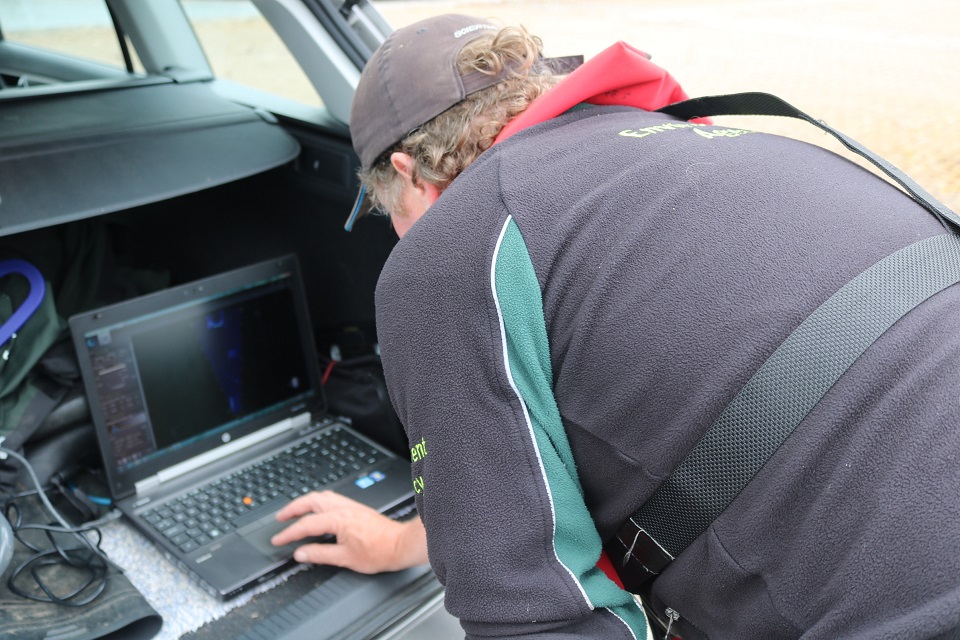
Image of Phil Rippon checking the sonar footage

Downstream migration improved

Phil Rippon, Fisheries Technical Specialist at the Environment Agency, said:

As well as improving the routes for returning adult fish we are also looking to improve the downstream migration of these precious fish and maximise the number of smolts reaching the North Sea.

By lowering the main barrage gates at set times, it means that as well as providing an additional upstream route for adult salmon we are providing a much easier route for the young salmon moving downstream as well. It is known that the sooner the smolts reach the sea the better their survival chances are, resulting in more returning adult fish.

Our recent work using an underwater sonar has shown large numbers of smolts using the gates to pass successfully downstream. It’s really positive to see yet more evidence that salmon are spawning upstream and these youngsters have been living in the river for up to 3 years before they move out to the sea.

Every year smolts, which are between 1 and 3 years old, leave the river to start their feeding migrations to the sea – travelling as far as Greenland – where they will spend up to three more years as an adult salmon before returning to the river to spawn.

Smolts are vulnerable throughout their migration and only around 5% of those that leave the river will return to spawn the next generation of salmon.

Underwater sonar footage of River Tees smolts crossing the Tees Barrage

Steering group

The Tees Barrage Fish Pass and Operation Steering Group, made up of Tees Barrage owners the Canal & River Trust, the Environment Agency, Angling Trust, Salmon & Trout Conservation Trust, Tees Rivers Trust, Industries Nature Conservation Association and Tees Barrage International White Water Centre, oversees the monitoring and research of fish and seal populations and carried out action to improve fish passage.

Research to understand the preferred routes through the barrage for fish and how to make it easier for them while reducing seal predation has been the focus of recent surveys.

Last year also saw the use of an acoustic deterrent device (ADD) to deter seals from entering the navigation lock, which showed promising results. Phil added:

We’re working really hard together with our partners to understand how fish naturally try to pass through the barrage and then to make it as easy as possible for them. We’ve changed the way the main gates and navigation lock operate to allow more fish passage, and we’ll be using an acoustic deterrent device again this summer.

We want as many fish as possible to make it upstream to their spawning grounds to ensure the River Tees continues to improve.