News story: Environment Agency’s ‘Incident Management Portal’ receives international award

The Environment Agency’s Incident Management (IM) Portal has been awarded a ‘Special Achievement in Geographical Information Systems (GIS) Award’ at the 2018 International ESRI User Conference in recognition of its outstanding use of GIS technology.

Launched in October 2016 the IM Portal has already:

  • Reduced the time between data capture and reporting during an incident
  • Improved the Environment Agency’s ability to easily share mapping internally and externally during an incident ensuring consistency
  • Simplified and standardised the tools used, and the process for capturing, storing, analysing and sharing data

Catherine Wright, Director for Flood and Coastal Erosion Risk Management said:

The Incident Management Portal is just one example of how the Environment Agency is working to improve incident response. The portal is a great example of how the Environment Agency is using technology to improve its response to environmental incidents – from everything to flooding and drought to tackling waste crime and improving biodiversity. It has revolutionised how we collect and use data during incidents by providing real-time data and images to our incident rooms across the country.

The portal has already proved invaluable during incidents and we are continuing to look at ways we can build on the system to maximise the longer term benefits from the data captured and use it to help inform future decision making. It is an honour to accept this international award on behalf of the team who have created this innovative system.

Stuart Bonthrone, Esri UK Managing Director, visited the Environment Agency office in Bristol where he presented the award.

The Incident Management Portal Team has put the Environment Agency at the forefront of this international audience.

At the conference in San Diego, Jack Dangermond, President and Founder of ESRI, said:

The work of the Environment Agency stood out from more than 100,000 other applicants and I would like to congratulate you on a job well done.

The Incident Management Portal was established following a review of the Environment Agency’s mapping capabilities after the floods of winter 2015/16. The review identified the need to improve how data is acquired, shared, and used during an incident.

The Incident Management Portal is just one example of how the Environment Agency is working to improve incident response. Since the flooding of 15/16, the Environment Agency has invested £12.5 million in new flood equipment including an additional 40km of temporary barriers, 500,000 sandbags and 250 pumps, including 12 ultra-high volume pumps. There are around 6,500 trained staff across the country, ready to respond to flooding, including 500 flood support officers and the Environment Agency have awarded a new Incident Management Logistics Contract to store and deploy the temporary flood defences.

More than 1.4 million people are signed up to the Environment Agency’s free flood warning service, which sends a message directly by voice message, text or email when a flood warning is issued. Over the last year the Environment Agency has partnered with mobile phone networks to automatically add thousands of mobile customers to the service and this work will continue throughout 2018.


Press release: Hoteliers and haulier fined after waste illegally dumped to extend hotel car park

Three North East men have been ordered to pay over £10,000 for illegally landfilling waste after a successful prosecution by the Environment Agency

David Bradley (57) and Alan Bradley (64), the brothers and joint owners of Hardwicke Hall Manor Hotel, near Blackhall in East Durham were fined £3,855 & £971 respectively. The haulier, Alan Waggott (53) of Howden-le-Wear, near Crook was fined £6,007 after appearing at Newton Aycliffe Magistrates Court today (15 August) where they pleaded guilty to various environmental offences.

Chris Bunting, prosecuting told the court that in September 2016 Environment Agency officers attended the hotel and found part of the car park, which is close to a watercourse, covered in various waste materials. Enquiries revealed that the edge of the car park had suffered from landslip, so the Bradleys had decided to repair the damaged area.

It is illegal to dispose of waste by landfilling without an environmental permit and Hardwicke Hall Manor Hotel had no such authorisations. Environmental permits safeguard people and the environment by placing controls on any activity that could pollute air, water or land.

During their inspection, Environment Agency officers witnessed a fully laden waste vehicle arrive on site belonging to Alan Waggott Haulage. The waste was seen to be of the same type which could be seen on the ground.

Photographs showed a wide range of waste materials which should never have been deposited in such a mixed state, at such a location where no permit was in place. Traces of bonded asbestos, a hazardous waste, were identified by officers although it was made clear that Waggott was responsible for only a fraction of the total waste material which had been used.

The court heard that Waggott was contracted to remove waste from construction sites in North Ormesby and Stockton-on-Tees. Whilst paperwork issued by Waggott claimed that this waste was to be deposited at a permitted landfill site, 36 wagon loads were in fact tipped for free at the hotel.

Having ordered tipping operations to stop and given instructions for the illegally tipped waste to be removed and disposed of at a permitted facility, a subsequent inspection by the Environment Agency found that additional waste had been deposited in the car park area.

In mitigation, John Elwood for the Bradleys showed photographs of fly tipped waste which formed part of the problem, and said that they never realised at the outset that a permit may have been needed. Ben Pegman for Waggott, confirmed that his client had acted on trust, but recognised he needed to improve his working methods to ensure he was acting lawfully.

In passing sentence, the Court said there was no doubt the incident was clearly for monetary gain.

Rachael Caldwell for the Environment Agency said:

We will not tolerate abuses of the environmental permitting system. Those who ignore environmental laws can cause serious pollution to the environment, put communities at risk and undermine legitimate business and the investment and growth that go with it.

We hope that the sentencing handed down today acts as a deterrent to those who may think they can get away with it.

If you see or are aware of waste crime, you can report it by calling the Environment Agency’s incident hotline on 0800 80 70 60 or call Crimestoppers anonymously on 0800 555 111.


Press release: Adur tidal walls scheme harnesses the unique power of the Giken

The Environment Agency’s Adur tidal walls scheme in Shoreham-by-Sea is making great strides as it nears the final stages of construction with completion expected by the end of the year.

A major component to making good progress has been the use of the Giken press piling train to drive in the steel piles. This is a Giken silent piling unit, power pack, and crane mounted onto the piles (a ‘reaction stand’), using the installed piles as tracks – like a train. The Giken piler drives piles silently by pressing them into the ground. This is located at the front of the ‘train’ pressing piles in at the front. The whole train walks along, following the Giken silent piler to install piles in a linear fashion.

This equipment has proved to be key to working in the tight spaces between the Shoreham houseboats and the houses landside of the path, driving in the steel piles to form the wall’s core support.

The planning process needed to be carefully managed to ensure that stakeholder agreements were completed on time because of the specialist Giken press piling train required to install the sheet piles. This needed to be booked 6 months in advance as there are only a few in the world. Scheme contract partners Team Van Oord developed a stakeholder engagement programme to set out the process to obtain the agreements and the roles of project team organisations at each stage.

Following completion of sheet piling in the W5 reach*, the Giken train will be decommissioned on Thursday 2 August. The W5 reach is scheduled for reopening this autumn.

*The 7.2 kilometre long defence is split into 10 sections labelled as E for east or W for west of the river, ie E1, E2, E3, W1, W2, W3, W4, W5, W6, W7.

An Environment Agency spokesperson said:

We would like to thank everyone in Shoreham-by-Sea for their continued patience and support. More than two-thirds of the Shoreham Adur tidal walls flood defence scheme has now been completed. Having started construction in October 2016 we expect to finish by the end of this year.

A Team Van Oord spokesperson said:

In the W5 reach we have had to install some 1,176 sheet piles – each one 11 metres long. The work was complicated by being close to 40 houseboats along a stretch of 700m. However, we made sure to consult with stakeholders and houseboat owners keeping them informed on developments.

Thanks to their cooperation, we were able to continue the pile driving works in this reach without closing a larger area to the public.

Further information about the scheme is available on GOV.UK.

In addition, there is a dedicated visitor centre for the project, located in the Beach Green car park in Shoreham, and open from midday to 5pm Monday to Friday.

Contact details: email shorehamwestbank@environment-agency.gov.uk or write to:

SSD Enquiries

Environment Agency

Guildbourne House

Chatsworth Road

Worthing

BN11 1LD

For general information on how to prepare for flooding and the latest flood warnings in force please visit our floodline page or ring Floodline on 0345 9881188.

Notes to editors

The Shoreham Adur tidal walls scheme, made up of raised walls and embankments along the River Adur, is being constructed by the Environment Agency. Once complete, it will reduce the tidal flood risk to thousands of homes and commercial properties in the area, as well as protecting important local infrastructure such as roads, railway lines and Shoreham Airport. It is part of the Environment Agency’s 6-year plan to reduce the risk of flooding to at least 300,000 homes by 2020/21.

Adur tidal walls scheme in numbers

  • 7.2km of defences
  • 2,527 properties protected
  • 2.5km of steel sheet piling
  • 3km of flood embankment
  • 1km of concrete walls
  • ½km of flood glass
  • ½km of rock revetment
  • 2,316 lizards and slow worms relocated
  • 14,000m2 saltmarsh habitat to be created

Other key points of the scheme

The scheme will reduce the risk of flooding to over 2,300 homes and 169 commercial properties.
Consultation events in 2014 and 2015 provided public feedback on the designs now incorporated into the detailed designs.

The scheme boundary includes the nationally designated Adur Estuary Site of Special Scientific Interest (SSSI) and a RSPB reserve. These areas have over-wintering bird populations and significant areas of saltmarsh and mudflat. Saltmarsh and mudflat are priority habitats that have been identified as requiring conservation action under the Natural Environment and Rural Communities Act (2006).

The Environment Agency is aiming to minimise loss of saltmarsh habitat by moving the embankment next to the airport further back from its current position to create new saltmarsh habitat.


Press release: Native crayfish make a comeback in Lincolnshire

A threatened species of crayfish is making a comeback in Lincolnshire thanks to efforts by the Environment Agency and local conservation groups.

Last July, 600 white-clawed crayfish were moved from locations in the River Witham – where they’re at risk of being wiped out by invasive signal crayfish – to new remote locations including a chalk stream in the Lincolnshire Wolds.

Now, surveys show the transfer – the first in the county – has been successful, and the crayfish have started to breed.

Native white-clawed crayfish have been in decline since non-native American signal crayfish escaped into UK waters in the 1970s. These larger, invasive crayfish outcompete native species for food and habitat and carry a disease fatal to the UK species.

But working with partners such as the Lincolnshire Chalk Streams Project (LCSP) and the Lincolnshire Wildlife Trust, the Environment Agency is seeking to secure their future by relocating them to areas free of the invaders in a scheme known as the ‘ark project.’

Richard Chadd, senior environmental monitoring officer with the Environment Agency said:

These crayfish are a vital part of our ecology, so preserving them is yet another example of how we’re protecting our environment for the future.

Having personally worked on this project – physically picking up these crayfish, measuring them, checking their health and relocating them to their new homes – I’m thrilled that our efforts at protecting them have been so successful.

Previously the crayfish were only present in two locations in the county, so we’ve potentially doubled their habitat in the space of a year – and Lincolnshire’s rare, protected chalk streams are the perfect home. They’re remote, clean, and the water is high in calcium, which helps crayfish form strong exoskeletons and makes them more robust.

Ruth Craig, Lincolnshire Chalk Streams Project Officer, said:

The Lincolnshire Chalk Streams Project jumped at the chance to support this EA-led initiative to establish native white-clawed crayfish sites in the chalk streams of the Lincolnshire Wolds.

We offered up some potential sites and once they were all assessed, we were excited to hear one of the chalk streams had scored as highly suitable.

We worked closely with local landowners to secure access and their long-term support in protecting the area from disturbance, and we will return to monitor the populations as needed. But the hard work doesn’t end here – we plan to continue identifying further possible locations, supporting the work of the EA.

White-clawed crayfish, named for the pale colour of the underside of their claws, are the country’s largest native freshwater crustaceans. Generally growing to 30 – 40mm in length, some can live up to 12 years and reach 120mm long from tip to tail.

Collectively, non-native invasive species cost the UK economy an estimated £1.7b every year.
Everyone can do their part to prevent the spread of invasive species and protect native ones by taking care to follow the biosecurity steps of thoroughly checking, cleaning and drying your clothes and equipment any time you’ve been in the water. You can get more information from the Non-native Species Secretariat.


Press release: Happy dace for River Tyne fish survey

The Environment Agency joined forces with expert anglers for the second year running to carry out an important survey to assess the numbers of a highly prized fish in Northumberland.

Surveys for dace, the main species of coarse fish in the River Tyne, much valued by anglers, took place on the North Tyne tributary as part of a wider programme to monitor any impact of the revised releases of water from Kielder Reservoir.

Environment Agency specialists teamed up with 17 expert anglers from the Tyne Anglers Alliance and other fishing clubs – with anglers from as far afield as Yorkshire and the Scottish Borders making the trip – to fish around a dozen locations between Kielder and Watersmeet.

The aim was to both update and enhance our existing information on dace populations.
There were some great results – including a whopping 27lb catch at Wark and an 18lb bag from Redesmouth.

Good numbers of young dace

Environment Agency Fisheries Officer Niall Cook, who organised the survey, said:

After such a successful event last year we are now looking to run this annually so we can build up a detailed picture of where dace can be found in the North Tyne and also where perhaps they aren’t so abundant.

The survey this year was particularly successful in that it showed good numbers of young dace in the middle reaches of the North Tyne. This contrasted with the 2017 survey when almost all dace caught were older fish.

Angling was used in preference to other survey methods like electric fishing and netting because dace are highly mobile and difficult to catch, especially in wide rivers like the North Tyne.

The Environment Agency, Northumbrian Water and the hydropower operator, Innogy Renewables UK Ltd worked together in 2016 to make changes to the operating arrangements for the release of water from Kielder Reservoir.

An annual trial concluded in October 2017 and the changes are intended to maintain the future of water supply to the North East, better reflect the natural changes in river flows, provide increased flood storage in the reservoir and increase the generation of clean, renewable energy.

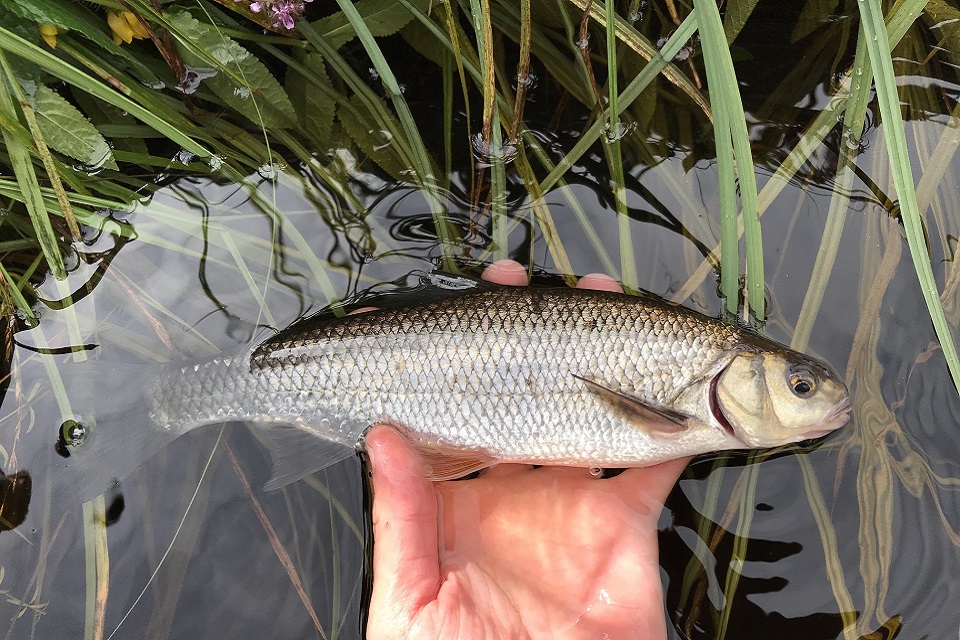
Image shows one of the dace caught in the survey

Surveys provide information

Hydrologist Rachel Merrix, who led on the trial for the Environment Agency, added:

Although the annual trial of the revised release regime ended last October we continue to monitor river flows and temperature to ensure that the environment is protected. Fish surveys such as this one provide us with additional information which increases our confidence that the revised releases are not having an adverse effect on native coarse fish.

We have had some feedback from both reservoir and river users on the impact of the releases but would encourage others to let us know if they have any concerns.

We continuously monitor river levels, flows and water temperatures at several locations in the Tyne catchment and all of this data is available on request.

Other activities to monitor the impact of the new Kielder release regime include temperature monitoring at 11 new sites, as well as electric fishing surveys for juvenile salmonoids and freshwater pearl mussel assessments.

For more information and updates on the trial visit the Kielder release website or email Kielder.reservoir@environment-agency.gov.uk with any queries or observations.