Policy paper: Draft Animal Welfare (Sentencing and Recognition of Sentience) Bill 2017
Updated: Added a link to the summary of responses for the consultation carried out on this draft bill.
This paper, laid in Parliament on Tuesday 12 December 2017, includes the draft Animal Welfare (Sentencing and Recognition of Sentience) Bill 2017, and the explanatory notes that accompany it.
The draft bill would do two things. It would increase the maximum penalty for animal cruelty offences from 6 months to 5 years imprisonment, and it would ensure that animals are defined in UK law as sentient beings.
News story: Landmark for English Channel electricity link project
Updated: Added further explanation of the milestone following feedback
The Marine Management Organisation (MMO) has issued a comprehensive decision for the IFA2 (Interconnexion France-Angleterre) project under the TEN-E Regulations, after it attained all of the required statutory consents in UK consenting regime.
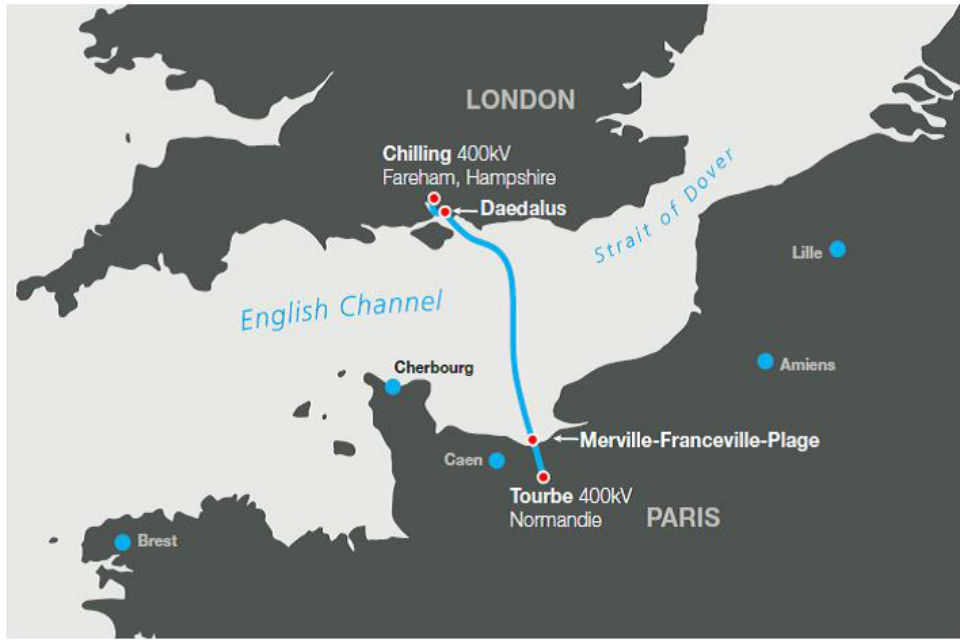
The IFA2 interconnector is a 1,000mw high voltage direct current (HVDC) link, which will run from Normandy in France to Hampshire in England. The project is being carried out by National Grid IFA2 Ltd and RTE.
MMO Senior Marine Licensing Manager Matthew Kinmond said:
This is the first comprehensive decision from the MMO under the TEN-E Regulations and the first in the UK for a cross-border and multiple consenting regime interconnector project. It represents a major milestone for the IFA2 project.
Dave Luetchford Head of IFA2 from National Grid said:
Enhancing Great Britain’s energy connection to France will bring a number of benefits, including increasing security of electricity supplies for both countries and providing opportunities for shared use of renewable energy.
Press release: Environment Agency’s Christmas stocking for Berkshire anglers
Updated: Photos updated.
The Environment Agency is delivering an early Christmas gift to anglers in Berkshire this week, when it carries out a Christmas stocking of young adult fish into the River Cut at Jocks Lane recreation ground in Bracknell.
Thousands of fish, including roach, dace and chub, will be added to the river’s existing fish population this Thursday, 14 December. This will provide an immediate boost to numbers, which will be multiplied many times over when the new arrivals settle into their new homes and begin to produce offspring.
Stuart Keable, a fisheries officer for the Environment Agency, said:
We carry out a number of fish stockings every year. Sometimes it is to help fish populations recover when they’ve suffered from a pollution incident, or through flooding, which can push large numbers of fish downstream, and many never return.
The River Cut has suffered from recurrent pollution near Jocks Lane recreation ground in 2017, where uncontaminated water from a large proportion of Bracknell drains into the Cut. Environment Agency officers have been working closely with Thames Water, which manages the surface water network, to investigate the source of the pollution. The partnership has also resulted in pollution-prevention visits to nearby industrial estates, where officers advised businesses on oil and chemical storage compliance, hazardous waste disposal and the risk to streams and rivers.
Rachel Brown, an Environment Agency team leader in east Berkshire, said:
The Environment Agency has responded to a number of incidents on the River Cut this year, reported to us through our incident hotline. We have been working with Thames Water to find why the river was polluted, whilst also reducing the impact to the environment. We have carried out pollution-prevention visits at the nearby industrial estates, to raise awareness of the surface water drainage network and correct disposal of waste. Information provided by the public is vital in helping us with these ongoing investigations, and we urge anyone witnessing an environmental pollution to call our 24-hour incident hotline on 0800 80 70 60.
Christmas is a good time to introduce the fish into rivers, as it enables them to acclimatise to their new surroundings, ahead of their spawning season in the spring. Fish also play a critical role in sustaining a river’s finely-balanced eco-system, so the wider natural environment will also get a festive boost.
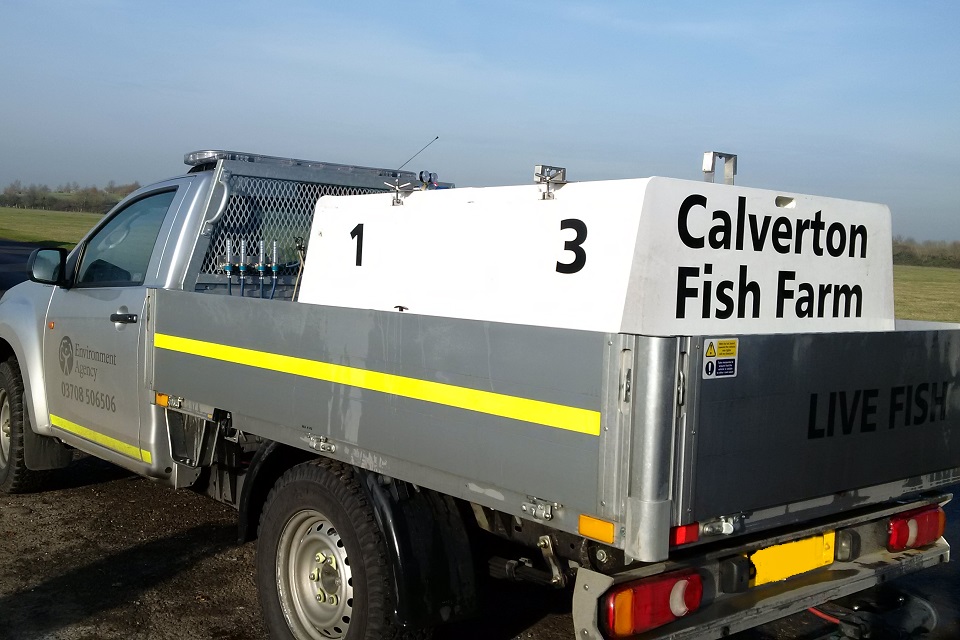
Environment Agency vehicle with oxygenated tanks for transporting live fish.
Stuart Keable added:
The River Cut has undergone some fantastic enhancements recently. We’ve done a lot of that ourselves, but we increasingly work with local angling clubs, Bracknell Town Council, community groups and volunteers to get bigger and better results. The council has already installed 10 fishing platforms on the upstream section of the river at Jocks Lane, which will eventually see a wheelchair ramp installed for disabled access to this area. These improvements were made through the Angling Trust’s Angling Improvement Fund.
Through the Environment Agency’s Fisheries Improvement Programme, we have started on some major
habitat improvement work in the river itself. In November, we installed the first of 10 marginal berms to provide a more diverse habitat for fish, insects, birds and plants, as well as push silt out of the system. This work will be ongoing throughout the winter. The collective contribution from our various partners to the wellbeing of the river has been immense.
The fish are being brought to site in oxygenated tanks from their birthplace and home for the last 12-18 months, the Environment Agency’s own Calverton Fish Farm in Nottingham. Funded through rod licence fees, Calverton produces some 450,000 coarse fish each year which are used to help the vitality and diversity of fish populations in rivers, lakes and ponds throughout England.
Consultation outcome: Nuclear Decommisioning Authority: Business Plan 2018 to 2021
Updated: Final NDA Business Plan published.
We sought views from members of the public, nuclear regulators, employees within our Site Licence Companies, trade unions, local authorities, Site Stakeholder Groups, Non-Governmental Organisations, other organisations and public bodies.
Notice: EX17 3DH, Crediton Milling Company Limited: environmental permit issued
The Environment Agency publish permits that they issue under the Industrial Emissions Directive (IED).
This decision includes the permit and decision document for: