Detailed guide: The UK’s nuclear history

Our nuclear legacy

The United Kingdom is a pioneer of nuclear technologies and opened the world’s first commercial nuclear power station in 1956, at Calder Hall near Sellafield in Cumbria. Nuclear power has delivered great benefits: it has supported national defence, generated electricity for more than 60 years and our country remains a world-leading nuclear enterprise.

Today the UK is faced with the challenge of cleaning up the legacy of its early nuclear operations – a large-scale programme undertaken by the Nuclear Decommissioning Authority (NDA). This includes delivering innovative solutions for managing radioactive waste that meet today’s safety standards and will protect us into the distant future.

Why we use nuclear energy today

UK Government policy is to have a wide mix of energy supplies, so we use nuclear alongside other energy sources, such as gas and solar. Today, nuclear energy generates around one fifth of the country’s electricity, and under current government proposals that include Hinkley Point C, some of our power will come from nuclear sources in the future.

There are important reasons why nuclear is part of the mix:

  • it’s a low carbon choice that supports the UK’s climate change goals: nuclear power stations generate electricity without emitting greenhouse gases like carbon dioxide and methane

  • nuclear power plants produce electricity 24 hours a day, whatever the weather

  • nuclear power plants don’t require a daily supply of new fuel to operate, unlike gas, coal and biomass plants

Where else does radioactive waste come from?

Besides nuclear power generation, radioactive waste comes from:

  • Medical – in particular, radioactive materials are used to sterilise equipment, and help diagnose and treat medical illnesses.

  • Industry – for example, gamma rays are used to test the quality of welds or the thickness of products, such as paper.

  • Defence – includes the operation of active nuclear-powered submarines and the decommissioning of retired submarines.

  • Research and development – from nuclear fusion technology to developing new radiotherapy treatments to testing novel solid materials for encapsulating liquid radioactive wastes.

The full list of radioactive waste present in our country is kept up to date and published on the UK’s Radioactive Waste Inventory website.

To learn more about radioactivity, read or download
What is radioactive waste?
(PDF, 1.03MB, 4 pages)

What we need to do now

The radioactive waste resulting from power generation, medicine, defence and other industries needs to be managed carefully. Existing waste is currently stored above ground at more than 30 sites around the UK. These surface stores can be safe for many decades, but require continuous protection to keep them secure and in good condition, as the waste remains radioactive for hundreds of thousands of years.
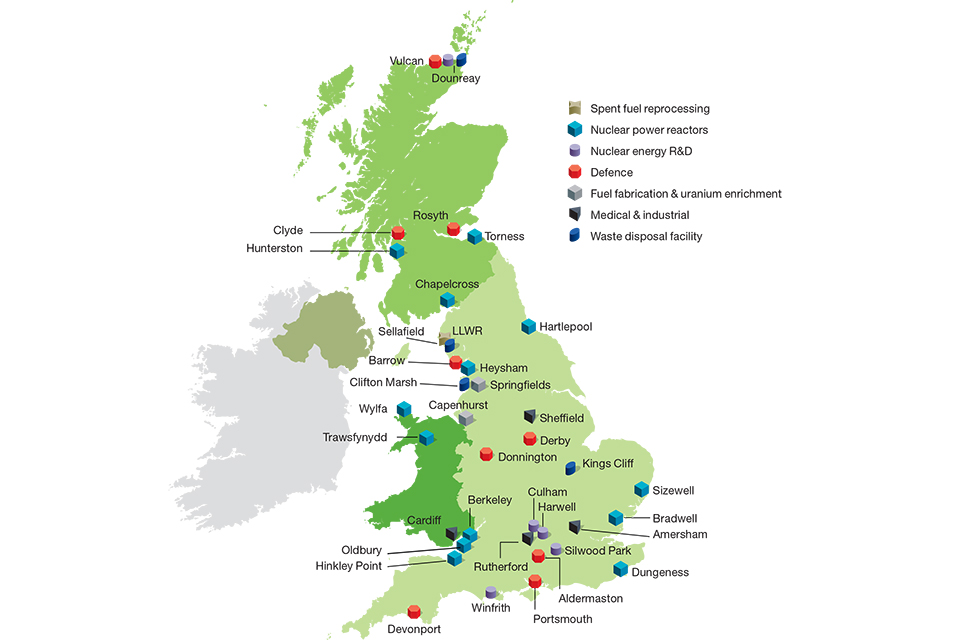
A map of nuclear sites across the UK
Nuclear sites in the UK

There is international consensus that geological disposal is the safest and most secure way to manage higher activity waste for the long term, and that a Geological Disposal Facility (GDF) will ensure that the responsibility of continually protecting this waste is not passed on to future generations.
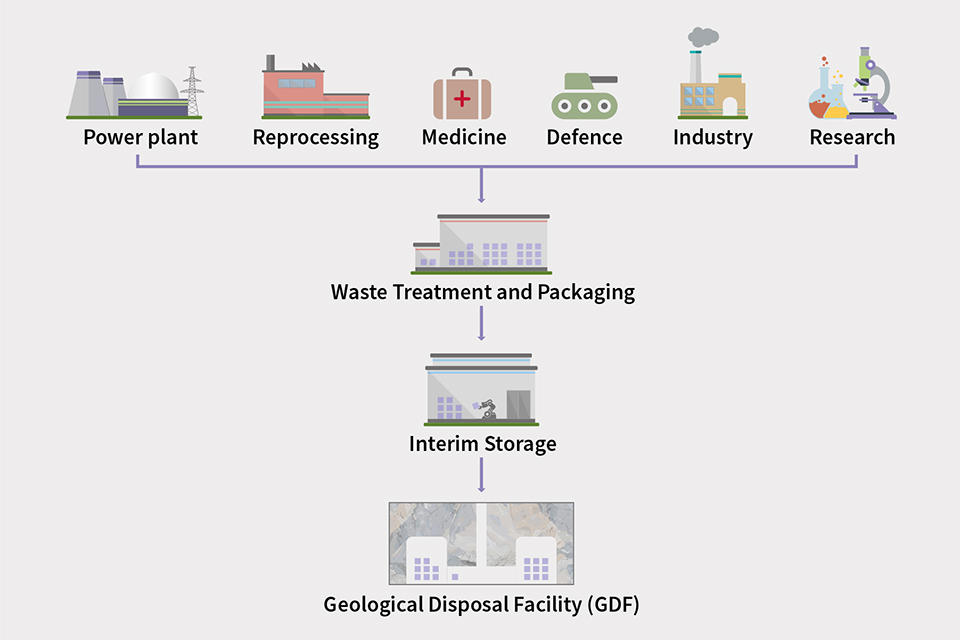
A diagram showing the sources of radioactive waste and the process for managing radioactive waste through treatment, packaging, interim storage and then permanent disposal in a GDF.
Source and management of radioactive waste

Science file

For further information about radioactive waste, read our science file
What is radioactive waste?
(PDF, 1.03MB, 4 pages)

What is radioactive waste?

About us

Radioactive Waste Management (RWM) is a public organisation responsible for delivering safe geological disposal in the UK. Find out more about RWM.

If you would like to receive email notification of updates to these pages, please sign up to our e-bulletin service
Go to geological disposal homepage


Detailed guide: Radioactive Waste Management (RWM) – about us

Radioactive Waste Management (RWM) is a public organisation established by government and responsible for planning and delivering geological disposal in the UK.

We collaborate with scientists around the world on multi-million pound research programmes, sharing the latest scientific advances and best practice. We also work with the producers of radioactive waste to find ways to package it that are suitable for disposal in a Geological Disposal Facility (GDF).

Our vision is to create a safer future by managing radioactive waste effectively, to protect people and the environment.

30 years of scientific research and development

The RWM team includes scientists and engineers with over 30 years’ experience in carrying out research and development to support geological disposal, supported by community engagement specialists.

Our organisation is a subsidiary of the Nuclear Decommissioning Authority (NDA), a public sector organisation tasked by the UK government with the safe and efficient clean-up of Britain’s civil nuclear legacy.

Independent scrutiny

Our work is regulated by the Office for Nuclear Regulation (ONR) and the following agencies:

It is also scrutinised by an independent body set up by the government, the Committee on Radioactive Waste Management, (CoRWM).

If you would like to receive email notification of updates to these pages, please sign up to our e-bulletin service
Go to geological disposal homepage

To better understand our mission and what we do, watch our company video below.

Road to Delivery


Detailed guide: Why underground?

There is international consensus that the safest permanent solution to manage higher activity radioactive waste is geological disposal, which involves putting the waste in a Geological Disposal Facility (GDF) beneath several hundred metres of solid rock.

This is already the chosen approach in countries including Canada, Finland, France, Sweden and Switzerland. Some of these countries are well on the way to developing their own GDFs.

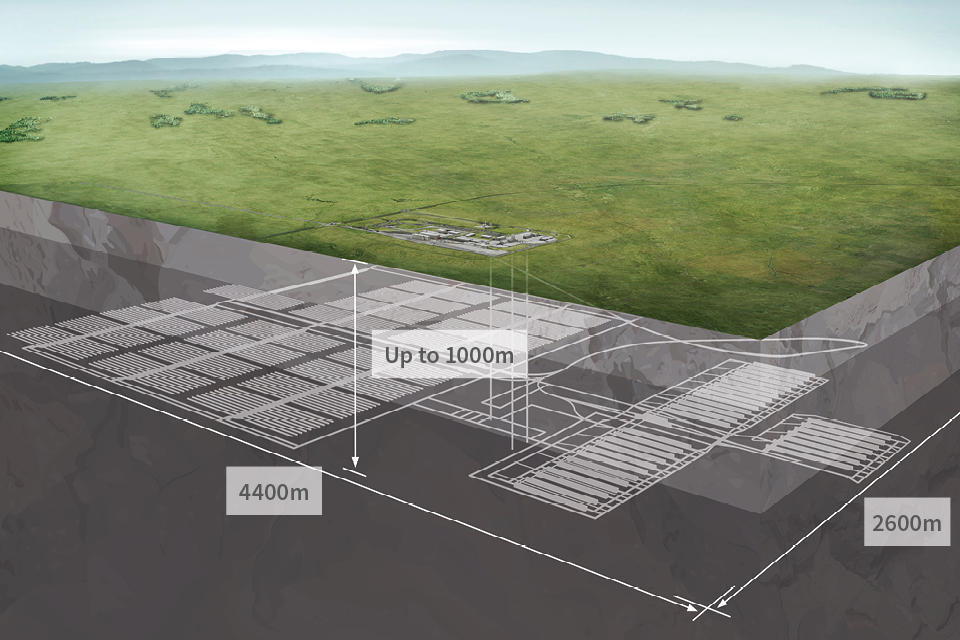
A diagram showing the depth and dimensions of a geological disposal facility (GDF): it will be up to 1000 metres under ground and the dimensions will be 2600 metres long by 4400 metres wide.
A Geological Disposal Facility (GDF)

How does geological disposal work?

Geological disposal is possible thanks to world-class engineering, science and technology. This involves:

  • isolating the radioactive waste in sealed vaults and tunnels deep underground, between 200 m and 1000 m below the surface
  • containing the radioactivity while it decays naturally over time
  • preventing radioactivity from ever reaching the surface in levels that could cause harm

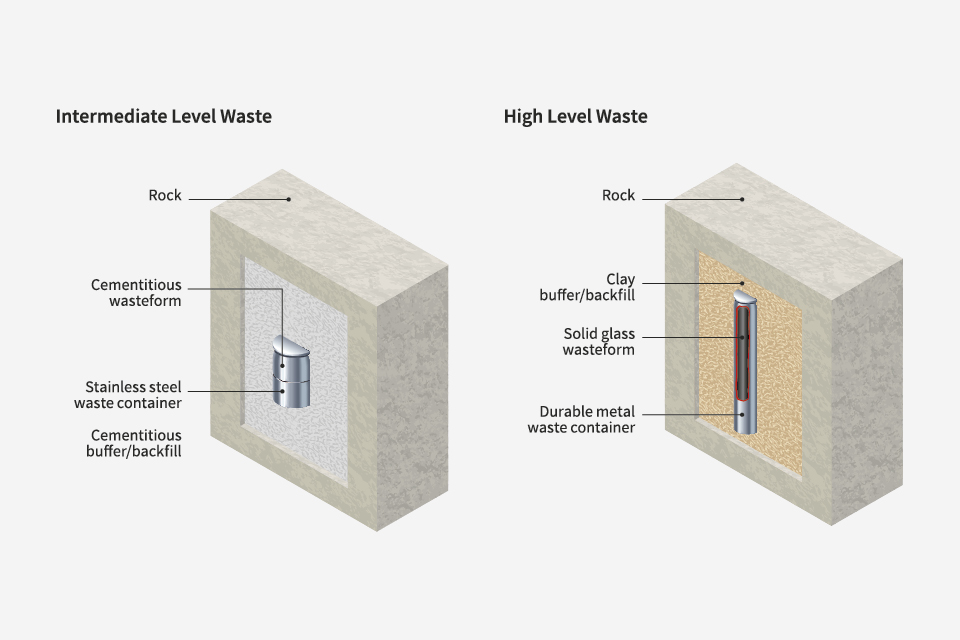
Solid radioactive waste is packaged in secure engineered containers, typically made of metal or concrete, and then placed in a stable rock formation hundreds of metres below the surface, with the containers surrounded by clay or cement. This is called the multi-barrier approach.

Diagrams illustrating the multi-barrier concept: a cementitious wasteform is encased within a stainless steel waste container within a cementitious buffer/backfill within rock.
The multi-barrier concept

In addition, a GDF:

  • requires no ongoing maintenance
  • is less vulnerable than surface storage to human activities such as terrorism or war
  • is less vulnerable than surface storage to natural processes such as climate change

Watch our video that shows how a GDF will be implemented.

Welcome to the future of geological disposal

After the waste has been placed into a GDF, deep underground and away from people and the environment, it will eventually be permanently sealed to provide safety without the need for further action.

The safest solution

Safety is our absolute priority. When constructing a Geological Disposal Facility we are working to keep the risk arising from the GDF directly above ground to a lower than one in a million chance of people developing health problems at any time in the future. (Source: Environment Agency’s Guidance on Requirements for Authorisation of Geological Disposal, 2009)

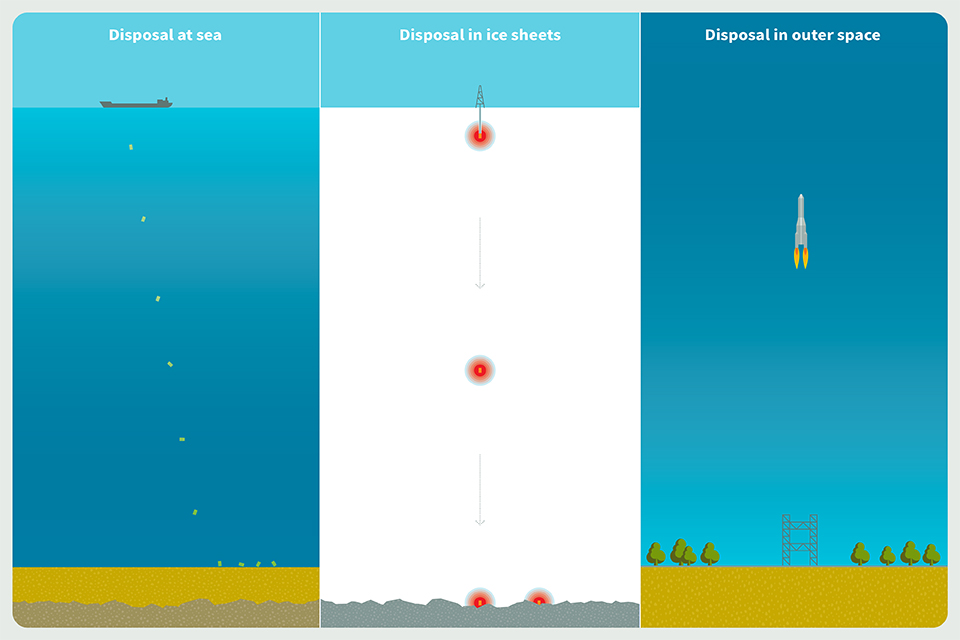
Alternatives to geological disposal have been carefully considered and we continue to keep options under review. At present, they are all either not technically achievable (for example: converting the waste to non-radioactive material), not environmentally safe (for example: disposal at sea or in ice sheets), or too dangerous to implement (for example: firing the waste into space on rockets).

Images to illustrate unsuitable disposal methods for radioactive waste: disposal at sea, disposal in ice sheets, disposal in outer space.
Unsuitable waste disposal methods

Next steps

We are looking for a suitable site to implement geological disposal safely, with a willing community who will work in partnership with us, as part of an agreed vision for the future.

Planning for geological disposal will take between 15 to 20 years. Independent regulators will ensure that all processes have been followed to their satisfaction. Only then can construction start.

If you would like to receive email notification of updates to these pages, please sign up to our e-bulletin service
Go to geological disposal homepage

Got a question?

If you have any questions our scientists and engineers are on hand to answer any technical queries you may have. Please email us at gdfenquiries@nda.gov.uk

To understand in more detail what will go into a GDF, what it will look like and what the multi-barrier approach is, please read more in the downloadable science files below.

The science files

What will go into a GDF?

This file may not be suitable for users of assistive technology.
Request an accessible format.

If you use assistive technology (such as a screen reader) and need a
version of this document in a more accessible format, please email rwmfeedback@nda.gov.uk.
Please tell us what format you need. It will help us if you say what assistive technology you use.

The multi-barrier approach

This file may not be suitable for users of assistive technology.
Request an accessible format.

If you use assistive technology (such as a screen reader) and need a
version of this document in a more accessible format, please email rwmfeedback@nda.gov.uk.
Please tell us what format you need. It will help us if you say what assistive technology you use.

What will a GDF look like?

This file may not be suitable for users of assistive technology.
Request an accessible format.

If you use assistive technology (such as a screen reader) and need a
version of this document in a more accessible format, please email rwmfeedback@nda.gov.uk.
Please tell us what format you need. It will help us if you say what assistive technology you use.


Detailed guide: Communities and GDF

Your voice matters

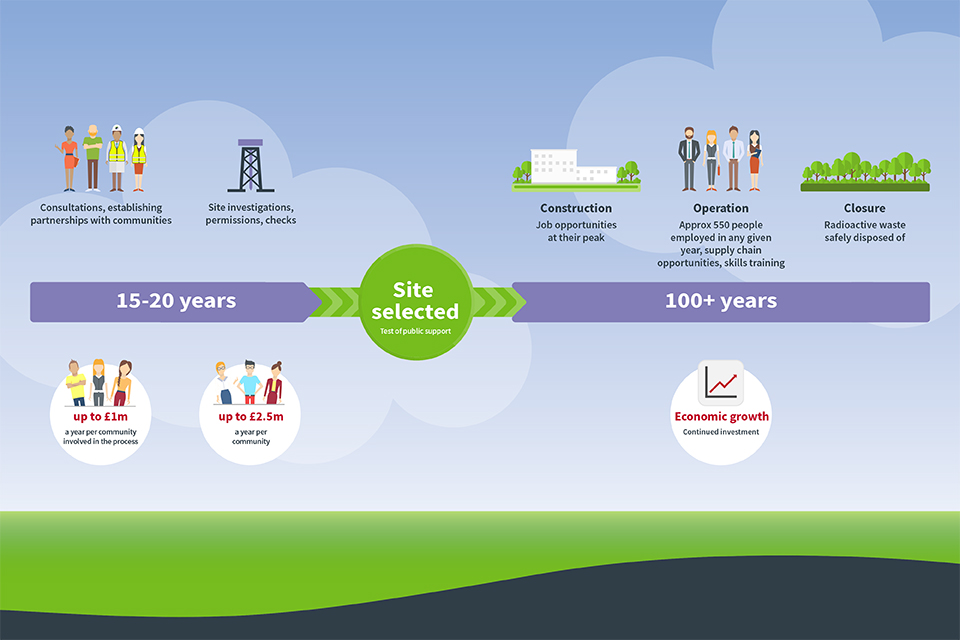
This year, we’ll be starting a process to find a site for a safe Geological Disposal Facility (GDF) for radioactive waste in the UK. Communities will be right at the heart of the siting process for a GDF and a facility will be built where both a suitable site AND a willing community are selected.

The process of finding a site will take between 15 to 20 years. Then, only following a positive test of public support and after the relevant permissions from the independent regulators have been obtained, can construction start.

This process is consent-based and communities will be able to work in partnership with us from the beginning, so that people will have the opportunity to create a future that works for them.

As our commitment to interested communities, we will:

  • cover the costs for communities engaged in the process
  • invest up to £1 million per year in communities who enter the siting process 
  • also, invest up to £2.5 million per year in communities where deep borehole investigations take place
  • support economic growth by employing an average of 550 people in any given year throughout the operational lifetime of the project, with skills training, supply chain opportunities and infrastructure investment
  • enable a long-lasting economic and social legacy for future generations
A timeline showing that it will be 15 to 20 years before a site is selected for a geological disposal facility, which will then be in operation for over 100 years.
The operational timeline of a Geological Disposal Facility (GDF)

The role of government

In 2014 the UK government and Northern Ireland Executive set out a renewed approach to finding a site to host a GDF in their Implementing Geological Disposal White Paper. In it, the UK government committed to help interested communities understand more about hosting a geological disposal facility and engaging with confidence in the processes involved.

Building on this commitment, the UK government is now consulting on proposed policy on how communities should be engaged in a siting process for a geological disposal facility for higher activity radioactive waste.

In 2015 the Welsh Government set out its Policy on the Management and Disposal of Higher Activity Radioactive Waste, similar to that adopted in England and Northern Ireland. The Welsh Government is now consulting on the proposed policy on how communities in Wales should be engaged in a siting process for a GDF.

Scottish policy is not for geological disposal. The Scottish Government published its Implementation Strategy for Scotland’s policy on higher activity radioactive waste following consultation in 2016.

Next steps

If you want to learn more about GDF and the role of communities in the siting process, please get in touch by emailing gdfenquiries@nda.gov.uk and one of our team will get back to you.

Following the government’s consultations and final policy statements, we will also be publishing ‘Guidance to Communities’, which will contain helpful and more in-depth information on how to engage in the siting process.

Go to geological disposal homepage


Detailed guide: About National Geological Screening (NGS)

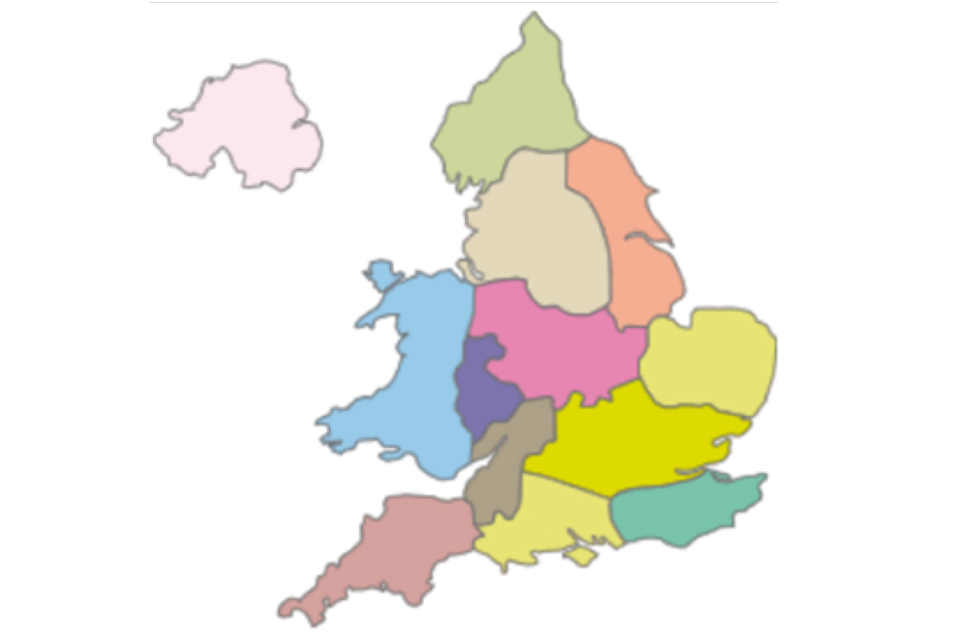
At Radioactive Waste Management (RWM) we are bringing together existing geological information across the whole of England, Wales and Northern Ireland. This will give you a picture of what’s under your feet, which is relevant to the long-term safety of a Geological Disposal Facility (GDF).
 
Our study has applied the National Geological Screening – Final Guidance which was published in April 2016 following expert independent review and public consultation.
 
The geological information will be made available for 13 British Geological Survey regions in an accessible format showing a high-level summary of each region’s potential to host a GDF. More detailed knowledge will be needed to identify locations that would definitely be suitable.

A map of the 13 regions across England, Wales and Northern Ireland that will have geological information made available.
The thirteen geological regions

This study will provide useful information for our conversations with any local community that shows an interest in our GDF programme.
 
If you have any questions, please get in touch by emailing gdfenquiries@nda.gov.uk and one of our team will get back to you.

If you would like to receive email notification of updates to these pages, please sign up to our e-bulletin service
Go to geological disposal homepage