What are the benefits of vaccination?
Vaccination is one of the greatest successes of public health. Before vaccines existed, many children would die young, or become crippled for life. In Europe, seasonal flu vaccination prevents around 2 million people from getting the flu each year. Worldwide, vaccination prevents 2.7 million people from contracting measles, 2 million from getting neonatal tetanus, and 1 million from getting pertussis (whooping cough) each year. Vaccination has also led to the eradication of smallpox, and the near elimination of polio.
Vaccines are a safe and effective way of protecting children and adults from serious illness and complications from vaccine-preventable diseases. They can prevent a disease from occurring in the first place, saving human suffering, and reducing healthcare costs. Vaccines protect not only you but others around you, provided that ‘herd immunity’ is reached. In the case of measles, diphtheria, tetanus and pertussis, a 95% coverage rate is required to protect the whole community.
Are vaccines safe?
Yes. Despite the myths that have led to doubts amongst a growing proportion of EU citizens, an extensive body of research has proven the effectiveness and safety of vaccines. Reports of a link between the Measles, Mumps, and Rubella (MMR) vaccine and autism, for example, were based on a now discredited study. The EU has very strict rules for the market authorisation of vaccines. On average, it takes 12 to 15 years, including extensive clinical studies, to develop a vaccine. Once on the market, the European Medicines Agency continues to supervise a vaccine’s safety, to detect, prevent and communicate any adverse effects.
Are vaccine-preventable diseases increasing in the EU?
Several EU and neighbouring countries are in the midst of unprecedented outbreaks of vaccine-preventable diseases, due to insufficient vaccination coverage. Between 2016 and 2017, cases of measles more than tripled in the EU, bringing the total in 2017 to 14,000 cases. In the past 2 years, over 50 people have died due to measles and 2 from diphtheria. Furthermore, although the EU is currently polio-free, with falling vaccination rates, we run the risk that the virus will reappear on European soil.
Seasonal flu vaccination coverage in older age groups has also decreased in the past few years in the majority of EU countries, and the European Centre for Disease Prevention and Control estimates that 40,000 people in Europe – many of whom are elderly, die prematurely from complications from seasonal flu every year.
What are the key drivers of falling vaccination coverage?
The first reason is vaccine hesitancy. Misconceptions about vaccination have shifted the public focus away from the benefits of vaccination, towards distrust in science and fear of possible side effects. While routine vaccination has led to a sharp reduction in vaccine-preventable diseases, it has also led to the severity of such diseases frequently being underestimated by citizens and healthcare workers alike.
A second challenge is the variation of vaccination policies and schedules between EU countries, which can be a particular obstacle to people who move between several EU countries during their lives. Variation in when vaccines are administered and the number of doses, for example, can cause confusion, and this can result in children not getting all the vaccines they need. Varying vaccine policies between countries can also lead to the perception that there are differences in opinion on the vaccines themselves.
Other factors that play a role in immunisation gaps include a lack of access to vaccines, vaccine shortages, challenges related to the research and development for new and existing vaccines, including unpredictable demand and insufficient motivation for industry to make the necessary investments in terms of financing and expertise, and constraints linked to public financing.
Why should we step up EU-level cooperation in this area?
Infectious diseases such as measles, diphtheria and influenza are not confined within national borders. One EU country’s immunisation weakness puts at risk the health and security of citizens across the EU. Given the cross-border nature of vaccine-preventable communicable diseases, and the common challenges faced by EU countries, there is a clear advantage to strengthening cooperation among all relevant sectors at EU level. Moreover, Member States themselves have requested intensified EU support, and stressed the need for common EU action and a more coordinated approach.
Why have you chosen a Council Recommendation as the instrument?
Given that the organisation of vaccination programmes is a national competence, the Commission is proposing that Member States agree on a set of joint measures, in the form of a Council Recommendation. The proposal for a Council Recommendation on vaccine preventable diseases, accompanied by a Commission Communication on the policy rationale of acting together in this area, gives Member States flexibility and takes into account their history, practices and particular cultural challenges. It is also the best instrument for achieving the desired results.
Who was consulted on the proposal and to what effect?
The Commission consulted stakeholders and citizens, and organised a series of targeted face-to-face meetings with professional healthcare organisations, health NGOs, student organisations and the industry. The most support was for:
- EU and national authorities’ support for healthcare professionals in advocating for vaccination and tackling hesitancy;
- scientific guidance and information from the EU and its agencies tailored to the specific circumstances of individual EU Member States;
- investment in R&D focusing on vaccine safety and effectiveness, with greater transparency and industry involvement.
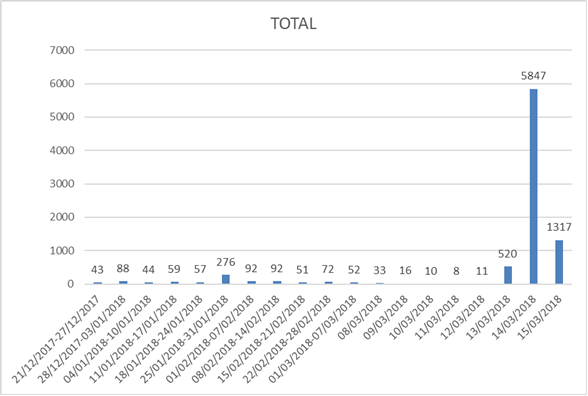
The online consultation revealed citizens’ lack of trust in the safety and effectiveness of vaccines as well as a lack of trust of public authorities and industry. For instance, 70% of the 8,688 citizens’ replies, most of which were from France and submitted to the 12-week consultation within the same 24-hour period, chose ‘no opinion’ for all questions and submitted anti-vaccination comments. These replies suggest that powerful influencers greatly contribute to the current vaccine hesitancy in the EU that the Commission initiative intends to tackle as a key priority.
Timescale and number of replies to online consultation
What are the next steps?
The Commission’s proposal will be discussed by the Council, with the aim of seeing it adopted before the end of 2018, with an immediate entry into force. Following this, every 3 years, the Commission will report on progress made in the implementation of the Recommendation. In addition the Commission will also produce a report on ‘The State of Confidence in Vaccines in the EU’, to monitor attitudes towards vaccination, in the context of the State of Health in the EU process.
For more information
https://ec.europa.eu/health/vaccination/overview_en
https://ecdc.europa.eu/en/immunisation-and-vaccines