Press release: Environment Agency begins work on £5million Isle of Wight Flood Scheme

On 1 March Environment Agency contractors are starting construction of a new £5 million flood scheme to better protect more than 300 properties in Ryde. In partnership with the Isle of Wight Council and the Southern Regional Flood and Coastal Committee, the completed scheme will significantly reduce flood risk in the area.

Environment Agency Manager John O’Flynn said:

We are delighted to be launching this multi-million pound scheme on the island, which includes over £1 million of partner contributions that will benefit so many local homes and businesses. A sensible approach to funding and a good relationship with our partners has allowed us to begin the work in early spring. We’ll now be able to minimise disruption to the beach in the summer, avoid environmental constraints (including overwintering birds) and deliver a completed scheme that will reduce the flood risk by the autumn.

Environment Minister Thérèse Coffey said:

We are investing £2.6 billion to better protect the country from flooding, including over 1,500 flood defence schemes which will better protect 300,000 homes by 2021. The Isle of Wight scheme is an important step in building our resilience, protecting more than 300 homes and businesses locally and giving people all important peace of mind.

Cabinet member for environment and heritage Councillor John Hobart, said:

Together with our partners, we are making great progress on flood prevention measures for Ryde and we are working alongside the Environment Agency and the Southern Regional Flood and Coastal Committee to reduce the risk of floods in the long term. We are excited to see this work beginning early spring to further strengthen flood measures for the residents of Ryde and surrounding habitat.

The first stage of the project is to build a new outfall pipe from the sea wall in front of the existing pump station across Ryde sands to the marina. This will mean a clear outfall is maintained allowing more water to be discharged to the sea in heavy rainfall events and a significant reduction in the frequency of river flows overtopping the bank and flooding land and properties in Ryde.

This work will result in the closure of the section of beach from the existing outfall to Ryde Marina. The Environment Agency expects these essential works to be completed in July 2018, allowing it to reopen for the summer holidays. Although the children’s play area next to the public toilets will be used as a works compound, it will be replaced at the end of the project.

The second and final stage is the construction of a flood wall around Simeon Street Recreation Ground, Marymead Close and the river boundary of the BT depot. These works are planned to start in June 2018 and be completed by October 2018.

Anyone who would like to find out more about the scheme or ask questions, is welcome to come along to the next Ryde Flood Action Group Meeting which will be held at the Simeon Arms on 13 March at 5:00pm. There will also be an open day later in the spring where the Environment Agency will present a detailed design of the flood wall that constitutes the second stage of the project.

NOTES TO EDITORS

The Monktonmead Brook drains a catchment of approximately 10km2 and flows north into the sea via an outfall at Ryde, Isle of Wight. A culvert carries flows the last 170m to the sea wall and a pumping station, after which a 60m long culvert (an underground pipe) carries water to an outfall on the beach. Flows usually drain through gravity. A tidal flap at the sea wall closes against high tides leading to tide locking. High water levels in the Brook trigger operation of the pumps, which lift water over the seawall and into the last 60m of outfall.

As a result of tidal processes, sand has accumulated on the beach surrounding the end of the outfall leading to its regular burial. This sand migrates up the culvert towards the sea wall restricting flow through the outfall. Despite an automatic increase in pumping, the restriction of flows causes water to back up in the Brook, leading to an increase in flood risk to Ryde.

All media enquiries: 0800 141 2743

Please ask for the duty press officer.


Hong Kong Customs seizes suspected cannabis buds (with photo)

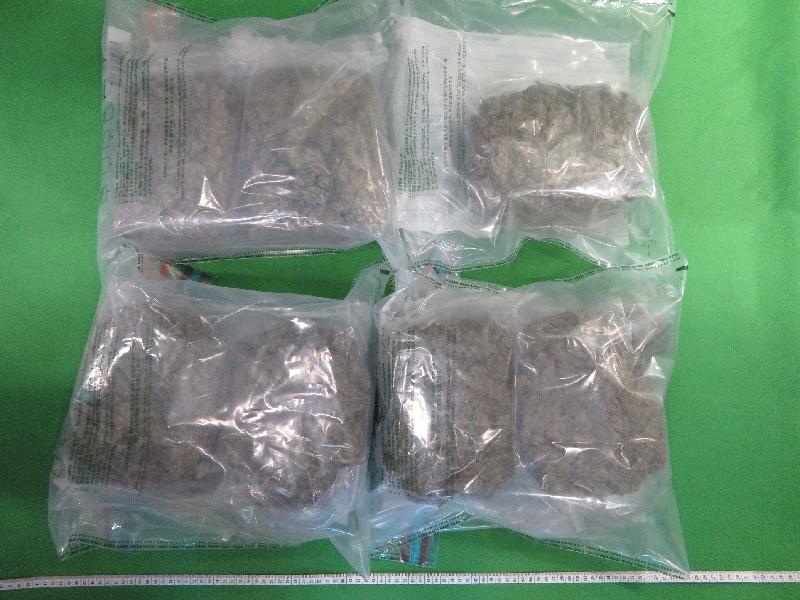
     Hong Kong Customs yesterday (February 28) and today (March 1) seized about 3.7 kilograms of suspected cannabis buds with an estimated market value of about $660,000 in total at Lok Ma Chau Spur Line Control Point.

     Customs officers intercepted a 47-year-old incoming male passenger at Lok Ma Chau Spur Line Control Point yesterday evening and found in his rucksack about 1kg of suspected cannabis buds concealed inside tea packets.

     After investigation, Customs officers further seized a small quantity of suspected methamphetamine and apparatus fit for inhaling dangerous drugs at the 47-year-old man’s residential premises in Yau Ma Tei.

     Also, Customs officers intercepted a 53-year-old incoming male passenger at Lok Ma Chau Spur Line Control Point this morning and found in his rucksack about 2.7kg of suspected cannabis buds concealed inside tea packets.

     The two men were arrested and investigations are ongoing.

     â€‹Under the Dangerous Drugs Ordinance, trafficking in a dangerous drug is a serious offence. The maximum penalty upon conviction is a fine of $5 million and life imprisonment.

Photo  


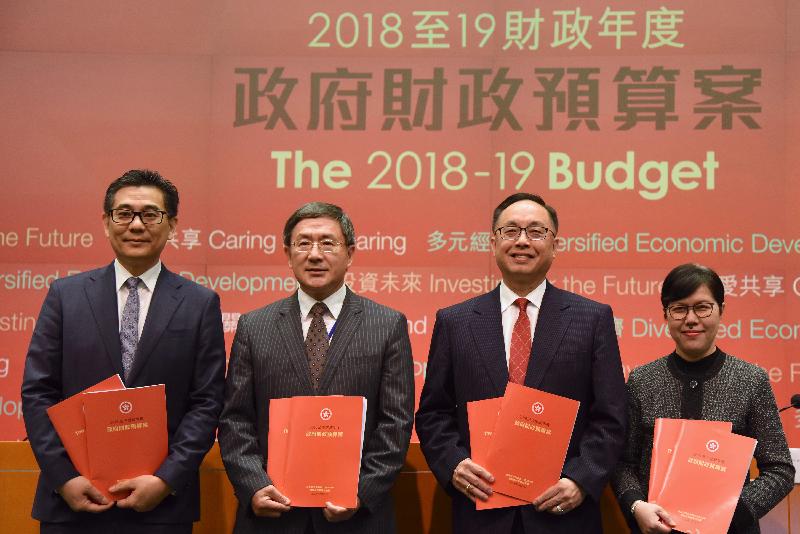
Opening remarks by S for IT at press conference on innovation and technology initiatives in 2018-19 Budget (with photo/video)

     Following are the opening remarks by the Secretary for Innovation and Technology, Mr Nicholas W Yang, at a press conference on innovation and technology (I&T) initiatives in the 2018-19 Budget today (March 1):
      
     Welcome to today’s press conference. I would like to make a brief introduction first, before opening the floor to questions.
      
     Since setting up the Innovation and Technology Bureau in November 2015, the Government has put in a huge amount of resources for I&T development. We have implemented measures to finance translational research and development (R&D) activities, promote re-industrialisation, support start-ups and nurture I&T talents, forge ahead with smart city development and promote the use of I&T to improve people’s livelihood. In the past two years, the progress of our I&T development is encouraging.
      
     In the 2018-19 Budget announced yesterday, the Financial Secretary unprecedentedly allocated more than $50 billion to further speed up the development of I&T in Hong Kong, through investing in infrastructure development, R&D collaboration, nurturing start-ups and promoting industries. I shall briefly introduce the relevant measures. 
      
     First, the Government will set aside $20 billion as the first tranche of funding for developing the Hong Kong-Shenzhen Innovation and Technology Park in the Lok Ma Chau Loop, which is a huge and long-term project to make Hong Kong an important I&T hub in the Bay Area. This provision will cover the site formation, infrastructure and superstructure works, as well as initial operation of the Park. 
      
     Secondly, we will inject $10 billion into the Innovation and Technology Fund to keep up our support for applied R&D work and I&T projects in Hong Kong. Of this, $500 million will serve to implement the Technology Talent Scheme announced in the Policy Address. To enable more start-ups and medium-sized enterprises to benefit from the Technology Voucher Programme, we will remove the requirement on having one year of substantive business operation in Hong Kong, and expand the programme to cover enterprises of all sizes.  
      
     Thirdly, $10 billion will be earmarked to support establishing two research clusters in the Hong Kong Science Park, one focusing on healthcare technologies and the other on artificial intelligence and robotics technologies. Hong Kong has clear advantages in these technologies, the applications of which would benefit the whole community. The two research clusters aim at attracting world class scientific research institutions and technology enterprises to Hong Kong, and to join forces with our local universities and scientific research institutions in conducting more midstream and downstream R&D projects, which will serve to nurture more technology talent in Hong Kong. We will provide financial support to non-profit-making scientific research institutions that will establish their presence in these two clusters.
      
     Fourthly, we will allocate $10 billion to the Hong Kong Science and Technology Parks Corporation for constructing research infrastructure and facilities, as well as enhancing support for its tenants and incubatees.
      
     Fifthly, $300 million will be allocated to Cyberport. Of this, $200 million will be used for enhancing support for start-ups and promoting the development of a digital technology ecosystem. Cyberport will boost its incubation programme and put forward new support measures to attract multinational companies to set up offices and R&D units in Hong Kong. The remaining $100 million will be spent to foster the development of e-sports industry. Cyberport will develop its arcade into a local e-sports and digital entertainment node and provide support for the e-sports industry.
      
     In his Budget speech, the Financial Secretary remarked that “I&T is undoubtedly an economic driver in the new era.” I&T can introduce new industries and create wealth, drive economic transformation, bring quality jobs for young people and improve people’s quality of life. In the Policy Address, the Chief Executive has already set forth eight major areas to map out a clear direction for I&T development. This Budget provides the timely, critical and significant resources for accelerating Hong Kong’s I&T development. In addition to its vital catalytic effect, the sizeable financial commitment demonstrates the Government’s commitment and determination in I&T development. 
      
     Fostering I&T development is the way forward for Hong Kong, impinging on the welfare of every citizen and our next generation. I call upon everyone to support Government’s efforts to promote I&T. Thank you very much.

Photo  


Keynote speech by President Donald Tusk at the BusinessEurope day

Thank you, Emma (Marcegaglia), for your reflections, for your determination and dedication, and of course, for inviting me to this 60th anniversary event; and thank you for our excellent cooperation in the framework of the Tripartite Summit, where the social partners will meet again this month. I want to, first and foremost, wish BusinessEurope a very happy birthday. Certainly from my own experience, I can tell you that this is when life really gets going, at 60. With the European economy expanding strongly, I can say with confidence that your best days are ahead.

I am here as your guest today, full of appreciation for your hard work. The confederation of European business and industry has, since the days of the Coal and Steel Community, been a consistently positive voice in Europe’s story, always good at balancing ambition and moderation. First as CIFE, then as UNICE, and now as BusinessEurope, a fraternity that stretches north and south, east and west — from the Italian Confindustria, to the German BDI, to the Confederation for British Industry and, of course, to the Polish Lewiatan, which I know well. Your service to Europe truly deserves acknowledgment and praise. And I extend it here without reservation.

But the main source of my respect for you is that — at the end of the day — businesses, both large and small, hold the key to the success of the European economy. You are on the front-lines of making Europe the workshop of a changing world economy. Politicians do not create jobs, generate wealth or adapt to technological revolutions; enterprises and employees do, working hard each day in a global market place that does not tolerate complacency or waste.

To support your efforts, it is our job as politicians to provide the right conditions, set the right incentives and maintain the independent institutions that are needed to underpin a prosperous economy. Has the European Union done a good job in this regard? I believe that we have, and would even say that our track record of the last years is something we can look at with satisfaction.

Let me just mention a few steps that we took. Three years ago, EU leaders created the European Fund for Strategic Investments to kick-start investment in Europe. We pushed forward an ambitious market opening agenda on trade, such as the CETA agreement with Canada, while at the same time protecting ourselves against unfair trade practices. We redoubled our efforts to fight youth unemployment. We took further steps towards a more sophisticated and complete internal market, progressing the capital markets union, the energy union, and the digital agenda. And last but not least, we agreed on the process that will decisively strengthen Economic and Monetary Union.

The economic statistics confirm that we are on the right track. The economy is now growing at its fastest pace in a decade, with robust growth expected to continue. And all EU countries share in this expansion: each and everyone of them are showing positive growth numbers. Fortunately, these good growth figures are also translating into a stronger labour market. Unemployment is declining fast, and the total number of people employed is at a record high.

However, it would be foolish to let a little good news obscure the unfinished business that we still have in economic policy. The effects of the past crisis are still visible, especially when it comes to youth unemployment. Leaders are due to have tough debates over the coming weeks that will incorporate our strategies for the single market and common policies on tax, trade, and research and innovation. My first priority is to complete our work on EMU, to make our monetary union stronger and more resistant to future economic shocks. Despite the current positive outlook, these will surely come, sooner or later.

In December, leaders agreed that it makes sense to prioritise completing the Banking Union and further developing the European Stability Mechanism. Politically, we are not as far away from a consensus on these matters as some imagine. Indeed, if not now, then when? And economically, this is the moment to remove a key vulnerability of EMU: the fiscal link between sovereigns and banks. A complete Banking Union and a more solid ESM will help break this link. Accordingly, I have asked the Finance Ministers in the Council to speed up their work on these topics, so that we are ready to take decisions on them in June. In the meantime, leaders will have another broader discussion in March on the long-term development of EMU, including on more ambitious proposals in the fiscal and economic dimension.

Last week, leaders began discussions on modernising the EU budget to better reflect our economic priorities, but also to take greater account of new political imperatives like security, defence, and stemming illegal migration. At our discussion last week, I was pleased to see that all the leaders approached this question with open minds, rather than red lines, and agreed that the EU will need to spend more on these new priorities, while not losing sight of traditional areas like agriculture and cohesion policy. Even though many leaders said that they are ready to contribute more to the post-2020 EU budget, it is clear that this will be a very difficult debate. But it is one which we must have anyway, if only because of the revenue gap of some €10 billion annually that will be caused by Brexit.

Brexit is indeed, as your programme puts it, the “one big question” that hangs over everything. Yesterday, Michel Barnier published a draft Withdrawal Agreement, which will be discussed by Member States in the coming days. But I am absolutely sure that all the essential elements of the draft will be accepted by all. I would like to underline here again that Mr Barnier has the full support of both the EU institutions and the EU27.

Recently, London has definitively confirmed its red lines, including “no customs union” and “no single market”. We acknowledge these red lines without enthusiasm and without satisfaction. But we must treat them seriously. With all their consequences. And one of the possible negative consequences of this kind of Brexit is a hard border on the island of Ireland. The EU wants to prevent this scenario. Hence, if no other solution is found, the proposal to “establish a common regulatory area comprising the Union and the United Kingdom in respect of Northern Ireland”. And, until now, no-one has come up with anything wiser than that. In a few hours I will be asking in London whether the UK government has a better idea, that would be as effective in preventing a hard border between Ireland and Northern Ireland.

Everyone must be aware that the UK red lines will also determine the shape of our future relationship. Next week I will present the draft guidelines in this respect. Here I want to stress one thing clearly. There can be no frictionless trade outside of the customs union and the Single Market. Friction is an inevitable side effect of Brexit. By nature. Thank you


News story: Defence Secretary names new warship HMS Cardiff on St David’s Day

The third to be named in the City Class of eight brand new, cutting-edge, anti-submarine warfare frigates, HMS Cardiff will provide advanced protection for the likes of the UK’s nuclear deterrent and Queen Elizabeth Class aircraft carriers, and offer an unrivalled anti-submarine warfare capability.

Defence Secretary Gavin Williamson said:

HMS Cardiff will be a terrific tribute to Wales and its capital city. She will bolster the United Kingdom’s defences across the seven seas – protecting our aircraft carriers and defending our waters from intensifying threats.

First Sea Lord Admiral Sir Philip Jones said:

It’s great to see the name HMS Cardiff returning to the Fleet as one of our new Type 26 Frigates, reflecting the Royal Navy’s long-standing bond with the city and the people of Wales. The name HMS Cardiff brings with it a proud history. A century ago the light cruiser HMS Cardiff famously led the German High Seas Fleet into internment at Scapa Flow at the end of the First World War. The last HMS Cardiff, a Type 42 destroyer, also distinguished herself on operations around the world, including the 1982 Falklands campaign, the 1991 Gulf War and service in the Adriatic during the 1999 crisis in Kosovo.

This next generation of frigates will encompass the very latest innovations and technological advances to deliver a world class anti-submarine warfare capability within a globally deployable and highly versatile platform. For years to come, as part of a Royal Navy carrier-led task group or working with our international partners, HMS Cardiff and her sister ships will be ready to deliver a wide spectrum of operations from diplomatic and humanitarian missions to high end warfighting, promoting and protecting Britain’s interests worldwide.

The naming was marked by an event at Mansion House in Cardiff this morning, led by students from the Welsh University Royal Naval Unit. The training establishment for a group of undergraduates from across the nation who show potential as future leaders of society.

Welcoming the news, Defence Minister Guto Bebb said:

As a proud Welshman, it is a great honour to herald another era of a warship with the name HMS Cardiff protecting the UK at home and abroad. These students have shown great passion for everything the Royal Navy stands for, and if they do go on to be captains of the future, they could be at the helm of a truly formidable, cutting-edge warship in HMS Cardiff.

The new HMS Cardiff is set to enter service in the 2020s and, along with her fellow Type 26 frigates, will deliver high-end warfighting wherever it is needed, whilst protecting the UK’s interests as well as Britain’s nuclear submarines. Its flexible design will also enable these capabilities to be adapted to counter future threats, and the ships will benefit from the latest advances in digital technology.

She will be the fourth ship to be named in honour of the Welsh capital city, and the announcement comes 100 years after the first HMS Cardiff led the surrendered German High Seas Fleet into Scapa Flow at the end of the First World War.

The St. David’s Day announcement is a further example of Defence’s commitment to Wales, where the MOD has today announced it spends £300 for every member of the population, £20 more per person than last year. The work being done in Wales includes the UK’s biggest single order for an armoured vehicle in 30 years: the £4.5bn Ajax vehicles being built at General Dynamics’ Merthyr Tydfil factory.

Also, this years’ Armed Forces Day will be held in Wales, on the 30 June in the historic North Wales seaside town of Llandudno. The event, which will also mark Armed Forces Day’s tenth birthday, will celebrate the work of our servicemen and women with a spectacular military parade, fly pasts and impressive displays of equipment.

North Wales has many current and historic links to the Armed Forces, including many Regular and Reserve Army units. Many North Walians are proud to serve in the Royal Welsh and nearby RAF Valley on Anglesey is home to a fast jet training base. Nearly 10,000 veterans live in Conwy, supported by a number of local and national charities.

The announcement also comes as BAE Systems have awarded Lockheed Martin a contract to equip the Type 26 with the only system of its kind capable of launching anti-air, anti-submarine, surface-to-surface and strike-length missiles. Three MK 41 Vertical Launching Systems will be fitted on each ship. The Royal Navy has ordered an initial nine modules for the first three ships, including HMS Cardiff.

A number of close allies, including Australia and Canada, are also considering the state-of-the-art Type 26 design. HMS Sutherland is currently in Australia demonstrating the UK’s world-class anti-submarine capability.

The Royal Navy’s Type 26 frigates are being built at the Clyde shipyards in Scotland. The MOD announced an unprecedented 20 years of work there in 2017, safeguarding over 4,000 jobs, with the £3.7bn contract for the first three of eight submarine hunting Type 26 frigates to be built there. Two other ships in the class have already been named HMS Glasgow and HMS Belfast. HMS Cardiff is the third ship to be named and will be the second to enter production.

Secretary of State for Wales Alun Cairns said:

This is a very proud moment not only for the Royal Navy but for the whole of Wales.

Wales has a strong military footprint, and this announcement is a celebration of the contribution our nation makes to the defence of the UK.

I’m proud to see the name of our capital city on a Royal Navy warship that will take to international waters to defend our national security and protect our servicemen and women around the world.