Every day, 20 billion emails and 150 million social media posts are written, and 650 million online searches are carried out in the EU. These statistics show how much the internet has transformed our lives. Yet not everything has kept pace: global corporate tax rules are over one hundred years old and are out of step with the boom in the digital economy. They were designed for ‘brick-and-mortar’ businesses, meaning that a company should be physically present in a country to be taxed there. Companies that do business and generate value online are now growing far quicker than the economy at large, yet today’s rules cannot effectively tax profits generated largely from consumer data.
The EU has embraced the development of the digital economy, which is making a great contribution to economic growth. But this has also created a major fiscal distortion: the effective tax rate for digital companies – such as social media companies, collaborative platforms and online content providers – is around half that of traditional companies – and often much less.On average, digitalised businesses face an effective tax rate of only 9.5%, compared to 23.2% for traditional business models.
At the same time, EU Member States are under increased political pressure to ensure that all businesses – both digital and traditional – pay their fair share of tax. There is a real risk to Member State tax revenues if profits made by digital companies cannot be taxed. Last September, EU finance ministers called for a common EU solution to tackle the challenges of digital taxation, a call echoed by EU leaders in October 2017. The European Parliament has also demanded quick and ambitious action on digital taxation.
EU citizens and business are also calling for Member States and the Commission to take action to improve the fairness of tax systems. Nearly three-quarters (74%) of citizens want EU action to fight against tax avoidance. In a recent public consultation, three quarters of respondents agreed that current international taxation rules allow companies with digital business models to benefit from certain favourable tax regimes and push down their tax contributions. Some 82% believed that something should be done.
The taxation of the digital economy is a key part of the Commission’s fair taxation agenda with President Juncker noting the need for digital companies to pay their fair share of taxes in his 2017 State of the Union speech. In its Communication last September, the Commission committed to examining the options for digital taxation with a view to developing a common EU approach.
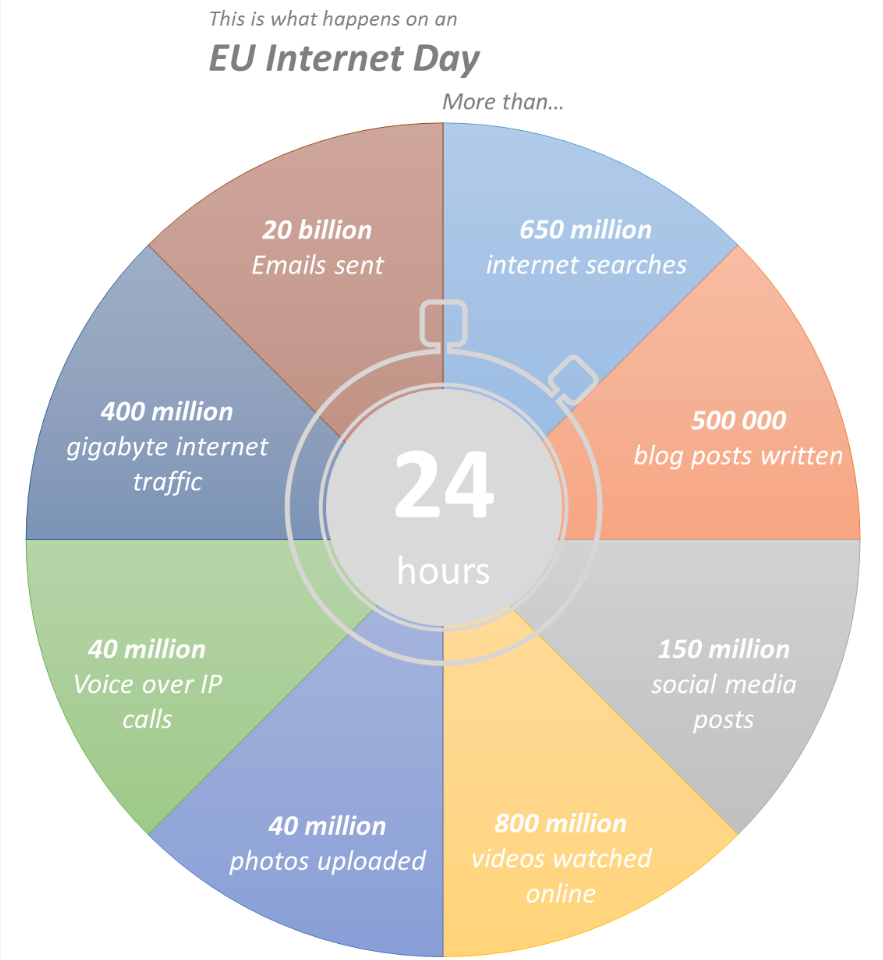
(Source: Commission services based on InternetLiveStats.com)
Today’s package complements the extensive work already done at EU level in recent years to ensure fair, effective and growth-friendly corporate taxation in the Single Market. It supports the Commission’s key priority of completing the Digital Single Market. The EU proposals for taxing the digital economy should also provide inspiration and create momentum for the ongoing international work on digital taxation, steered by the G20 and OECD. At the same time, the solution at EU level must also take into account the global dimension: the OECD has committed to bring forward a report on the next steps internationally by 2020. By being a first adopter of digital tax solutions, the EU can be at the forefront in shaping the global response.
What are the main problems?
Today’s international corporate tax rules are not fit for the realities of the modern global economy and do not capture business models that can make profit from digital services in a country without being physically present. Current tax rules also fail to recognise the new ways in which profits are created in the digital world, in particular the role that users play in generating value for digital companies. As a result, there is a disconnect – or ‘mismatch’ – between where value is created and where taxes are paid.
Given the rapid pace at which the digital economy is growing, this situation poses several risks that should be tackled urgently:
– The system is unfair and there’s no level playing field as traditional companies tend to carry a heavier tax burden than digital ones. Today’s tax systems give an advantage to digital business models for a variety of reasons. In some cases this is intentional, for example to foster digitalisation and R&D activities. But in other cases, mismatches and loopholes between different national systems, combined with the mobile and ‘virtual’ nature of digital businesses, reduce the tax burden much more than expected. It is quite common for digital companies to have tax levels close to zero in countries where they have a significant market share.
– Member States’ tax revenues are at risk if they cannot tax profits from digital activities. EU countries are under increasing pressure to take action to tax the digital economy, in order to safeguard public finances that pay for schools, hospitals and transport and ensure a level playing field. Several EU countries are already taking unilateral action, creating inconsistencies and loopholes in the Single Market and making it a legal minefield for companies.
– Digital companies need a stable, competitive environment to thrive. The EU needs modern, fair and growth-friendly tax rules to support the growth of the Digital Single Market. Above all else, companies need a stable, predictable environment and one set of rules across the EU to do business.
What are you proposing?
Today’s package consists of:
– A common EU solution for the taxation of the digital economy in the EU, enabling Member States to tax profits made in their territory, even if a company does not have a physical presence there. The new rules would ensure that online businesses contribute to public finances at the same level as traditional ‘brick-and-mortar’ companies. This proposal is accompanied by a Recommendation to Member States to amend their Double Taxation Treaties with third countries so that the same rules apply to EU and non-EU companies. The Commission has offered to assist Member States with exploratory talks on implementing the digital corporate tax update at international level.
– A new interim tax for digital services, which would apply to the most urgent gaps and loopholes in the taxation of digital activities. The measure ensures that those activities which are not currently effectively taxed would begin to generate immediate revenues for Member States.
Why is the taxation of the digital economy such an urgent global issue?
Digital companies are growing far faster than the economy at large, and this trend is set to continue. In 2006, only one digital company was in the top 20 firms by market capitalisation, whereas by 2017 this had risen to 9 digital companies. The challenge is to make the most of these digital opportunities to ensure Europe’s competitiveness, while ensuring fair taxation. Profits should be taxed where the value is created. However, how the value is created has evolved with new business models while the rules for taxing profits have remained the same. This makes it very difficult to tax profits where the value is created from digital activities.
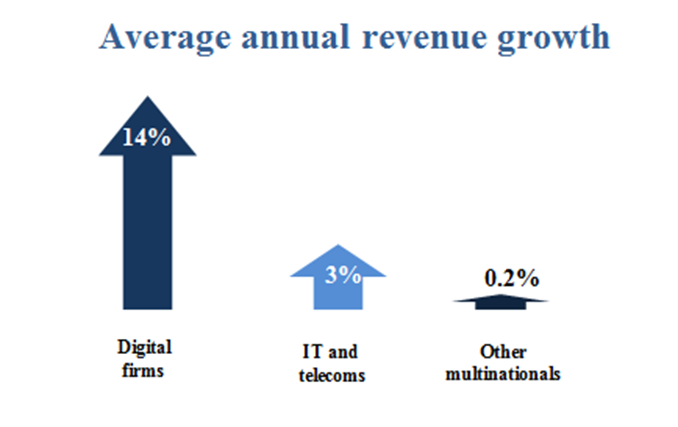
Value Creation in the Digital Economy
In the digital economy, value is often created from a combination of algorithms, user data, sales functions and knowledge. For example, a user contributes to value creation by sharing his/her preferences (e.g. liking a page) on a social media forum. This data will later be used and monetised for targeted advertising. The profits are not necessarily taxed in the country of the user (and viewer of the advert), but rather in the country where the advertising algorithms has been developed, for example. This means that the user contribution to the profits is not taken into account when the company is taxed.
How does this fit in with international work?
The EU wants to create momentum behind the ongoing international work on digital taxation. In its Communication last September, the Commission stressed that the ideal solution to taxing the digital economy would be at global level. Member States agreed with this in their discussions and conclusions on digital taxation last year. The EU has been actively supporting the OECD’s work on this issue, and is keen to see ambitious and effective solutions implemented internationally. The OECD’s report to the G20 in April will be an important step in that direction.
But progress at international level on digital taxation is challenging. The EU cannot afford to delay any longer, given the growing number of problems related to digital taxation. In line with calls of EU leaders, the Commission has proposed EU solutions for the fair and effective taxation of the digital economy.
In developing these proposals, the Commission was in close and regular contact with the OECD, G20 and other international partners, to keep the EU and global approach as aligned as possible. The EU proposal should feed the international debate and help push our global partners into action by providing a clear example of how the principles under discussion at international level can be transformed into a modern, fair and efficient corporate taxation framework adapted to the digital era.
The Commission has taken into account the parameters agreed at global level, as well as existing Member State practices in designing the interim solution.
Will consumers have to bear the cost of new tax measures for the digital economy?
There is no reason why this should happen, provided that companies behave responsibly towards their customers. The Commission’s goal is to ensure that all companies contribute their fair share to public revenue. This aim is to secure a level playing field between different types of companies, which is important for fair competition. Pushing out competitors by offering low prices that are compensated through tax dumping is not a sustainable situation for companies.
Are these proposals compatible with the EU’s Digital Single Market?
Yes. By proposing a fair and effective EU solution to digital taxation, the Commission aims to improve certainty, stability and ease of business for companies in the Digital Single Market. A common EU approach will prevent a patchwork of uncoordinated national measures from creating new barriers for companies and distorting competition in the Digital Single Market.It will ensure a level playing field in the Single Market so that all companies – large or small, more or less digitalised – pay their fair share of tax. However, today’s proposals will also ensure that digital start-up and scale-up companies are not unduly burdened. The proposed thresholds will ensure that only the largest businesses that have a significant digital presence or make large amounts of revenue in EU Member States will come under the scope of the new rules.
Fair and effective taxation is essential to support the Digital Single Market. It cannot reach its full potential if young and innovative companies are held back by antiquated tax rules. The Digital Single Market could contribute €415 billion to the European economy, boosting jobs, growth, competition, investment and innovation. The value of the data economy in the EU will increase to €739 billion by 2020, representing 4% of overall EU GDP. With digitalisation, cross-border opportunities for even the smallest companies will increase.
Do the new proposals discriminate against non-EU digital companies?
The new rules do not target or ring-fence any individual companies, sector or nationality. The common structural approach covers all companies, both EU and non-EU that have a significant digital presence in the Union. Any EU company or non-EU company located in a country where there is no applicable double tax treaty, with a significant digital presence in a Member State will be subject to taxation on its digital activities. Similarly, the interim tax is designed in a way that it includes both EU and non-EU companies. Our goal is to ensure a level-playing field for all businesses operating in the EU, large or small, more or less digitalised.
A COMMON EU SOLUTION FOR TAXING THE DIGITAL ECONOMY
What are the key elements of the common EU solution to taxing the digital economy, proposed by the Commission?
Under the proposed new rules, Member States will be able to tax profits that are generated in their territory, even if these companies do not have a physical presence there. A company will be considered to have a significant digital presence in a Member State if it fills one of the following criteria:
– It exceeds a threshold of €7 million in annual revenues from digital services in a Member State
– It has more than 100,000 users who access its digital services in a Member State in a taxable year
– Over 3000 business contracts for digital services are created between the company and business users in a taxable year.
This reform addresses two of the main problems that Member States encounter when it comes to taxing digital activities:
- First, it will no longer be necessary for a company to be physically present in a Member State in order for it to be taxed. A significant digital presence will allow Member States to tax profits generated in their territory.
- Second, factors such as user data will now be taken into account in the allocation of profits, since they play an increasingly important role in companies’ value creation. Today’s proposal changes the system for allocating taxable profits, to better reflect the different ways in which digital companies create value.
What does the Commission propose on allocating digital profits and how is this different from today’s rules and the CCCTB?
The proposed rules lay down the general principles for allocating profits to a significant digital presence. These build on the current corporate tax rules which look at the risks managed, the functions performed and the assets used by a permanent establishment and the criteria for allocating profits. Today’s proposal also includes additional tests in the profit allocation process to reflect the fact that a significant part of a digital business’ value is created where users are based and data is collected. This means that the market value of user data or of digital services could be taken into account when allocating profits to tax in the future.
While this broad reform of the current corporate tax rules is a standalone Directive, which would operate independent of other tax frameworks, the measure could eventually be integrated into the scope of the Common Consolidated Corporate Tax Base (CCCTB). The proposed CCCTB is considered the optimal solution to create fairer and more efficient taxation in the EU. It provides a solid EU framework for revised permanent establishment rules. Adapting the CCCTB in line with today’s proposed new rules would ensure that it effectively captures the digital activities of multinational companies too. The Commission stands ready to work with Member States and the European Parliament to make this happen. The Parliament’s reports on the CCCTB are a good basis for further work.
Why has the Commission recommended that Member States adapt their Double Tax Treaties with non-EU countries in line with today’s proposal?
This broad reform of the EU’s corporate tax system would supersede double taxation treaties between Member States. The proposed new rules will also apply if a Member State does not have a double taxation treaty with a third country.
However, when Member States have double tax treaties with third countries, the proposed new rules will not apply. This means that, unless the tax treaties are adapted, the new provisions will not apply in situations where a business with EU users is tax resident outside the EU. This could disrupt the level playing field between EU and non-EU businesses. Tax treaties are an area of national sovereignty, which is why the Commission has issued a Recommendation to Member States to take the necessary measures. The Recommendation states that Member States should make the following changes to their Double Tax Treaties:
- change the definition of a ‘permanent establishment’ to take into account situations where a company has a significant digital presence in given country/jurisdiction.
- include rules for how profits should be attributed to a significant digital presence, in line with the provisions proposed by the Commission.
The Commission also stands ready to help Member States identify the key third countries to prioritise in their negotiations to implement this solution at international level. This may help to ensure a smooth and consistent approach by all Member States.
Double Tax Treaties
Different countries have their own tax laws. If you are resident in one country and have income and gains from another, you may have to pay tax on the same income in both countries. This is known as ‘double taxation’. To avoid companies from being taxed twice on the same income, the allocation of taxing rights between two countries is laid down in bilateral double tax treaties. These treaties lay down the rules of ‘where to tax’, i.e. what triggers a right to tax in a country, and ‘how much to tax’, i.e. how much of corporate income is allocated to a country.
Why has the Commission proposed an interim tax?
THE INTERIM SOLUTION
The interim tax would target the most urgent gaps and loopholes in the taxation of digital activities. The measure ensures that those activities which are not currently effectively taxed would begin to generate immediate revenues for Member States. The aim is to ensure a level playing for all businesses, whether EU or non-EU based, large or small, more or less digitalised.
Today’s proposal for an interim digital tax will discourage Member States from seeking their own divergent solutions to the challenges they face which would create a patchwork of national solutions, risking the fragmentation of the Single Market. A significant number of Member States have already started to take such measures.
If agreed first, this measure would only apply until Member States have agreed and implemented the more forward-looking proposed reforms to their corporate tax systems.
How will the tax work?
The interim tax will apply to two main types of digital services, which would not be able to exist in their current form without user involvement. The common feature of such services is that they are heavily reliant on the exploitation of user participation or data obtained from users as a way to generate revenues.
- Firstly, it will cover services where the main value is created by user data, either through advertising or by the sale of the data collected by companies such as social media or search engines.
- Secondly, it will cover services of supplying digital platforms that facilitate interaction between users, who can then exchange goods and services via the platform (such as peer-to-peer sales apps).
The proposal for an interim tax focuses on activities with the biggest gap between the value created and Member States’ ability to tax them – essentially where user participation and user contribution plays a central role in value creation. The tax will be collected by the Member States where the users are located. A number of countries already have a similar tax in place, including Israel, India and some US states.
This interim measure ensures that those activities which are currently not effectively taxed would begin to generate immediate revenues for Member States. Revenues would be collected by the Member States where the users are located, and will only apply to companies with total annual worldwide revenues of €750 million and annual EU revenues of €50 million. The first threshold will limit the tax to companies of a certain scale and ensure legal certainty for companies and tax authorities in determining who is liable for tax. At the same time, it will help to ensure that smaller start-ups and scale-up businesses remain unburdened. The second threshold will ensure that the tax only applies to companies with a significant digital footprint in the EU.
An estimated €5 billion in revenues a year could be generated for Member States if the tax is applied at a rate of 3%. This single rate, once applied throughout the EU would help to avoid “tax shopping” and distortions in the Single Market. The proposed rate of 3% was chosen after a careful analysis of many different factors and impacts, including the tax burdens of businesses with different margins.
This tax will apply only as an interim measure, until the updated corporate tax rules to underpin the digital economy have been implemented.
How exactly will Member States know when the tax is due and how will they collect it?
As with all other taxes, the interim tax is based on a system of self-declaration by taxpayers. Member States will be able to carry out tax audits to check that taxpayers are fulfilling their obligations (as they do in the traditional economy). A digital portal, known as the One-Stop-Shop, system will be set up to help companies comply. As part of that system, one Member State will be responsible for identifying the taxpayer, collecting the tax and allocating it to other Member States as appropriate.
Is there a risk of double taxation and new administrative burdens with the interim tax?
The retained approach does not breach any double tax treaties with third countries or WTO rules. It remains fully grounded on the most basic principle of corporate taxation – namely, that profits should be taxed where value is created. Moreover, the Commission has included measures in the proposal to mitigate the risk of double taxation. Companies will be able to deduct the tax as a cost from their corporate tax base, alleviating the risk of being taxed twice on the same income. At the same time, simply by introducing this coordinated EU tax, the Commission is averting the risk of new burdens for business due to interim unilateral measures in individual countries.
Furthermore, the tax proposed today has a relatively simple structure and additional compliance costs will be quite limited. The tax will also only apply to businesses that exceed the thresholds of revenues for specific activities, so SMEs will not be affected. The online One Stop Shop system should also help businesses that have to pay the tax in more than one Member State.
When will the interim tax be wound down? How will the transition be handled?
The tax is intended as a temporary solution to help Member States claw back some revenues and to address the immediate risks to EU competitiveness, while the common EU solution is being discussed, developed and implemented by Member States.
The more holistic solution will give Member States the right to tax digital activities vianew corporate taxation rules and will also capture the concept of ‘user value creation’ – to which the interim tax applies. Therefore, there will be no need for it to remain in place once the final, permanent tax rules for the digital economy have been implemented.