Guidelines on stress tests scenarios under Article 28 of the MMF Regulation
Company fined after workers develop Hand Arm Vibration Syndrome (HAVS)
Design and Supply Limited has today been fined after a worker was exposed to Hand Arm Vibration Syndrome (HAVS).
Merthyr Tydfil Magistrates’ Court heard how an employee of the company was exposed to vibration from the use of handheld pneumatic buffing and sanding tools over a period of 15 years causing him to develop HAVS.
An investigation by the Health and Safety Executive (HSE) found the company failed to implement a safe system of work in order to control the risk of exposure to vibration. The company had not carried out a suitable risk assessment of work activities from the use of the power tools resulting in poor control measures. The company had not provided adequate information, instruction and training for employees or supervisors which resulted in inadequate control measures when working and a lack of adequate supervision. The court heard employees were exposed to vibration levels that had not been reduced to as low as was reasonably practicable thereby increasing their risk of developing HAVS. The investigation also found the company had did not have a suitable health surveillance system in place which is vital to identify symptoms at an early stage.
Hand Arm Vibration Syndrome (HAVS) is a serious condition caused by regular and frequent exposure to hand arm vibration. Regular and frequent exposure can lead to permanent health effects. HAVS can result in tingling, numbness, pain and loss of strength in the hands causing distress and sleep disturbance, affecting the ability to do work safely.
Design and Supply Limited of Pant Industrial Estate, Merthyr Tydfil, pleaded guilty to breaching Section 2(1) of the Health and Safety at Work Act 1974, and has been fined £50,000 and ordered to pay costs of £1,881.70.
Speaking after the hearing, HSE inspector Lee Jones said, “This was a case of the company completely failing to understand the importance of assessing the risk to their employees from exposure to vibration and therefore putting in place the correct control measures.
“If they had understood why health surveillance was necessary, it would have ensured that it had the right systems in place to monitor worker’s health and the employee’s condition would have not have been allowed to develop to a severe and life altering stage.”
Notes to Editors:
- The Health and Safety Executive (HSE) is Britain’s national regulator for workplace health and safety. We prevent work-related death, injury and ill health through regulatory actions that range from influencing behaviours across whole industry sectors through to targeted interventions on individual businesses. These activities are supported by globally recognised scientific expertise. hse.gov.uk
- More about the legislation referred to in this case can be found at: legislation.gov.uk/
- HSE news releases are available at http://press.hse.gov.uk
Journalists should approach HSE press office with any queries on regional press releases.
Worker sentenced for unregistered gas work
Mr Cody Stevens, an unregistered gas fitter operating as a director of Master Plumbing Contractors Limited, has today been sentenced for carrying out gas work without being registered with Gas Safe Register.
Milton Keynes Magistrates’ Court heard how Mr Stevens undertook gas work in two properties in Milton Keynes between 2015 and 2016 when he was served with a prohibition notice on 9 February 2016. At the time, Mr Stevens was also reported to Gas Safe Register for the poor quality of the work.
An investigation by the Health and Safety Executive (HSE) found that Mr Stevens was not Gas Safe registered at the time he conducted this work. The gas work carried out at one of the properties was inspected by a Gas Safe inspector who found it to be ’at risk’ meaning that the appliance, if operated, may have been a potential danger to life or property.
Mr Stevens of Reynolds Place, Grange Farm, Milton Keynes, pleaded guilty to breaching Regulation 3(7), Regulation 26 (1), and two charges under Regulation 3(3) of the Gas Safety (Installation and Use) Regulations 1998. He also admitted a breach under Section 33(1)(g) of the Health and Safety at Work Act 1974. Mr Stevens was sentenced to a 12-month custodial sentence.
Speaking after the hearing, HSE inspector Andrew McGill said: “Mr Stevens undertook gas work which he knew he was not registered to do. He also ignored enforcement action taken by HSE against him.
“HSE will not hesitate to take appropriate action against rogue gas fitters who disregard the law and place lives at risk. Working with gas appliances is difficult, specialised and potentially very dangerous, so it is vital that this is only undertaken by trained and competent engineers who are registered with Gas Safe.”
Further information about gas safety can be found at http://www.hse.gov.uk/gas
Notes to editors:
- The Health and Safety Executive (HSE) is Britain’s national regulator for workplace health and safety. We prevent work-related death, injury and ill health through regulatory actions that range from influencing behaviours across whole industry sectors through to targeted interventions on individual businesses. These activities are supported by globally recognised scientific expertise. hse.gov.uk
- More about the legislation referred to in this case can be found at: legislation.gov.uk/
- HSE news releases are available at http://press.hse.gov.uk
Journalists should approach HSE press office with any queries on regional press releases.
Press release: North East man fined for running illegal scrapyard
A man has been fined for running an illegal scrapyard in Teesside.
Anthony Hanley, 34, of Marton Burn Road in Middlesbrough, appeared at Teesside Magistrates’ Court on Tuesday 20 March where he pleaded guilty to two charges of operating a scrapyard without a permit.
He was fined £800, ordered to pay costs of £4,000 and a victim surcharge of £80.
Prosecuting on behalf of the Environment Agency, Simon Crowder told the court that Hanley is the owner of Cliffs Autos which deals with end of life vehicles.
To take end of life scrap vehicles on to a site, the operators need an environmental permit for disposal of vehicle waste to ensure no risk to the environment by preventing fluids from going into the ground or into drainage systems.
Illegal site
On 25 August 2016 Environment Agency officers attended the illegal site at King George Terrace in Middlesbrough where they saw a sign offering to buy vehicles ‘dead or alive’, leading them to believe Hanley wanted to buy scrap vehicles.
Officers noticed there was in excess of 30 end of life vehicles stored at the premises. The defendant was co-operative with officers and was told to clear the site within 28 days.
On 12 September the same year, officers returned to the site and saw the number of vehicles had now reduced, and a further visit in December saw the site had been cleared.
But on 7 April 2017, the two Environment Agency officers returned to the site to see it had resumed operation again, with in excess of 30 end of life vehicles present, with some leaking fluids on to the ground.
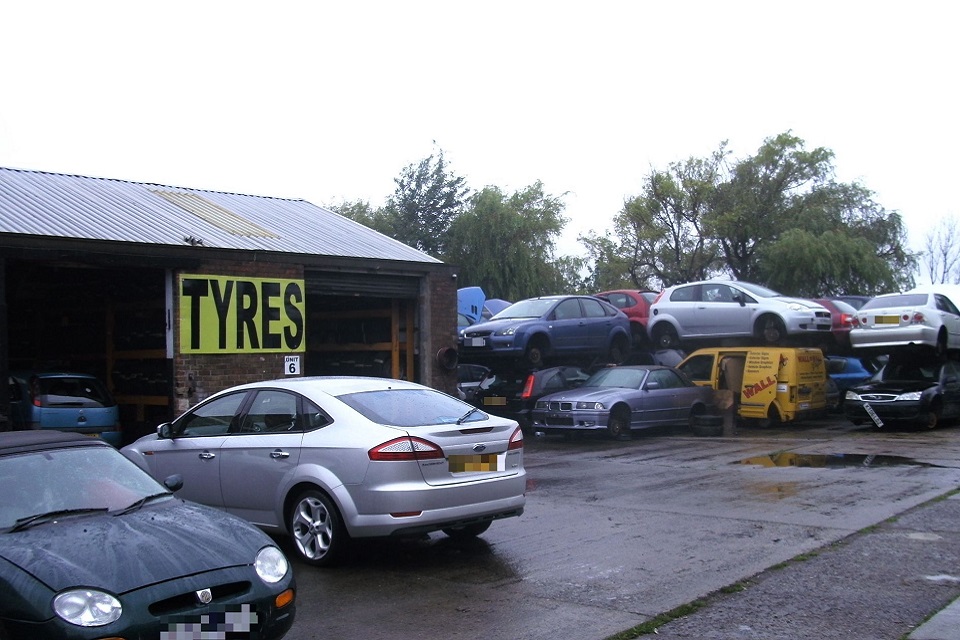
Illegal sites ‘impact on the environment’
Rachael Caldwell, Enforcement Team Leader at the Environment Agency said:
Hanley was given the opportunity to clear the vehicles of waste but when we returned to check the site it was full again.
Environmental permits are needed for a reason – they ensure operators have the correct procedures and equipment in place to protect the environment.
Not only do illegal sites impact on the environment but they undermine legitimate businesses. Every day our officers are out on the ground identifying illegal waste sites and taking the necessary action.
To report an illegal waste site contact Crimestoppers anonymously on 0800 555 111.