The Tories’ benefit cap is particularly punitive and shockingly arbitrary

This week I am joining my SNP colleagues in highlighting some of the most appalling cuts we have seen under this Tory Government – many of which were introduced by the Welfare Reform and Work Act 2016.


Go to Source
Author:


News story: Royal Navy prepares for future UK fishery patrols

HMS Forth is the first of five state-of-the-art Royal Navy vessels designed for fishery protection, as well as counter-piracy, anti-smuggling, border patrol, counter terrorism and maritime defence duties.

Defence Secretary Gavin Williamson said:

The Royal Navy has a proud tradition of protecting the UK’s coastline and keeping a close eye on our fishing waters. With these state-of-the-art, vastly capable ships we stand ready to protect our fisheries once Britain leaves the EU.

The River-class Offshore Patrol Vessels (OPV) ‘production line’ is moving apace with the £116 million ships emerging at around six month intervals. The Royal Navy Fishery Protection Squadron are expecting a further two ships – HMS Medway and Trent – to be handed over later this year, with the remaining two – HMS Tamar and Spey – expected to arrive in Portsmouth by 2020. Just last week HMS Trent was formally named at the Glasgow shipyard where was built.

They will become the Royal Navy’s eyes and ears around the UK, helping to safeguard fishing stocks. They will also assist in reassuring and protecting the Falkland Islands and are capable of deploying to the Mediterranean and Caribbean to uphold UK interests around the world.

Last week the Treasury announced that the MOD will receive £12.7 million from the Government’s Brexit preparation allocation to support work with DEFRA on maintaining the UK’s fisheries. The MOD is working closely with other government departments like DEFRA to determine the optimum deployment of these extremely flexible vessels.

With a total crew of around 58, but designed to go to sea with 39, they can spend up to 320 days a year on operational taskings. The larger crew allows a rotation of personnel to ensure they get to spend time at home or on training.

The new OPVs are four knots faster than their predecessors at 24 knots, have an increased range of 5,500 nautical miles, have a 30mm automatic cannon as their main armament instead of a 20mm gun, two Miniguns, four machine-guns and are equipped with two Pacific 24 sea boats. Each ship has an extended flight deck to operate up to Merlin size helicopters and accommodation for up to 50 embarked Royal Marines for boarding and supporting operations ashore if required.


News story: Royal Navy prepares for future UK fishery patrols

HMS Forth is the first of five state-of-the-art Royal Navy vessels designed for fishery protection, as well as counter-piracy, anti-smuggling, border patrol, counter terrorism and maritime defence duties.

Defence Secretary Gavin Williamson said:

The Royal Navy has a proud tradition of protecting the UK’s coastline and keeping a close eye on our fishing waters. With these state-of-the-art, vastly capable ships we stand ready to protect our fisheries once Britain leaves the EU.

The River-class Offshore Patrol Vessels (OPV) ‘production line’ is moving apace with the £116 million ships emerging at around six month intervals. The Royal Navy Fishery Protection Squadron are expecting a further two ships – HMS Medway and Trent – to be handed over later this year, with the remaining two – HMS Tamar and Spey – expected to arrive in Portsmouth by 2020. Just last week HMS Trent was formally named at the Glasgow shipyard where was built.

They will become the Royal Navy’s eyes and ears around the UK, helping to safeguard fishing stocks. They will also assist in reassuring and protecting the Falkland Islands and are capable of deploying to the Mediterranean and Caribbean to uphold UK interests around the world.

Last week the Treasury announced that the MOD will receive £12.7 million from the Government’s Brexit preparation allocation to support work with DEFRA on maintaining the UK’s fisheries. The MOD is working closely with other government departments like DEFRA to determine the optimum deployment of these extremely flexible vessels.

With a total crew of around 58, but designed to go to sea with 39, they can spend up to 320 days a year on operational taskings. The larger crew allows a rotation of personnel to ensure they get to spend time at home or on training.

The new OPVs are four knots faster than their predecessors at 24 knots, have an increased range of 5,500 nautical miles, have a 30mm automatic cannon as their main armament instead of a 20mm gun, two Miniguns, four machine-guns and are equipped with two Pacific 24 sea boats. Each ship has an extended flight deck to operate up to Merlin size helicopters and accommodation for up to 50 embarked Royal Marines for boarding and supporting operations ashore if required.


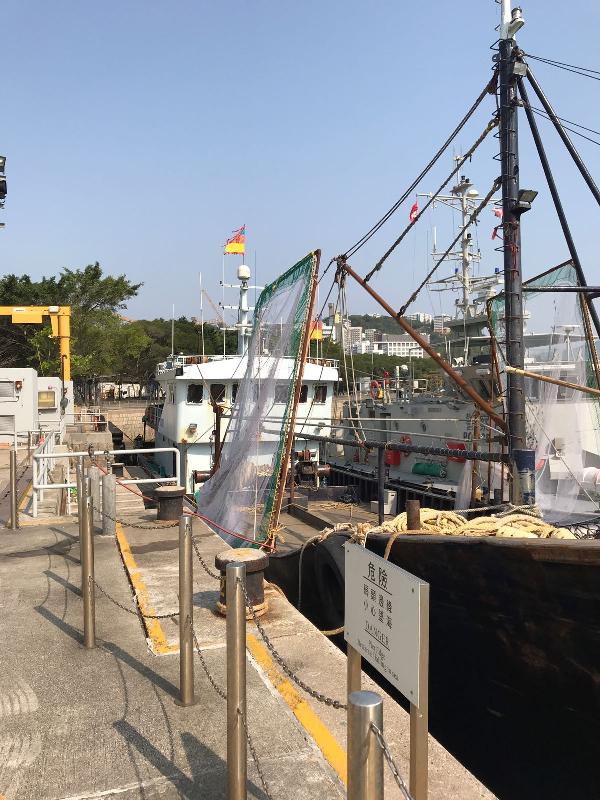
Trawler suspected of operating illegally intercepted in joint operation (with photo)

     A trawler suspected of operating illegally was intercepted in an anti-illegal fishing operation jointly mounted by the Agriculture, Fisheries and Conservation Department (AFCD) and the Marine Police in the northern waters of Hong Kong last night (March 21).

     At about 7.45pm last night, AFCD officers and the Marine Police patrolling the waters northeast of Shek Ngau Chau found a fishing vessel suspected to be trawling there. They signaled the vessel to stop for an inspection. About 2 kilograms of catch and some gear used for trawling, including a “framed trawl net”, were seized on board the vessel.

     Charges were laid today (March 22) against seven Mainland men found on the vessel, which was suspected to have contravened the Fisheries Protection Regulations by using prohibited fishing gear. They will appear at the Fanling Magistrates’ Courts tomorrow (March 23).

     An AFCD spokesman reminded the public that the ban on trawling came into force on December 31, 2012. Any person who contravenes the ban upon conviction is liable to a maximum penalty of a fine of $200,000 and imprisonment for six months under the Fisheries Protection Ordinance.

     The spokesman said that trawling is a non-selective fishing operation which damages the seabed and marine ecosystems. A ban on trawling brings this harmful depletion to an immediate halt, enabling marine ecosystems to be gradually rehabilitated to a sustainable level and be better conserved in the long run.

     The spokesman said, “The AFCD and the Police will continue to carry out joint enforcement operations to crack down on illegal fishing activities.”

Photo  


News story: MDP support Action Counters Terrorism (ACT) 2018 campaign

The ACT campaign, encourages the public to help the police tackle terrorism and save lives by reporting suspicious behaviour and activity.

With the enduring terrorist threat, it is now more important than ever that everyone, including all Ministry of Defence Police staff, plays their part in tackling terrorism.

Our actions could save lives. Communities defeat terrorism.

Speaking on the campaign T/Chief Constable Andy Adams said:

The core role of the MDP is the protection of the people and assets at the various Defence and national infrastructure sites where our officers are deployed across the UK. We cannot, however, do this in isolation. We need members of the public and the staff employed at the sites where we are located to report any unusual or suspicious behaviour that they see or hear. No report is a waste of time and any piece of information, no matter how small, could make the difference that enables us to disrupt and prevent a potential terrorist attack.

Ministry of Defence (MDP) crest logo. Crown Copyright
Crown Copyright

Like other criminals, terrorists need to plan.

To find out more about what could potentially be terrorist-related suspicious activity or behaviour visit the ACT campaign

If you see or hear something unusual or suspicious trust your instincts and ACT by reporting it in confidence at gov.uk/ACT. If it’s an emergency, call 999.

Don’t worry about wasting police time. Any piece of information could be important and it is better to be safe and report. No call or click will be ignored. What you tell the police is treated in the strictest confidence and is thoroughly researched by experienced officers before, and if, any police action is taken.

Remember to trust your instincts and ACT: Action Counters Terrorism.

The MDP will be further promoting the ACT campaign on Facebook and Twitter during the coming weeks.