China launches emergency measures over missing boat in Malaysia

File photo shows the port in Kota Kinabalu (KK). [Photo/Xinhua]

The China National Tourism Administration (CNTA) on Sunday activated emergency measures after a boat carrying mainly Chinese tourists was reported to have gone missing in Malaysia.

An emergency team led by a deputy chief of the administration has been set up to deal with the incident, according to a CNTA statement.

The administration is checking the information of the tourists, and the staff in its Singapore office are preparing to search the area where the boat went missing, the statement said.

A boat carrying 31 people, among them more than 20 tourists from China, lost contact with marine authorities after it left a port in Kota Kinabalu (KK) in the eastern Malaysian state of Sabah to Pulau Mengalum, a popular tourist island 60 km west of KK, on Saturday, the Consulate General of China in KK said Sunday.

It is not clear yet what caused the disappearance of the boat, but an official from the Chinese consulate said there was unfavorable weather condition Saturday.


Beijing parks receive 180,000 tourists on Spring Festival

Beijing’s 11 municipal parks and the Museum of Chinese Garden and Landscape Architecture received a total of 180,000 tourists on Saturday, the first day of the Lunar New Year, or Spring Festival.

During the Spring Festival public holiday, a string of events and activities, such as winter sports and flower exhibitions, are being held across Beijing’s parks. Many Beijingers have said that visiting parks is on their holiday “must do” list.

Taoranting Park reported 40,000 visitors, while the Temple of Heaven Park and the Summer Palace saw 30,000 tourists each, according to the Beijing parks office.

Spring Festival is the most important festival in China.


Heavy snow disrupts traffic in NE China

Heavy snow has disrupted traffic in northeast China’s Liaoning Province, local authorities said Sunday.

The snowstorm started Saturday afternoon, the first day of the Lunar New Year or Spring Festival, and continued Sunday.

As of 9 a.m., 18 expressways in the province, including the section that links neighboring Jilin Province and part of the Beijing-Harbin Expressway, are either closed or restricted, according to the provincial department of transportation.

Most highway coach stations in Liaoning are also closed as a result of the snow.

The local meteorological station forecast snow to continue in most parts of Liaoning throughout Sunday.


There is no legal basis for making any extra payments to the EU

There are some on the continent who seem to think the UK will have to pay to leave the EU, based around negotiations over how much of the continuing liabilities of the EU the UK must pay. This is all nonsense.

There is no power in the EU Treaties to impose an additional one off levy on a state as it leaves the EU. Nor is there any power in the Treaty to demand any continuing budget contributions after departure. This is wise, as of course once a state leaves it leaves behind the judicial authority of the EU which would be the means of enforcing any such payment. Article 50 is clear. Once the state leaves  it has  no further rights and benefits, and no further duties or obligations.

It is of course true the Treaty does not prevent the EU accepting a payment volunteered by a departing state if it wished to pay one. However, the UK could not make such a payment legally under our own law and system for controlling public spending. Ministers can only authorise spending and sign cheques for approved expenditure under UK legislation and with Parliamentary authority for the budget provision that covers the payments. Ministers have proper authority to make the annual contribution payments to the EU, required by the Treaty as incorporated into UK law by the European Communities Act.  They have absolutely no authority to make one off additional payments to the EU, and would have no authority to make contributions after we have left and have repealed the 1972 Act.

They will also find that if they wanted to make a payment as overseas aid to the EU it would not qualify under our Aid budget criteria, as the EU as a whole is too rich. The only way UK Ministers could authorise a leaving payment would be to put through an Act of Parliament specifically authorising such an ex gratia  payment. I can’t see many Conservative MPs wanting to vote for that.

Being in the EU is a bit like being a student in a College. All the time you belong to the College you have to pay fees. You have to obey all the rules of the institution. When you depart you have no further financial obligations, and you no longer have to obey their rules and accept their discipline. If you liked the College rules you can still apply them to yourself voluntarily. The College does not on your departure say we have borrowed money to improve the College while you were her so you will have a continuing bill for servicing the College debts. It does not say we failed to make proper provision for the future pensions of the people who taught you, so we will send you additional bills for their pensions. All your rights to reside and learn at the College cease, and all your duties to pay and obey cease. So it is with a country’s membership of the EU.


Foreign volunteers help make Chunyun easier

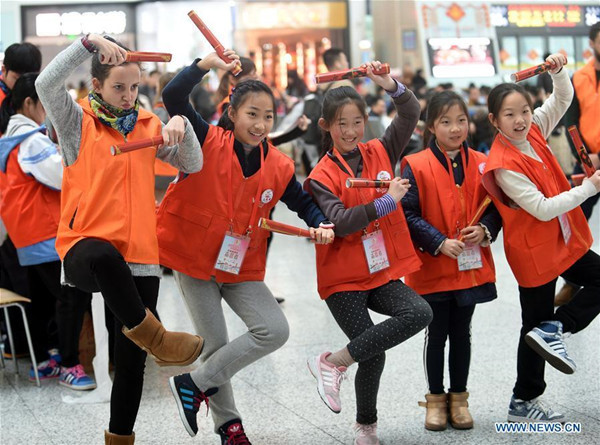
Rachel (1st L) from Britain performs the Monkey King with young volunteers during a break at the East Railway Station of Hangzhou, capital of east China’s Zhejiang Province, Jan. 23, 2017. Five foreign volunteers worked at the railway station to offer help to passengers who rush home for family reunion during the Spring Festival. (Xinhua/Wang Dingchang)

This Spring Festival, a group of foreigners volunteered to give something back to China as a gesture of thanks for what China has done for them.

Yu Zhongyan, was among about 80,000 passengers that will use Wuhan railway station each day during the Spring Festival travel rush, or Chunyun, this year.

She was deeply touched when the volunteers offered to help her with her bags.

“They made our holiday special this year,” said the granny with her grandson in arms.

Wuhan, the capital city of the central province of Hubei, is one of the country’s busiest railway hubs. This year 28 foreign students from 15 countries, wearing yellow hats and orange vests, were on hand to help passengers.

Thursday is Bassim Mohammed Dahash Aljizani’s last day in Wuhan. He earned his doctorate at Huazhong University of Science and Technology.

Together with his wife and three sons, the man had five suitcases and a buggy. Sadi Makangila Patrick from the Democratic Republic of the Congo and Agil Mubariz from Azerbaijan hurried to help.

Aljizani told Xinhua that he will take the train to Guangzhou, before flying back to Baghdad. “I have been in Wuhan for four years and I really don’t want to leave, but my country needs me,” he said.

“It is great experience to see people off at the station,” said Areen Muhammed, a student from Iraq. “The work is tiring. But when I see the smiles, I feel so happy.”

“China’s government provides us scholarship for our study here,” said another volunteer from Sri Lanka. “China helped me, and in return, I would like to do something for the people here.” [ Yuan Gaoping, an official with Wuhan railway bureau, said that by working in the station, the volunteers could experience Chunyun, and experience Chinese culture and the development of its railway firsthand.

Yu Zhongyan asked Patrick to pose for a photo together, before bidding farewell to the foreign “uncle.” “Thank you,” said the boy, while Yu waved, “Happy New Year.”