News story: Porton Down scientists on brink of titanium revolution

Titanium is as strong as steel and half the weight – but around ten times the cost. It is notoriously difficult and expensive to make which limits its wider use.

Defence Secretary Gavin Williamson said:

Our Armed Forces use titanium in everything from cutting-edge nuclear submarines and fighter jets through to life-changing replacement limbs – but production time and costs mean we haven’t always used it. This ground-breaking method is not only faster and cheaper but could see a huge expansion of titanium parts and equipment throughout the military. It is a clear example of how our world-class scientists are working behind the scenes to help our Armed Forces as well as bringing prosperity and security to Britain.

Titanium’s high strength, light weight and corrosion resistance sees it widely used in defence, in military aircraft and submarines, but its high production costs make it difficult to justify in all but essential areas.

Dstl has invested almost £30,000 in the new research project at the University of Sheffield, which led to the development of the new ground-breaking manufacturing process.

The announcement comes as Dstl supports the Defence Procurement Research Technology and Exportability (DPRTE), which takes place tomorrow [MARCH 27].

The pioneer of this revolutionary technique, Dr Nick Weston said:

FAST-forge is a disruptive technology that enables near net shape components to be produced from powder or particulate in two simple processing steps. Such components have mechanical properties equivalent to forged product. For titanium alloys, FAST-forge will provide a step change in the cost of components, allowing use in automotive applications in automotive applications such as powertrain and suspension systems.
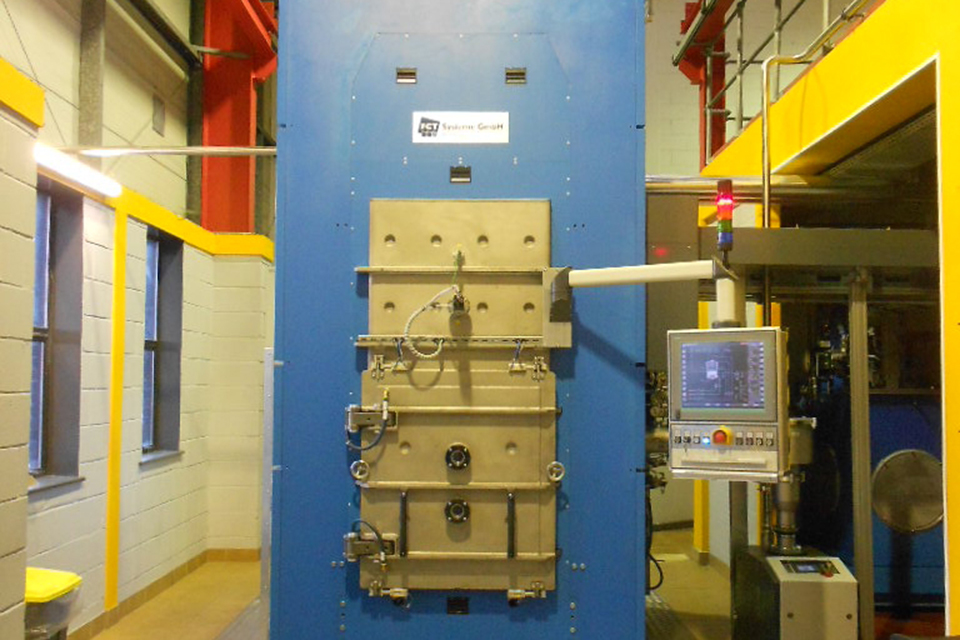
The Defence Science and Technology Laboratory (Dstl) in Porton Down has revolutionised the production of titanium by reducing the 40 stage process down to just two steps and potentially halving the cost. Crown copyright.

So far, small-scale trials have been carried out, but a new large-scale fast furnace facility jointly funded by Dstl and Kennametal Manufacturing (UK) Ltd has been built and will enable larger components to be produced for testing.

Matthew Lunt the Principal Scientist for Materials Science at Dstl said:

We’re really excited about this innovation, which could cut the production cost of titanium parts by up to 50%. With this reduction in cost, we could use titanium in submarines, where corrosion resistance would extend the life, or for light-weight requirements like armoured vehicles.



West Berkshire and Wokingham receive extra money to tackle potholes

Today the government has announced an extra £467,317 for West Berkshire to deal with road damage, and £282,055 for Wokingham Borough. This is welcome and I look forward to early use of this money by the Councils, as there are plenty of potholes in need of tarmac. I had raised this with Ministers during the bad weather.


Recording of the week: the four rooms of creativity

This week’s selection comes from David Govier, Oral History Archivist. Why do a corporate oral history? The late Wally Olins, co-founder of Wolff Olins, explains his mixed motivations in wanting to set up an oral history of the company – from an urge for immortality, to the representative nature of…


Weekly Road Report – West End Ward #dundeewestend

DUNDEE CITY COUNCIL – WEEKLY ROAD REPORT

REPORT FOR WEST END WARD – WEEK COMMENCING MONDAY 26 MARCH 2018

South Union Street/South Marketgait at Dundee Railway Station – northbound nearside lane closure from 9.30am for 7 weeks for footway works.

Riverside Drive/South Union Street at Dundee Railway Station – off-peak (9.30am – 3.30pm) east/northbound nearside lane closure for up to one week for footway works.

Bellfield Street (Hawkhill to No 24) – closed from Monday 26 March for 5 days for sewer works.

Lochee Road (at Benvie Steps) – temporary traffic lights on Wednesday 28 March for Scottish Water sewer repair.

Perth Road (Invergowrie Drive to Invergowrie roundabout) – off-peak temporary traffic lights for one week for street lighting works.

Forthcoming Roadworks

Glamis Road (at Blackness Road) – off-peak temporary traffic lights on Friday 6 April for Scottish Water ironwork repair.


Potholes and road capacity

The long and cold winter has not been kind to the roads. There are now many areas of damaged surfaces and a lot of holes forming through the tarmac. I am writing to government to urge them to do more to recover from this problem now we may have seen the end of the snow and ice. Prompt action before the holes get any bigger would be good in itself and cheaper in the long run.

I am also renewing my submissions on how to improve the capacity of the present road network through better traffic management, and how to spend on road improvements that can ease congestion and improve safety. The list of ideas includes:

1. Rephasing lights to give priority to main roads, with sensors for side roads
2. Right hand turning lanes where possible
3. Mini roundabouts and roundabouts in place of traffic lights where this can ease congestion
4. More off street parking and less on street parking
5. Better arrangements for drop off and pick up at schools, away from cars parking on the main road
6. More bridges over railway lines to replace level crossings and to provide more routes into town and city centres, and more bridges over rivers.
7. More cycleways away from main roads to provide a safer route for cyclists
8. New and replacement utility pipes and cables to be buried away from the main carriageways of roads, with easier access points for repairs
9. Clearer signs for times of bus lanes, with more use of lanes by other vehicles outside peaks
10. More bypasses to take through traffic away from residential areas and High Streets