Travel with your digital subscriptions: Joint statement by the European Commission, the European Parliament and the Bulgarian Presidency of the Council of the EU

From 1 April 2018 onwards, Europeans will be able to access the online content that they have subscribed to at home, wherever they are in the EU. European Commission Vice-President Andrus Ansip, Commissioner Mariya Gabriel, Bulgarian Minister of Transport, Information Technology and Communications Ivaylo Moskovski and Members of the European Parliament Pavel Svoboda and Jean-Marie Cavada issued the following statement:

“Citizens are at the core of all our digital initiatives. As of 1 April, wherever you are travelling to in the EU, you will no longer miss out on your favourite films, TV series, sports broadcasts, games or e-books, that you have digitally subscribed to at home. The rules will apply to paid-for services, but providers of free content may opt in. Providers of online content will also benefit from the new rules. They will no longer have to acquire licences for other territories where their subscribers are travelling to.

Removing the boundaries that prevented Europeans from travelling with digital media and content subscriptions is yet another success of the Digital Single Market for our citizens, following the effective abolition of roaming charges that consumers all over Europe have enjoyed since June 2017.

Our new rules directly respond to new behaviours and habits amongst European citizens using new technologies. For example, consumer spending on video subscription services rose by 113% per year between 2010 and 2014, and the number of users by 56% between 2014 and 2015. It is also estimated that at least 29 million people, or 5.7% of consumers in the EU, could make use of cross-border portability, and many more in the future – up to 72 million people by 2020.

In addition, almost 60% of young Europeans say that being able to travel with their subscriptions is an important factor in choosing to subscribe to online services. Making portability a reality addresses this concern, and in turn, will help service providers increase the numbers of subscribers.  

Reaching an agreement on portability is a great result of close collaboration between the EU institutions and European companies and stakeholders; and we have full confidence that broadcasters and platforms will take this as an opportunity to enhance the user experience. Today we have taken another concrete step towards building a true Digital Single Market and a united European digital society, accessible for all our citizens and profitable for our businesses.”


For More Information

Q&A

Factsheet

Statement by Vice-President Ansip after the vote in the European Parliament


News story: UK side by side with Allies a year on from NATO deterrence deployment

In his first visit to the Baltic ally, the Defence Secretary reaffirmed to the Estonian President and Defence Minister the UK’s unwavering commitment to Euro-Atlantic security, a year after UK forces first arrived in country.

Defence Secretary Gavin Williamson said:

For nearly 70 years, NATO has been the guarantee of mutual security. The threats and dangers we face are evolving, intensifying and increasingly challenging – our commitment to our Allies has seldom been more important.

I’ve seen first-hand the vital role our brave Armed Forces are playing on NATO’s eastern border, standing shoulder to shoulder with our Allies to deter Russian aggression.

Nearly 2000 British troops, across two rotations, have led a multinational battlegroup in Estonia as part of NATO’s enhanced Forward Presence (eFP) deployment since it officially began just under a year ago in April 2017.

In an address, alongside his Estonian counterpart, Defence Minister Jüri Luik, to the 800 British troops and their NATO colleagues, stationed there now Mr Williamson said this reflected Britain’s global outlook and commitment to the defence of our friends and Allies across the Baltic region.

The 1st Battalion, The Royal Welsh are currently based in Tapa to enhance NATO’s deterrence posture and the Defence Secretary confirmed that the 1st Battalion, The Yorkshire Regiment will take over from them in June as the UK’s enduring presence in Estonia continues.

The UK’s battlegroup forms part of the wider NATO eFP, with four multinational battlegroups deployed across the Baltic States and Poland, led by the UK, US, Canada and Germany. The UK has a further 150 soldiers based in Poland, part of the US led battlegroup, and RAF Typhoons are due to deploy to Romania in May, patrolling the Black Sea skies.

In addition to the 800 personnel, the UK has committed more than 150 vehicles to support Estonia during this deployment, including Warrior infantry fighting vehicles and Challenger 2 tanks.

The Defence Secretary also held meetings in Tallinn with the President Kersti Kaljulaid, Prime Minister Jüri Ratas and Defence Minister Jüri Luik.


News story: £400m deal signed for battle-winning Brimstone missile for RAF Typhoons

The Ministry of Defence (MOD) has signed a £400 million deal to launch battle-winning Brimstone missiles from RAF Typhoon jets, Defence Secretary Gavin Williamson has announced.

The ultra-accurate Brimstone already has a successful track record, playing a critical role from Tornado fighter jets in the fight against Daesh in Syria and Iraq, and the deal will now see the missile upgraded to become compatible with Typhoons.

The £400 million Brimstone 2 Capability Sustainment Programme with MBDA UK will also build new equipment to support the capability and develop a stockpile of weapons available for operations, creating around 130 brand new jobs and sustaining hundreds more across the country.

Defence Secretary Gavin Williamson said:

Our world-class defence industry is a key foundation on which our great military is built, and the weapons it produces like the pinpoint Brimstone missiles have been crucial in helping our fighter pilots on missions such as driving down Daesh territory in the Middle East. This massive £400m investment is a huge boost to the proud workforce equipping our Armed Forces and will create and protect hundreds of jobs across the country, bolstering both the power of the Typhoon jet and British prosperity.

The new variation is being developed through the Brimstone 2 Capability Sustainment Programme will replace all earlier variants in 2022 and have an upgraded seeker, rocket motor, warhead and guidance system, making it an even more effective weapon.

The new missile will arm Typhoon when it takes over as the RAF’s principal ground-attack aircraft in 2019.

The work has created around 130 new jobs and sustains a further 270 existing jobs at MBDA’s sites in Stevenage, Bolton and across the company’s significant UK supply chain.

Brimstone is currently in use by the UK’s Tornado squadrons in Iraq and Syria as part of Operation Shader and has also been used on operations in Afghanistan and Libya.

Chief of Material Land at the MOD’s procurement organisation, Lieutenant General Paul Jaques said:

The Brimstone 2 CSP contract enables us to continue to deliver a world class air to surface missile in support of the RAF’s Typhoon Squadrons on operations worldwide.

It is excellent news not only for our troops but also for the UK economy, with jobs and skills being sustained across the country.

The programme will also allow the weapon to be further developed for use on future aircraft. Brimstone is among weapons being considered for use by the British Army’s new AH-64E Apache attack helicopters and the RAF’s next-generation Protector unmanned aerial system.


Labour Department highly concerned about fatal work accident in Happy Valley today

     The Labour Department (LD) is highly concerned about the work accident that happened at a building renovation site in Happy Valley this afternoon (March 27), in which workers fell to the ground together with a partly collapsed bamboo scaffold. One worker died while another was injured. The LD is saddened by the accident and expresses its deepest sympathy to the deceased’s family and the injured worker.

     The LD’s spokesman said, “We commenced immediate on-site investigation as soon as we were notified of the accident and issued suspension notices to the contractors concerned to suspend the use of the scaffold involved for any work activity. The contractor cannot resume the work process until the LD is satisfied that measures to abate the relevant risks have been taken.”

     The spokesman added, “We will complete investigation as soon as possible to identify the cause of the accident, ascertain the liability of the duty holders and recommend improvement measures. We will take actions pursuant to the law if there is any violation of the work safety legislation.”

     The general duty provisions of the Factories and Industrial Undertakings Ordinance require employers to provide safe working environments, safe plant and safe systems of work for their employees. Those who contravene the above provisions are liable to a fine of $500,000 and imprisonment for six months.

     In regard to today’s accident, the LD will issue a Work Safety Alert through its website and email, giving a brief account of the accident concerned to duty holders, workers’ unions, professional bodies of safety practitioners and others, reminding the industry of the importance of following safety precautionary measures to prevent recurrence of similar accidents.

     The LD will also remind the employer concerned of the liability for employees’ compensation under the Employees’ Compensation Ordinance, assist family members of the deceased to claim employees’ compensation and closely follow up on the case. For those with financial difficulties, the LD will assist them to apply for appropriate emergency funds. Subject to the needs and wishes of family members of the deceased, the LD will also liaise with the Social Welfare Department for financial or other assistance.

     For the sake of securing the safety and health of employees at work, the LD appeals to employers to provide plant and systems of work that are safe and without risks to health. Employees should co-operate with their employers, adopt all safety measures and use personal protective equipment provided properly to avoid endangering their own work safety and that of other workers.


News story: MOT rule changes: 20 May 2018

Updated: Added Welsh translation.

The way that the MOT test works in England, Scotland and Wales will change from Sunday 20 May 2018.

The MOT test works differently in Northern Ireland.

The changes will affect cars, vans, motorcycles and other light passenger vehicles.

There are 5 main changes you need to know.

1. Defects will be categorised differently

Defects found during the MOT will be categorised as either:

  • dangerous
  • major
  • minor

The category the MOT tester gives each item will depend on the type of problem and how serious it is.

MOT testers will still give advice about items you need to monitor. These are known as ‘advisories’.

What the new categories mean

Item result What it means about the item How it affects your MOT result
Dangerous A direct and immediate risk to road safety or has a serious impact on the environment.

Do not drive the vehicle until it’s been repaired.

Fail
Major It may affect the vehicle’s safety, put other road users at risk or have an impact on the environment.

Repair it immediately.

Fail
Minor No significant effect on the safety of the vehicle or impact on the environment.

Repair as soon as possible.

Pass
Advisory It could become more serious in the future.

Monitor and repair it if necessary.

Pass
Pass It meets the minimum legal standard.

Make sure it continues to meet the standard.

Pass

2. Stricter rules for diesel car emissions

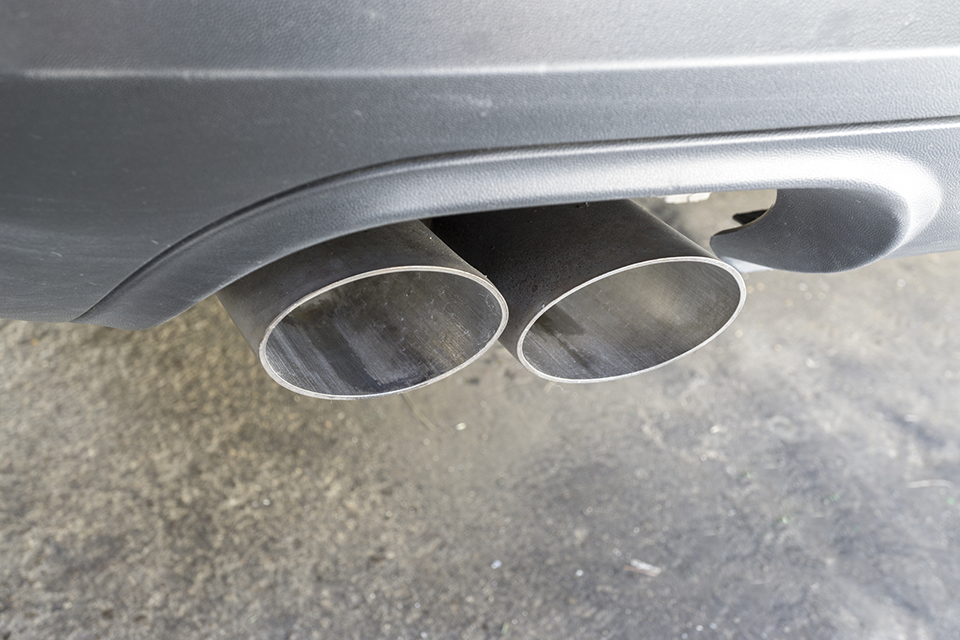
Diesel exhaust

There will be stricter limits for emissions from diesel cars with a diesel particulate filter (DPF).

A DPF captures and stores exhaust soot to reduce emissions from diesel cars.

Check your car’s handbook if you don’t know if your car has a DPF.

Your vehicle will get a major fault if the MOT tester:

  • can see smoke of any colour coming from the exhaust
  • finds evidence that the DPF has been tampered with

3. Some new things will be included in the MOT

Daytime running lights on a car
Daytime running lights will be checked on vehicles first used from 1 March 2018.

Some new items will be tested during the MOT.

They include checking:

  • if tyres are obviously underinflated
  • if the brake fluid has been contaminated
  • for fluid leaks posing an environmental risk
  • brake pad warning lights and if brake pads or discs are missing
  • reversing lights on vehicles first used from 1 September 2009
  • headlight washers on vehicles first used from 1 September 2009 (if they have them)
  • daytime running lights on vehicles first used from 1 March 2018 (most of these vehicles will have their first MOT in 2021 when they’re 3 years old)

There will be other smaller changes to how some items are checked. Your MOT centre will be able to tell you about these.

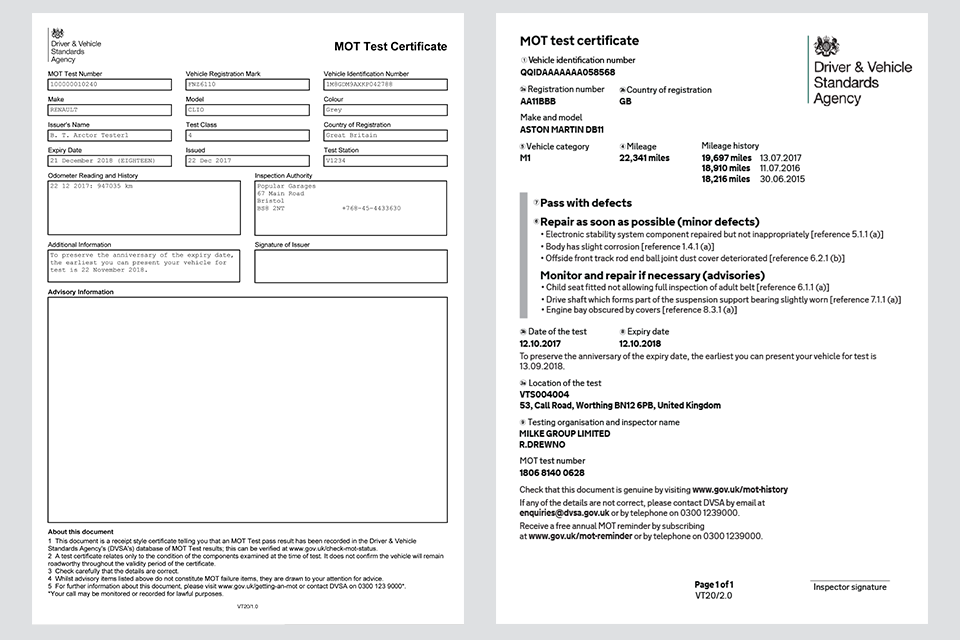
4. The MOT certificate will change

Current and new MOT certificate design
The current MOT test certificate (left) will change to a new style (right) to list the new types of defects.

The design of the MOT certificate will change.

It will list any defects under the new categories, so they’re clear and easy to understand.

The service to check the MOT history of a vehicle will be updated to reflect the changes.

5. Some vehicles over 40 years old won’t need an MOT

Headlight of a classic car

Cars, vans, motorcycles and other light passenger vehicles won’t need to have an MOT if they’re over 40 years old and have not been substantially changed (PDF, 62.8KB).

At the moment, only vehicles first built before 1960 are exempt from needing an MOT.

When the rules change on 20 May 2018, vehicles won’t need an MOT from the 40th anniversary of when they were registered. You can check the date the vehicle was registered online.

Example

If a car was first registered on 31 May 1978, it won’t need an MOT from 31 May 2018.

You won’t have to apply to stop getting an MOT for your vehicle.

However, each time you tax your historic vehicle (even if you don’t pay a fee), you’ll have to declare it meets the rules for not needing an MOT.

More information

The maximum fees MOT centres can charge won’t change.

In January 2018, the government decided to keep the age a vehicle needs its first MOT at 3 years, rather than extend it to 4 years.

You can get a free MOT reminder by text message or email a month before your MOT is due.

You can be fined up to £1,000 for driving a vehicle without a valid MOT.