China’s top political advisory body starts annual session

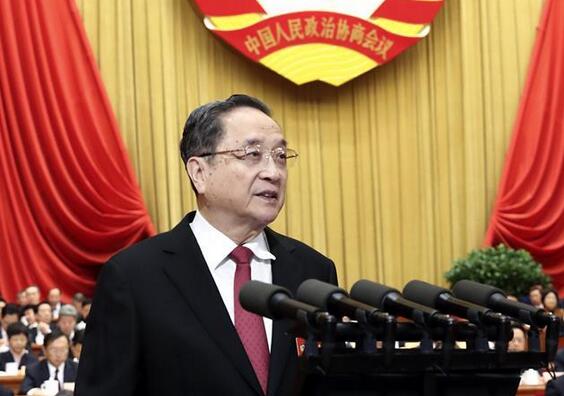
Yu Zhengsheng, chairman of the National Committee of the Chinese People’s Political Consultative Conference (CPPCC), delivers a report on the work of the CPPCC National Committee’s Standing Committee at the fifth session of the 12th CPPCC National Committee at the Great Hall of the People in Beijing, capital of China, March 3, 2017. The fifth session of the 12th CPPCC National Committee opened in Beijing on March 3. [Photo/Xinhua] 

China’s top political advisory body started its annual session Friday in Beijing, ushering in a political high season that will continue with the opening of the country’s top legislature Sunday.

Yu Zhengsheng, chairman of the Chinese People’s Political Consultative Conference National Committee, delivered a work report to more than 2,000 political advisors who gathered to discuss major political, economic and social issues in the world’s most populous nation and second-largest economy.

Top Communist Party of China and state leaders Xi Jinping, Li Keqiang, Zhang Dejiang, Liu Yunshan, Wang Qishan and Zhang Gaoli attended the opening meeting at the Great Hall of the People.


A million-tree mission

Zhao works on Bagua Hill in Jilin province. [Photo/China Daily] 

After spending almost half his life chopping down trees in Jilin province, Zhao Xihai decided it was time to make a change.

In 1989, the former logger and explosives worker formulated a plan to mitigate some of the damage he had done to the environment over the years – he would plant 100,000 trees before turning 70.

In the first spring following his retirement, Zhao bought 46,000 seedlings and set about planting them on a barren tract of land on Bagua Hill, 3 kilometers away from his home.

He set himself the goal of planting 1,000 seedlings per day, waking at 4 am each morning to walk to the hill, armed only with a shovel and some painkillers for his chronic stomach problems.

Every day for 46 days, come rain or shine, Zhao went to the hill to plant more trees, eating only small bites of snacks for sustenance and drinking from nearby streams.

He succeeded in completing his task in the time allocated, despite passing out from hunger and exhaustion one rainy day and having to be carried home by a neighbor.

Once the first 46,000 seedlings had been planted, Zhao continued with his task – albeit at a slower pace.

He persisted even after having a blood clot on the brain in 2004, which left him walking with a stick, telling his son: “I will not stop planting as long as I can move.”

By 2007, Zhao had achieved his goal of planting 100,000 trees, but he did not stop there. Joined by his 36-year-old son Zhao Jingchun, who had recently been laid off, he set himself a new mission – to plant 1 million trees, including a number of rare or unusual species.

Within four years, the pair had managed to cultivate 750,000 seedlings, inspiring Zhao Xihai to present his son with a flag honoring his dedication and symbolizing the passing of responsibility to the younger generation.

In March last year, Zhao Xihai was hospitalized after his blood clot returned. He lost the ability to talk and now requires 24-hour care.

His son has vowed to continue his legacy, however, and is on schedule to plant his 1 millionth tree this year, according to Jilin’s Hongshi Bureau of Forestry.

Some have questioned why Zhao Jingchun continues to plant trees when he has no income and a 13-year-old son to support. The entire family is also reliant on Zhao Xihai’s pension.

“Planting trees will be beneficial for generations to come, therefore it is worth all the hardships – that’s what my father would say,” he said.


Deputies call for action to stop sexual abuse of minors

Deputies to the NPC and experts attend a seminar on Thursday to call for immediate action against sexual abuse of minors. [Photo by Chen Weisong/China.org.cn] 

As the number of child sexual abuse cases has risen in recent years, some deputies to the National People’s Congress and various experts held a seminar on Thursday ahead of China’s annual two political sessions to call for immediate steps to stop the scourge.

The deputies proposed solutions including making sexual abuse awareness education compulsory in schools, and establishing a proper custody system for minors.

They said children should be taught about what constitutes a “safe touch” and know it is safe to tell teachers or other staff about abuse.

At the seminar, a survey report on child sexual abuse cases in 2016 was released by Girls’ Protecting, a charity fund initiated by dozens of female journalists in 2013.

The survey found that 433 cases of sexual abuse involving children under 14 were publicly reported in 2016, equating to an average of 1.21 cases a day, an increase of 30 percent year on year.

Wang Xuemei, co-founder of Girls’ Protecting, said the number of reported child sexual abuse cases significantly increased in the past three years, demonstrating it had become quite an acute social issue drawing more attention from society and the media.

However, many cases still go unreported because of the shame that comes with the act and complexity of the cases.

The survey report showed that of 778 victims whose cases were made public in 2016, 719 were girls, making up 92.42 percent, with a small number of boys. The perpetrators were mostly men.

“These figures awaken us to the gravity of the issue,” said Sun Xiaomei, an NPC deputy and a professor at China Women’s University. “The focus should be placed on building a protection net through coordinated efforts from families, schools and society.”

Li Yifei, an NPC deputy and principal of a middle school in Inner Mongolia, stressed the problem should be solved by a combination of law, education, moral and culture building.

According to the survey, in 2016, the youngest victim was aged less than 2, and 125 were under 7.

Girls’ Protecting pointed that children who are sexually molested are mainly aged between 12 and 14, reinforcing the fact that underage girls are easy targets of sexual abuse and there is a severe lack of awareness education for them.

The survey found more cases occurring in rural areas than in cities.

“Sexual abuse is a special topic when it comes to children’s protection,” said Tong Xiaojun, dean of the Institute of Children Studies at China Youth University of Political Studies. “There is currently no system in place to address the issue, certainly not in rural areas.”

He added that whether left-behind children in rural areas are more prone to sexual abuse is yet to be determined.

Lan Chuntao, an NPC deputy and a teacher at a high school in Guangxi Zhuang Autonomous Region, said: “The government should boost investment in rural areas. Moreover, I hope rural children can live with their parents who work in cities, thus reducing their vulnerabilities to sexual abuse.”

A more shocking fact revealed by the report is that offenders are largely people close to victims, with teachers making up 29.33 percent, neighbors 24.33 percent, relatives and friends 12 percent, family members 10 percent.

Grils’ Protecting has provided sexual abuse awareness education to more than 1,400,000 children along with more than 400,000 parents in 28 provinces in China by the end of last year.


Deputies call for action to stop sexual abuse of minors

Deputies to the NPC and experts attend a seminar on Thursday to call for immediate action against sexual abuse of minors. [Photo by Chen Weisong/China.org.cn] 

As the number of child sexual abuse cases has risen in recent years, some deputies to the National People’s Congress and various experts held a seminar on Thursday ahead of China’s annual two political sessions to call for immediate steps to stop the scourge.

The deputies proposed solutions including making sexual abuse awareness education compulsory in schools, and establishing a proper custody system for minors.

They said children should be taught about what constitutes a “safe touch” and know it is safe to tell teachers or other staff about abuse.

At the seminar, a survey report on child sexual abuse cases in 2016 was released by Girls’ Protecting, a charity fund initiated by dozens of female journalists in 2013.

The survey found that 433 cases of sexual abuse involving children under 14 were publicly reported in 2016, equating to an average of 1.21 cases a day, an increase of 30 percent year on year.

Wang Xuemei, co-founder of Girls’ Protecting, said the number of reported child sexual abuse cases significantly increased in the past three years, demonstrating it had become quite an acute social issue drawing more attention from society and the media.

However, many cases still go unreported because of the shame that comes with the act and complexity of the cases.

The survey report showed that of 778 victims whose cases were made public in 2016, 719 were girls, making up 92.42 percent, with a small number of boys. The perpetrators were mostly men.

“These figures awaken us to the gravity of the issue,” said Sun Xiaomei, an NPC deputy and a professor at China Women’s University. “The focus should be placed on building a protection net through coordinated efforts from families, schools and society.”

Li Yifei, an NPC deputy and principal of a middle school in Inner Mongolia, stressed the problem should be solved by a combination of law, education, moral and culture building.

According to the survey, in 2016, the youngest victim was aged less than 2, and 125 were under 7.

Girls’ Protecting pointed that children who are sexually molested are mainly aged between 12 and 14, reinforcing the fact that underage girls are easy targets of sexual abuse and there is a severe lack of awareness education for them.

The survey found more cases occurring in rural areas than in cities.

“Sexual abuse is a special topic when it comes to children’s protection,” said Tong Xiaojun, dean of the Institute of Children Studies at China Youth University of Political Studies. “There is currently no system in place to address the issue, certainly not in rural areas.”

He added that whether left-behind children in rural areas are more prone to sexual abuse is yet to be determined.

Lan Chuntao, an NPC deputy and a teacher at a high school in Guangxi Zhuang Autonomous Region, said: “The government should boost investment in rural areas. Moreover, I hope rural children can live with their parents who work in cities, thus reducing their vulnerabilities to sexual abuse.”

A more shocking fact revealed by the report is that offenders are largely people close to victims, with teachers making up 29.33 percent, neighbors 24.33 percent, relatives and friends 12 percent, family members 10 percent.

Grils’ Protecting has provided sexual abuse awareness education to more than 1,400,000 children along with more than 400,000 parents in 28 provinces in China by the end of last year.


White Paper on the future of Europe (sic- they mean EU)

The EU this week issued a White Paper on its future. As many of us argued before the referendum, and as the EU’s 5 Presidents Report argued, the Commission sees the future of the EU as one of far more integration. This new White Paper complements the 5 Presidents Report which I explained at the time of its first publication, and goes beyond it. The Paper starts by reciting favourably the Spinelli/Rossi vision of a united Europe in their “Il Manifesto di Ventotene” published at the end of the 2nd World War.

As the authors of the White Paper say, “The Lisbon Treaty and the decade long debate that preceded it, has opened a new chapter of European integration that still holds unfulfilled potential.”

It is true that this latest White Paper does contain five possible pathways forward for the EU, including one which envisages less integration than they currently enjoy. The Paper also makes clear that the Commission thinks that a bad option. They seem to strongly favour the fifth option, the one that  entails “doing more together across all policy areas”.  The President of the Commission in his foreword urges the EU to be radical and to opt for much more integration.

Option 2 is the only option that allows less EU control. It is based on doing nothing but the single market, fairly widely defined. The Paper raises the possibility  of more border controls and some limitations on freedom of movement under this scenario which they dislike.

Option 1, the carrying on option, envisages slower and piecemeal progress to more integration, highlighting possible advances on more integrated border and asylum policies, more EU defence and some stronger controls over the Euro and economic policy.  Again, this is not a favoured proposal.

Option 3, coalitions of the willing to drive ahead much more integration in various areas, and Option 4, doing less more efficiently by targeting areas like counter terrorism for more common action, are also not preferred. Option 4 does not seem to involve scrapping areas of competence in any meaningful way and still entails more integration in selected areas.

The proposal the EU wants its members to sign up to is Option 5, “Doing more together across all policy areas”. They envisage the EU having just one seat on each international body, with a common foreign policy on all main issues. They will make defence a priority for more integration. They will lead the global fight against climate change, and  have the largest world overseas aid budget. They will turn the European Stability Mechanism into the European Monetary Fund and get it to raise money to finance investment programmes. The Euro area will need more controls and a fiscal stability function, entailing more EU involvement in taxation and doubtless more “own resource” EU tax revenue.

I welcome their launch of this important debate. The 60th birthday of the EU is a fitting moment for its remaining members to take stock and ask themselves what next. The document reminds us just how central the Euro is to the whole project, and how much more they need to do to back their currency and tackle the high unemployment they have in many parts of its area. The UK being out will make it easier for them to use their institution in the way many of them wish to. A successful single currency needs a powerful central government with tax raising powers to stand behind it. As the 5 Presidents Report made clear, a single currency needs a Euro Treasury.