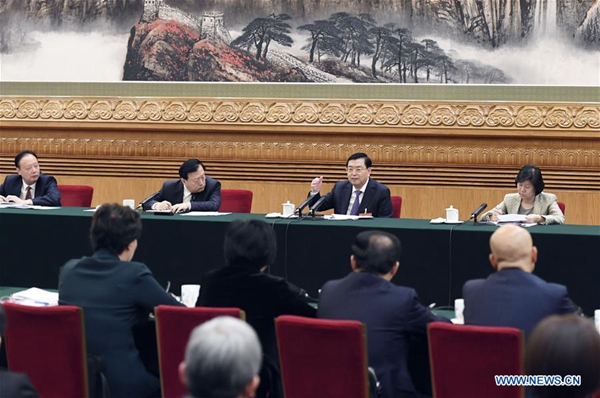
Chinese leaders review gov’t work report with lawmakers

Zhang Dejiang, chairman of the Standing Committee of China’s National People’s Congress (NPC), joins a panel discussion with deputies to the 12th NPC from Zhejiang Province at the annual session of the NPC in Beijing, capital of China, March 5, 2017. (Xinhua/Gao Jie)

Senior Chinese leaders on Sunday joined national legislators in deliberating the government work report, stressing the main theme of “seeking progress while maintaining stability.”

The report was delivered by Premier Li Keqiang at the opening of the annual session of China’s top legislature, the National People’s Congress (NPC).

Zhang Dejiang, Yu Zhengsheng, Liu Yunshan and Wang Qishan,all members of the Standing Committee of the Political Bureau of the Communist Party of China (CPC) Central Committee, joined national lawmakers in deliberating the report.

Zhang, also chairman of the NPC Standing Committee, joined lawmakers from east China’s Zhejiang Province.

Zhang stressed concrete actions to implement the decisions and policies of the CPC Central Committee, promote the steady and healthy development of the economy and the harmony of the society to create a favorable environment for the 19th National Congress of the Party, slated for later this year.

Yu Zhengsheng, also chairman of the Chinese People’s Political Consultative Conference National Committee, joined a delegation of lawmakers from central China’s Hubei Province during another panel discussion.

Yu urged Hubei Province to apply the new concepts of development and advance supply-side structural reform.

He called for further efforts to conserve energy and protect the environment to provide the people with clean water, fresh air, safe food and beautiful environment.

Liu Yunshan joined NPC deputies from Inner Mongolia Autonomous Region in their panel discussion.

Liu called for proper understanding of the relations between maintaining stability and seeking progress, stressing efforts to guide social expectations and dissolve risks, while making breakthroughs in reforms.P Major tasks in supply-side structural reform should be accomplished to improve growth quality and efficiency, he added.

Wang Qishan, also secretary of the CPC Central Commission for Discipline Inspection, joined NPC deputies from Beijing.

Wang stressed the need to explore effective CPC self-supervision for long-term governance, deepen reform of the national supervisory system and establish an anti-graft mechanism under the unified leadership of the Party.

The CPC should enhance supervision over itself and state organs to realize full-coverage oversight of all public servants, he added.



Government must put £2bn into the budget for social care – Barbara Keeley MP

Barbara
Keeley MP
,
Labour’s Shadow Minister for Social Care and Mental Health, commenting
on reports of funding for social care in the forthcoming budget, said:

“Reports of any additional money for social care are of course welcome,
but the reality is that it is the Tories who have spent the last 7 years
cutting billions from council budgets. This has meant the loss of £5 billion
for adult social care.

"Labour is calling on the government to put £2 billion into the budget for
social care. There is also an urgent need for a longer-term funding plan to get
social care out of the current crisis and on to a more stable footing”

ENDS


Tory failure on living standards see earnings fall by £1,100 a year, or £21 a week

Labour analysis, using House of Common’s Library endorsed modelling, shows that average real earnings are set to fall by just under £1,100 a year, or £21 a week, as a result of rising inflation and lower wage growth.

Inflation has been rising since last summer, with the OBR forecasting in the 2016 Autumn Statement that inflation is set to jump this year and next year. At the same time average earnings was revised down last year, this year and for the next two years.

The combination of higher prices and lower wages is that living standards are being squeezed.

This time last year, at the Budget 2016, the OBR was forecasting real average earnings growth of 9 per cent between 2015 and 2020 (average earnings adjusted for CPI inflation). However, at the 2016 Autumn Statement this was revised down to growth of 5 per cent between 2015 and 2020.

Converting this to income values, Budget 2016 was forecasting that real average earnings would be almost £2,500 higher in 2020 than in 2015. However, at the 2016 Autumn Statement this was revised down to £1,400. This is a difference of just under £1,100 a year, or £21 a week.

Today’s analysis comes on the back of IFS analysis last year which showed that the “outlook for living standards has deteriorated rather sharply”, between Budget 2016 and Autumn Statement 2016, describing the prospects for real earnings growth as “dreadful”.

The Resolution Foundation has also said that the “outlook for living standards in 21st century Britain does not look promising” and that “weak and regressive nature of income growth in the years ahead should concern us all”. 

This analysis looks at the effect on living standards resulting from changes to OBR forecasts at the last Autumn Statement. Tax and benefit changes, as well as previous OBR forecasts will impact on living standards; however, this analysis focuses on the Government’s last fiscal event and therefore highlights the importance that the upcoming Budget could have on living standards.

Commenting, John McDonnell MP, Labour’s Shadow Chancellor, said:

“Today’s analysis shows the impact of seven years of Tory economic failure.

“Living standards are being squeezed and working people are being hit hard. This is despite the Tories promising at the last General Election that they would raise living standards.

“The truth is that Theresa May has failed working people; with a lower National Living Wage than promised just 12 months ago and massive cuts to Universal Credit still in the pipeline.

“Only Labour will take the action needed to end the Tories’ economic failure by introducing a Real Living Wage of £10 an hour by 2020.“

ENDS


The idea that this will reverse years of Tory neglect is laughable – Angela Rayner

Angela Rayner MP, Shadow Secretary of State for Education, responding to the Sunday Times article suggesting that the Budget will contain new money for skills, said:                                            

“Any new funding for vocational education is welcome but it is on this Chancellor’s watch that colleges are facing closure due to soaring deficits.

"Much of the Chancellor’s plans have already been announced elsewhere, and the T-Levels simply formalise the 15 technical education routes that already exist. 

“The idea that this will reverse years of Tory neglect is laughable. It is very much the minimum needed to address the new skills challenges of Brexit.”


Temporary Traffic Order – Fleuchar Street, Blinshall Street and Scott Street

From the City Council :

Dundee City Council proposes to make an Order under Section 14(1) of the Road Traffic Regulation Act 1984 for the purpose of facilitating works for the SSE cable renewal scheme.  The Order is expected to be in force for 20 weeks from 6 March 2017.  Its maximum duration in terms of the Act is eighteen months.

The effect of the Order is to prohibit temporarily all vehicular traffic in (1) Fleuchar Street from Eassons Angle to Blyth Street, (2) Blinshall Street from Lochee Road to Douglas Street and (3) Scott Street from City Road to Glenagnes Road.

Pedestrian access and vehicular access to premises will be maintained where possible.

Alternative routes will be available via (1) Eassons Angle, Milnbank Road and City Road, (2) Douglas Street, Smellies Lane and Lochee Road and (3) City Road, Milnbank Road, Rosefield Street and Glenagnes Road.

Please forward any comments you may have regarding this proposal to the Network Management Team, City Development Department, Dundee House, 50 North Lindsay Street, Dundee  DD1 1LS and if you have any queries please contact 433082.