China creates world’s 1st coal-to-ethanol production line

China has successfully created the world’s first production line to turn coal into ethanol, or drinking alcohol, the Chinese Academy of Sciences said on Friday.

Created by Shaanxi Yanchang Petroleum and the academy’s Dalian Institute of Chemical Physics in Liaoning province, the production line went into operation in January and has the capacity to make more than 100,000 metric tons of pure ethanol every year, according to Liu Zhongmin, the institute’s deputy director.

By 2020, China will build a factory capable of producing 1 million tons of ethanol each year using the same technology, he said.

The country currently produces 7 million tons of ethanol each year using other methods, which can “hardly satisfy” its industrial and energy needs, according to Liu.

“Most countries produce ethanol using food, such as corn or sugar cane, but this is not a viable option for China given its massive population,” he said.

“By turning China’s abundant coal resources into ethanol, the technology will help safeguard our energy and food security,”

Moreover, ethanol is a green fuel and versatile ingredient. “Utilizing it could reduce our dependency on fossil fuels, and make our industrial production and energy structure more environmental friendly,” Liu said.

In addition to alcoholic beverages, ethanol can be used to produce thousands of everyday products from plastics to detergents. It can also replace more toxic ingredients, such as methanol, during industrial production.

Other uses include mixing it with petroleum to increase its fuel efficiency and reduce pollution. An abundant supply of ethanol would also make ethanol-fueled vehicles more viable, Liu said.


China creates world’s 1st coal-to-ethanol production line

China has successfully created the world’s first production line to turn coal into ethanol, or drinking alcohol, the Chinese Academy of Sciences said on Friday.

Created by Shaanxi Yanchang Petroleum and the academy’s Dalian Institute of Chemical Physics in Liaoning province, the production line went into operation in January and has the capacity to make more than 100,000 metric tons of pure ethanol every year, according to Liu Zhongmin, the institute’s deputy director.

By 2020, China will build a factory capable of producing 1 million tons of ethanol each year using the same technology, he said.

The country currently produces 7 million tons of ethanol each year using other methods, which can “hardly satisfy” its industrial and energy needs, according to Liu.

“Most countries produce ethanol using food, such as corn or sugar cane, but this is not a viable option for China given its massive population,” he said.

“By turning China’s abundant coal resources into ethanol, the technology will help safeguard our energy and food security,”

Moreover, ethanol is a green fuel and versatile ingredient. “Utilizing it could reduce our dependency on fossil fuels, and make our industrial production and energy structure more environmental friendly,” Liu said.

In addition to alcoholic beverages, ethanol can be used to produce thousands of everyday products from plastics to detergents. It can also replace more toxic ingredients, such as methanol, during industrial production.

Other uses include mixing it with petroleum to increase its fuel efficiency and reduce pollution. An abundant supply of ethanol would also make ethanol-fueled vehicles more viable, Liu said.


China creates world’s 1st coal-to-ethanol production line

China has successfully created the world’s first production line to turn coal into ethanol, or drinking alcohol, the Chinese Academy of Sciences said on Friday.

Created by Shaanxi Yanchang Petroleum and the academy’s Dalian Institute of Chemical Physics in Liaoning province, the production line went into operation in January and has the capacity to make more than 100,000 metric tons of pure ethanol every year, according to Liu Zhongmin, the institute’s deputy director.

By 2020, China will build a factory capable of producing 1 million tons of ethanol each year using the same technology, he said.

The country currently produces 7 million tons of ethanol each year using other methods, which can “hardly satisfy” its industrial and energy needs, according to Liu.

“Most countries produce ethanol using food, such as corn or sugar cane, but this is not a viable option for China given its massive population,” he said.

“By turning China’s abundant coal resources into ethanol, the technology will help safeguard our energy and food security,”

Moreover, ethanol is a green fuel and versatile ingredient. “Utilizing it could reduce our dependency on fossil fuels, and make our industrial production and energy structure more environmental friendly,” Liu said.

In addition to alcoholic beverages, ethanol can be used to produce thousands of everyday products from plastics to detergents. It can also replace more toxic ingredients, such as methanol, during industrial production.

Other uses include mixing it with petroleum to increase its fuel efficiency and reduce pollution. An abundant supply of ethanol would also make ethanol-fueled vehicles more viable, Liu said.


China creates world’s 1st coal-to-ethanol production line

China has successfully created the world’s first production line to turn coal into ethanol, or drinking alcohol, the Chinese Academy of Sciences said on Friday.

Created by Shaanxi Yanchang Petroleum and the academy’s Dalian Institute of Chemical Physics in Liaoning province, the production line went into operation in January and has the capacity to make more than 100,000 metric tons of pure ethanol every year, according to Liu Zhongmin, the institute’s deputy director.

By 2020, China will build a factory capable of producing 1 million tons of ethanol each year using the same technology, he said.

The country currently produces 7 million tons of ethanol each year using other methods, which can “hardly satisfy” its industrial and energy needs, according to Liu.

“Most countries produce ethanol using food, such as corn or sugar cane, but this is not a viable option for China given its massive population,” he said.

“By turning China’s abundant coal resources into ethanol, the technology will help safeguard our energy and food security,”

Moreover, ethanol is a green fuel and versatile ingredient. “Utilizing it could reduce our dependency on fossil fuels, and make our industrial production and energy structure more environmental friendly,” Liu said.

In addition to alcoholic beverages, ethanol can be used to produce thousands of everyday products from plastics to detergents. It can also replace more toxic ingredients, such as methanol, during industrial production.

Other uses include mixing it with petroleum to increase its fuel efficiency and reduce pollution. An abundant supply of ethanol would also make ethanol-fueled vehicles more viable, Liu said.


Beijing budgets billions of yuan in effort to clean up air

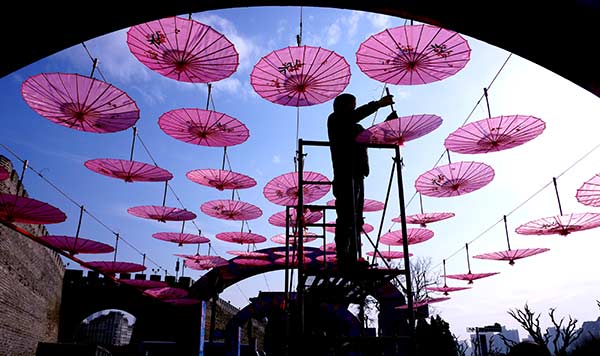
A worker hangs ornaments at the Ming Dynasty City Wall Ruins Park under a blue sky in Beijing this month. [Liu Ping/China Daily]

Beijing will expand funding to reduce air pollution in 2017, including phasing out hundreds of thousands of automobiles and replacing coal furnaces in hundreds of villages, the municipal government said.

So far in March, more than 10 days of clear, blue skies have been recorded. There were 198 such days last year and 186 in 2015, according to the Beijing Environmental Protection Bureau.

In addition, the number of days with severe air pollution mainly due to a high concentration of PM2.5-particulate matter of 2.5 microns deemed dangerous to human health-fell to 39 last year, down from 46 in 2015, 47 in 2014 and 58 in 2013.

PM2.5 is used as a major index to record the concentration of the six major airborne pollutants.

“Beijing saw its average PM2.5 level lowered to 73 micrograms per cubic meter in 2016, a year-on-year decrease of 9.9 percent,” said the capital’s mayor, Cai Qi, giving credit to existing measures such as reducing coal consumption and the number of vehicles.

Data from the environmental protection bureau showed the capital cut PM2.5 levels by 19 percent from 2013 to 2016, said Zhang Dawei, director of the Beijing Environmental Monitoring Center.

Beijing will take tougher measures in 2017.

“We will crack down on air pollution with an iron fist … to meet the public expectation of blue skies,” Cai said.

Among those measures are subsidizing drivers, as about 300,000 old vehicles with excessive exhaust will be banned from the roads; and helping 700 villages replace coal-fired boilers with clean energy such as electricity and gas, which would eliminate coal consumption in the downtown districts and southern regions.

In winter, coal consumption for heating in rural areas was a major source of air pollution, Zhang said.

“In 2017, Beijing will lower its coal consumption (including for industrial production and heating) by 30 percent, with the total amount falling to less than 7 million metric tons,” Cai said.

The Action Plan on Air Pollution Control and Prevention stipulated that the capital should lower its PM2.5 concentration to 60 micrograms per cubic meter by the end of this year.

The municipal government plans to spend up to 18.2 billion yuan ($2.6 billion) this year on stronger pollution-control measures, the Beijing Finance Bureau said. In 2014, the special allocation for air pollution was 12.9 billion yuan.