Last week London saw both the very worst – and the very best – of humanity

Last Wednesday, politics in Edinburgh and in London stopped.

The shocking events in and around the Palace of Westminster put into perspective our daily jousts and squabbles, whether at Holyrood or on the green benches of the Commons.


Delivering For Glasgow

Today I stood with the SNP’s team of candidates for Glasgow to launch our manifesto for this great city. We have 56 candidates from all sorts of backgrounds and walks of life. We all share the passion and commitment of the people who live here for making our city the best we know it can be.


Wall ruins believed to be ancient capital of Loulan found

Ruins of city walls were found in northwest China’s Lop Nur Desert, the site of the former capital of Loulan, a prosperous settlement built around 2,000 years ago to serve passing traders traveling the Silk Road.

Loulan, which is often called the Oriental Pompeii, was an important stop on the ancient trade route linking China and Central Asia. It thrived based around an oasis in a part of the desert known as “No man’s land.”

The archeological institute of Xinjiang Uygur Autonomous Region said excavations had unearthed a circular wall, with a diameter of 300 meters. The base of the wall is 2.2-2.7 meters wide. The highest remaining part is 2.5 meters tall.

Hu Xingjun, a research fellow with the institute, said red willow branches and reeds found among the ruins had been carbon dated, and the results suggested the structure dates back to the late period of Eastern Han Dynasty (25-220AD).

The archeologists believe the city was one of the capitals established by the Kingdom of Loulan, which was moved several times due to water resources, natural disasters, widespread disease and war. It had disappeared completely by the Tang Dynasty (618-907).

The mysterious city was rediscovered first by Swedish adventurer Sven Hedin in 1900. The wall ruins that he found were square in shape.

Hu said the circular ruins were about 57 kilometers away from those found by Hedin. The new discovery might be one of the capitals of Loulan, while the earlier finding could be a newer location of the ancient kingdom, which was renamed Shanshan, and administrated by the Han Dynasty.

Along with the wall ruins, archeologists also discovered a number of items in seven adjacent tombs, including wooden plates, a copper mirror, a wooden comb and textiles.

Since the 20th century, archeologists from around the world have found a great number of well-preserved bodies and antiques around Loulan.

The central government has allocated millions of yuan to Loulan excavation projects. Items ranging from Han Dynasty coins, utensils and fabrics in Greek and Roman styles have been unearthed from previous Loulan digs.


Wall ruins believed to be ancient capital of Loulan found

Ruins of city walls were found in northwest China’s Lop Nur Desert, the site of the former capital of Loulan, a prosperous settlement built around 2,000 years ago to serve passing traders traveling the Silk Road.

Loulan, which is often called the Oriental Pompeii, was an important stop on the ancient trade route linking China and Central Asia. It thrived based around an oasis in a part of the desert known as “No man’s land.”

The archeological institute of Xinjiang Uygur Autonomous Region said excavations had unearthed a circular wall, with a diameter of 300 meters. The base of the wall is 2.2-2.7 meters wide. The highest remaining part is 2.5 meters tall.

Hu Xingjun, a research fellow with the institute, said red willow branches and reeds found among the ruins had been carbon dated, and the results suggested the structure dates back to the late period of Eastern Han Dynasty (25-220AD).

The archeologists believe the city was one of the capitals established by the Kingdom of Loulan, which was moved several times due to water resources, natural disasters, widespread disease and war. It had disappeared completely by the Tang Dynasty (618-907).

The mysterious city was rediscovered first by Swedish adventurer Sven Hedin in 1900. The wall ruins that he found were square in shape.

Hu said the circular ruins were about 57 kilometers away from those found by Hedin. The new discovery might be one of the capitals of Loulan, while the earlier finding could be a newer location of the ancient kingdom, which was renamed Shanshan, and administrated by the Han Dynasty.

Along with the wall ruins, archeologists also discovered a number of items in seven adjacent tombs, including wooden plates, a copper mirror, a wooden comb and textiles.

Since the 20th century, archeologists from around the world have found a great number of well-preserved bodies and antiques around Loulan.

The central government has allocated millions of yuan to Loulan excavation projects. Items ranging from Han Dynasty coins, utensils and fabrics in Greek and Roman styles have been unearthed from previous Loulan digs.


China-made large amphibious aircraft to fly in May

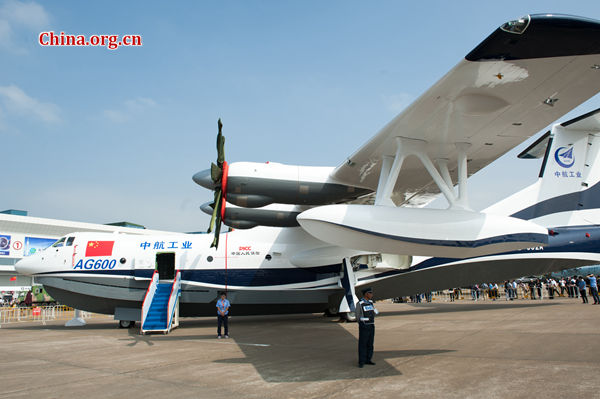
An amphibious aircraft AG600 is displayed for the 11th China International Aviation and Aerospace Exhibition in Zhuhai, south China’s Guangdong Province, Nov.1, 2016. [Photo by Chen Boyuan/China.org.cn]

China’s large amphibious aircraft AG600 will embark on its maiden flight in May from the southern Chinese city of Zhuhai, according to the Aviation Industry Corp. of China (AVIC) Thursday.

The AG600, designed to be the world’s largest amphibious aircraft, will conduct a full resonance test before its maiden flight over land in late May and on water in the second half of 2017, said AVIC.

The 37-meter AG600, with a wingspan of 38.8 meters, has a maximum take-off weight of 53.5 tonnes. It can collect 12 tonnes of water in 20 seconds, and transport up to 370 tonnes of water on a single tank of fuel.

With excellent maneuverability and a relatively wide search scope range, the AG600 will be very useful for marine resource exploitation, marine environmental monitoring, resource detection and transportation.