The Great Repeal Bill – the Bill all MPs have to support

I am happy with the principles behind the proposed legislation. Whilst we are leaving under the Treaty provisions, the actual legal abolition of EU power in the UK requires the repeal of the Act of Parliament which gave the EEC, then the EU, the powers in the first place.

The Bill is misdescribed as the Great Repeal Bill. It is really the Great Continuity Bill. Its prime purpose is to transfer all current directly acting EU laws and past court decisions into UK law. It is therefore reassuring to all those who voted Remain because they liked current EU laws and protections, as this legislation will preserve them and make them UK requirements on our departure.

Labour and the Lib Dems were keen to stress their wish to see areas like employment law protected. This Bill does just that. They will therefore need to vote for the Bill to carry out their clearly expressed wish that every EU employment protection survives Brexit. This should be an unusual Bill where the whole House wants to support it. There will of course be amendments which will cause debate and division, about how much detail has to be put into the Act itself. Anyone who does not vote for this Bill is supporting no continuity in our laws and uncertainties over what the law is in many fields.

Some are now saying what is the point of leaving the EU if we keep all the EU laws. The point is once they are UK laws, we in the UK can decide to keep them, improve them or remove them. The UK government has reassured the Opposition that it has no wish or intention to repeal or dilute any of the employment protections that stem from EU law all the time it is in office. The government does, however, wish to introduce new border controls and benefit and migration policies, which is only possible once we have taken back control and transferred the EU border and benefits law into UK law. This will of course need UK primary legislation which will go through a full parliamentary process to change what we currently have. I also trust the government will want to put through a new fishing policy which is kinder to both our fish and our fishermen. That too will need a full Parliamentary process with new legislation.

I have commented before on the so called Henry VIII powers. Most modern Acts of Parliament have needed Statutory Instruments to implement them and handle the details. The scope of this is debated by Parliament when the Act is passed. Each Statutory Instrument itself is put to Parliament, and Parliament can debate and vote on them if it wishes.



Second carrier nears launch

The construction site of China’s first home-made aircraft carrier. [Photo/People.cn ]

China’s first domestically built aircraft carrier is being outfitted with equipment and the work is progressing smoothly, Defense Ministry spokesman Wu Qian said on Thursday.

As for the carrier’s launch, Wu said the date is coming soon and “we won’t keep the public waiting for too long”.

Wu made the remark in response to media speculation that the new carrier would be launched on April 23-the 68th anniversary of the founding of the People’s Liberation Army Navy.

Outfitting usually implies installing radar, engines and other key components. But some equipment, like the weapons systems, also has to be installed after the ship has been launched into the water, said Zhu Chenghu, a professor at National Defense University.

“The launch is only the first step,” he said. “By current progress, the new carrier would still have to undergo one to two years of testing, both at the dock and at sea, before it could be officially handed to the Navy.

“Nevertheless, China launching its first domestically designed aircraft carrier is a monumental step toward building a world class navy,” he said. “The valuable lessons learned from building a carrier from scratch will help China build more carriers faster in the future and enable them to reach combat readiness quicker.”

According to the Defense Ministry, the new aircraft carrier is under construction in Dalian, Liaoning province. It will have a displacement of about 50,000 metric tons, as well as conventional engines and fighter jet launch systems similar to those of the CNS Liaoning-China’s first aircraft carrier.

The most important difference lies in the roles of the two vessels, Zhu said. While the Liaoning is primarily for training and research purposes, the new carrier will focus on combat and defense.

The new carrier will have more cargo room, more sophisticated radar, more advanced weapons systems, and more reliable engines than the Liaoning, which was refitted from an unfinished Soviet-era carrier-the Varyag-that “did not leave much leeway for optimization and improvement due to its old design,” he added. It was commissioned by China in 2012.

PLA Major General Peng Guangqian, a military strategist, said China’s carriers, as well as the carriers from other nations, are still far behind US carriers in terms of size, scale and combat capability, “because US Navy doctrine requires unchallenged global dominance, while Chinese carriers are mainly used for self-defense”.

When asked about the Chinese military’s recent drills on the Chinese side of the Sino-Myanmar border following clashes between Myanmar security forces and ethnic rebels, Wu said the drills were part of the annual training schedule and China had informed Myanmar of the drill before it began.


New Xinjiang regulation aims to prevent extremism

Northwest China’s Xinjiang Uygur Autonomous Region has introduced China’s first local regulation, which will come into effect on Saturday, to contain and eradicate extremism.

The regulation clarifies major acts of extremism, proposes detailed measures to prevent, contain and purge them, and identifies responsibilities of government departments and the public.

According to the regulation, 15 actions are categorized as extremism, including interfering with others’ religious freedom, forcing others to participate in religious activities, driving believers of different religions away from their homes, expanding the concept of “halal” to areas other than food, wearing or forcing others to wear burqa-like robes, marriage or divorce through religious means rather than legal processes, and depriving children of the right to national education.

The introduction of the regulation draws a clear line between legal religion and illegal religion, which provides legal support for protecting the former and purging the latter, said Chen Tong, president of the law school under Xinjiang Normal University.


Wildlife diversity increases at planned park

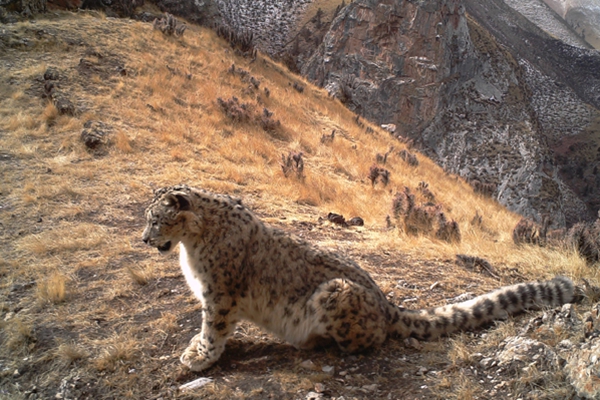
An image of a snow leopard is captured by an infrared camera in the Sanjiangyuan area in January. [Photo/Xinhua]

Wildlife protectionists and herders said the diversity of wild animals has increased in the Sanjiangyuan area, China’s first planned national park.

A three-year observation project, which began in 2014, recorded frequent sightings of snow leopards, brown bears, lynxes, Tibetan foxes, wolves, steppe cats and otters in the region, said Xiao Lingyun with Peking University’s Center for Nature and Society.

These animals were observed in a 2,000-square-kilometer area, Xiao said.

“From images captured by infrared cameras, we can see these animals often move around, not alone, but in groups, and their movements show they have a rather casual lifestyle,” she said.

It is generally known that wild animal habitats have grown increasingly fragmented due to human activity, but the fact that wild carnivores were frequently observed at the source of the Lancang River is a key sign that the area has a diverse animal population, Xiao said.

“Some wild species establish their habitats near residences of local herders, and they are not fearful of humans,” said Zhao Xiang, a wildlife protectionist with the Shanshui Nature Protection Center.

Sanjiangyuan literally means “the source of three rivers”, referring to the Yangtze, Yellow and Lancang (Mekong) rivers.

The national park is expected to open in 2020.


Panda dies after being released into the wild

Hesheng, a captive-bred panda, died in September 2016, two months after being released into the wild in southwest China’s Sichuan Province, Chengdu Research Base for Giant Panda Breeding announced Friday.

The male panda, born in 2013, had undergone training at Liziping Nature Reserve from March 2016 and was released into the wild in July.

On Sept. 11, Hesheng was spotted safe and well some 3.5 km away from where he was released. Just weeks later, however, on Sept. 27, his GPS collar sent an alarm, prompting an overnight search for Hesheng.

When researchers found his limp body they noticed injuries on his right shoulder, right ear and right hind limb. An autopsy confirmed Hesheng died of septicemia due to a bacterial infection after being attacked by unknown animals.

Giant pandas are among the world’s most vulnerable and rare animals, with a known population of only 1,600, mostly in China.