Business rates mess intensifies as firms forced to wait extra month for appeal

7 Apr 2017

IN PIC................. (c) Wullie Marr/DEADLINE NEWS For pic details, contact Wullie Marr........... 07989359845

Businesses seeking to overturn crippling rises in rates will be forced to wait an extra month before their appeals are considered, it has emerged.

The Scottish Government has changed the legislation to state firms must now wait at least 105 days before a decision is made on their rates bill.

Previously, the limit was just 70 days, meaning those affected will have an additional 35 days of being out-of-pocket.

It’s the latest set-back for the SNP as it struggles to address the business rates fiasco.

Earlier this week, it emerged finance secretary Derek Mackay’s 12.5 per cent cap on increases was in fact a 14.75 per cent one, as he’d forgotten to factor in inflation.

Scottish Conservative shadow finance secretary Murdo Fraser said:

“This is yet more evidence of the SNP’s business rates fiasco unravelling.

“Not only was the cap announced by Derek Mackay found to be misleading, but now firms are being forced to wait more than a month extra to get their appeals heard.

“Considering finances for many of these organisations affected will already be tight, they can hardly afford to wait an additional 35 days.

“This is just another indication of an anti-business SNP government, that would rather hit firms in the pocket than help them boost growth, jobs and the economy.”


  • An appellant can request that the Valuation Appeal Committee hear the appeal within a time period that the appellant requests, but this cannot be less than 105 days (previously 70 days) from the date they make the request in question.
  • The “70 day” mentioned was changed very recently (16 March and coming into force on 1 May 2017) when The Valuation Appeal Committee (Procedure in Appeals under the Valuation Acts) (Scotland) Amendment Regulations 2017 was laid (Legislation.Gov.UK, Scottish Statutory Instruments, link).
  • Previously, Section 8 (4 and 7) of The Valuation Appeal Committee (Procedure in Appeals under the Valuation Acts) (Scotland) Regulations 1995 stated (LegislationGov.UK, Scottish Statutory Instruments, link):

‘(4) The secretary shall give to each party not less than 70 days’ notice of the date, time and place set for the hearing of the appeal.’

‘(7) If an appellant considers that his appeal has not been or is not to be heard within a reasonable period of lodging it, he may request the Committee to hear the appeal within such a period as he may specify, being a period not less than 70 days from the date of his request, and if the Committee declines to hear the appeal within such a period-

(a)    It shall state its reasons for so declining; and

(b)   The Secretary shall notify both parties accordingly’.’

  • The Valuation Appeal Committee (Procedure in Appeals under the Valuation Acts) (Scotland) Amendment Regulations 2017 “70” for “105” in both these paragraphs 4 and 7 of regulation 8. It states: (Legislation.Gov.UK, Scottish Statutory Instruments, link)

‘(4) In regulation 8 (arrangements for hearing by the Committee)—

(a) in paragraphs (4) and (7), for “70” substitute “105”;

(b) in paragraph (5)(6), for “giving such information” to the end substitute “to be published on an appropriate website”; and

(c) in paragraph (6), for “name a place” to the end substitute “include a list of the appeals to be heard at that hearing”.’

  • Therefore as of 1 May 2017 the period covered by these sections will no longer be 70 but 105 days. Therefore the minimum time that an appellant can ask is 105 days, and if the Committee declines to hear the appeal within such a period, it must state why and notify both parties that this is the case.

World’s top magma minds embark on journey into molten Earth

Some of the world’s leading volcanologists and geothermal engineers have signed up to a US$100m magma drilling project in a bid to help protect millions of people, towns and cities across the world from volcano disasters; and to make a strategic step in scaling up the use of geothermal energy.


Declaration by the High Representative on behalf of the EU on the alleged chemical attack in Idlib, Syria

The EU condemns in the strongest terms the air strike that hit the town of Khan Sheikhoun in Idlib province on 4 April 2017, which has had horrific consequences, causing the deaths and injuries of scores of civilians including children and relief workers, with many victims displaying symptoms of gas poisoning.

The EU urges the United Nations Security Council to come together, strongly condemn the attack on Khan Sheikhoun and ensure a swift, independent and impartial investigation of the attack.

The OPCW’s Fact Finding Mission (FFM) is in the process of gathering and analysing information from all available sources. While the investigation into this attack is ongoing, the EU is deeply worried to note that the Syrian regime has previously used chemical weapons in 2015, as identified in the August and October reports of the OPCW-UN Joint Investigative Mechanism, and which the EU strongly condemned at the time. In this context, the EU reiterates that as a party to the Chemical Weapons Convention, the Syrian regime has explicitly obligated itself to refrain from the use of chemical weapons and that the Syrian regime has the primary responsibility for the protection of the Syrian population. The EU therefore calls on the regime’s allies, notably Russia, to exercise appropriate pressure on the Syrian regime to this end.

The use of chemical weapons or chemical substances as weapons amounts to a war crime. Their use in Syria, including by the regime and Da’esh, must stop and identified perpetrators must be held accountable for this violation of international law.

Those guilty of violations of international law and the use of chemical weapons have to be sanctioned accordingly. In March, the EU added 4 high-ranking Syrian military officials to the sanctions list for their role in the use of chemical weapons against the civilian population, in line with the EU’s policy to fight the proliferation and use of chemical weapons.

The EU will continue to support the efforts of the OPCW in Syria with regard to the investigation of the use of chemical weapons and considers that such efforts have to be continued in the future by the international community.

This attack constitutes a flagrant violation of the ceasefire. It underlines the urgent need for a real and verified ceasefire. The EU calls on Russia, Turkey and Iran to live up to their commitments as guarantors in this regard.

Attacks of this kind only reinforce the urgent need for a genuine political transition in Syria and the EU’s will to support UN efforts to broker a political solution to the Syrian conflict through the intra-Syrian talks in Geneva, as reaffirmed at the International Conference “Supporting the future of Syria and the region” that the EU hosted in Brussels on 5 April 2017.


Mogherini rencontre Mankeur Ndiaye, Ministre des Affaires Etrangères de la République du Sénégal

La Haute Représentante/Vice-Présidente Federica Mogherini, a rencontré aujourd’hui à Bruxelles Mankeur Ndiaye, Ministre des Affaires Etrangères et des Sénégalais de l’Extérieur de la République du Sénégal. 
 
La Haute Représentante s’est félicité de l’excellente qualité des relations entre l’Union Européenne et le Sénégal. La rencontre aujourd’hui s’inscrit dans le cadre du dialogue permanent entre ces deux partenaires de longue date dans de multiples dossiers régionaux et internationaux. 

Mogherini a salué le Sénégal pour son engagement à promouvoir la paix et la stabilité en Afrique et sa participation significative aux opérations de maintien de la paix. Elle a souligné le fait que le Forum International sur la Paix et la Sécurité en Afrique, dont la quatrième édition se déroulera au mois de novembre à Dakar, sera l’occasion de poursuivre le dialogue stratégique sur les menaces communes telles que la radicalisation et l’extrémisme violent.
 
Les deux parties ont aussi évoqué le prochain sommet Afrique-UE, qui offrira une opportunité unique de renforcer la relation entre les deux continents et de se concentrer sur les opportunités qu’offre la jeune population d’Afrique.

Ils ont passé en revue leur coopération dans le domaine de la migration et ils ont accueilli positivement les progrès accomplis. Mogherini et le Ministre Ndiaye ont aussi réitéré leur préoccupation commune quant au nombre de migrants mettant leur vies en péril en mer et dans le désert, ou restant bloqués sur la route vers la Méditerranée, qui sont souvent les victimes de passeurs et trafiquants sans scrupules. Mogherini a souligné l’importance du travail de l’OIM au Niger, et en Libye, et l’ appui donné par l’Union européenne, pour fournir un soutien aux ressortissants des pays tiers. 

Les deux parties ont salué les efforts du nouveau gouvernement en Gambie pour relancer le pays sur la voie de la démocratie, des droits humains et de l’Etat de droit. Mogherini a confirmé le soutien de l’Union européenne à la Gambie et a souligné le rôle essentiel du Sénégal dans l’évolution positive des derniers mois.


Press release: Fish stocks boost for endangered pearl mussel

Thousands of sea trout have been released into rivers in Northumberland to stock rivers for anglers and help protect the future of a critically endangered species, the freshwater pearl mussel.

Pearl fishing and water pollution from industry have led to worldwide decline of the pearl mussel.

A healthy population of endangered freshwater pearl mussels is important for water quality – each mussel filters 50 to 70 litres of water. They improve the quality of the habitat, increasing the ecological diversity, which includes juvenile trout and salmon numbers.

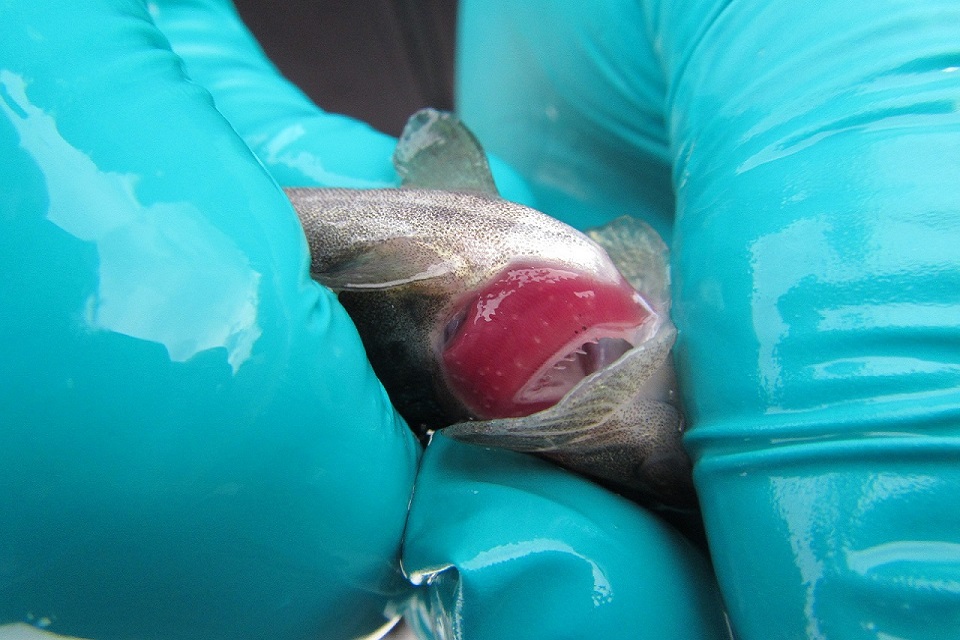
The Environment Agency’s Kielder Salmon Centre staff Richard Bond and Jess Anson have developed a technique to enable pearl mussel larvae to attach to the fish gills, replicating their natural life cycle in the wild.

The larvae will drop off the sea trout gills towards the end of May where they will settle on to the river bed. Given the right conditions, these juveniles could survive into adulthood and live for up to 100 years.

Image shows pearl mussel larvae on the sea trout's gills
Close up of pearl mussel larvae (white dots) attached to the sea trout gills

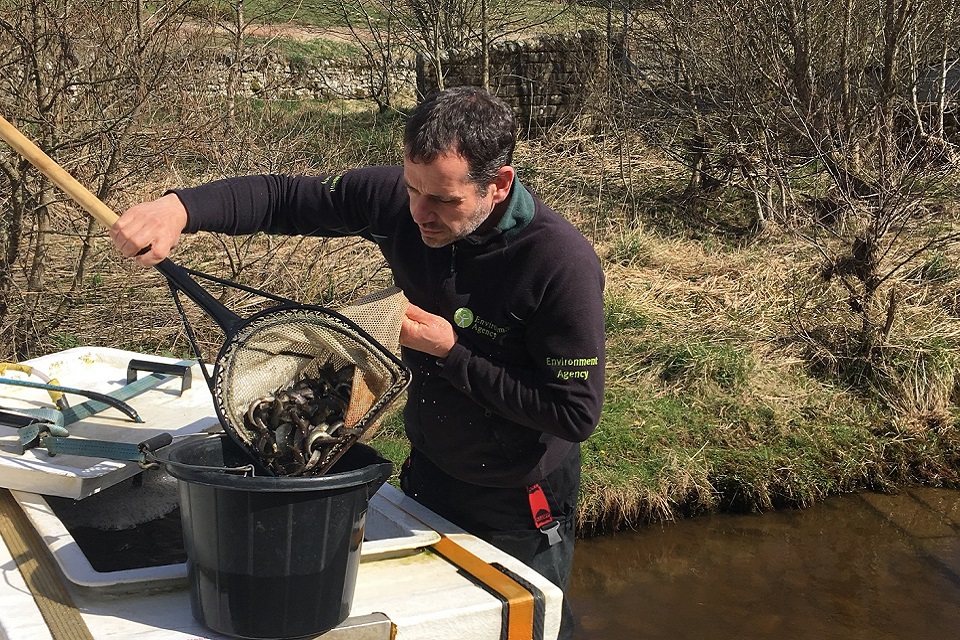
Around 12,000 one-year-old sea trout, which have been bred at Kielder Salmon Centre, were released this week into North Tyne tributaries of the River Tyne.

The larvae attached to them were harvested from 80 adult mussels which are cared for at the centre.

Kielder Salmon Centre breeds 360,000 salmon and between 10,000 and 20,000 sea trout every year to stock rivers.

Complex life cycle

Richard said:

The pearl mussel has a complex life cycle which begins as larvae. These larvae, called glochidia, requires salmon or sea trout to host them for the first stage of their development.

They attach to the gills of trout in the River Tyne between late July and early August, where they remain until the following spring when they drop off the fish’s gills. They need clean water and gravel, and well oxygenated water where they continue to grow.

The survival rate for juveniles has declined over the years, which has led to an ageing population, with few mussels under 50 years old.

This means they are a critically endangered species with only around 30,000 adult mussels in the wild in the North Tyne area, and 500,000 across the country.

This work at the hatchery is to try to increase the numbers of juveniles in the river, boost future numbers, natural reproduction and survival rates in efforts to halt the population decline.

Image shows Richard Bond preparing the fish for stocking

Water quality improvements

After considerable investment, water quality has improved dramatically across the UK and rivers in England are the healthiest they have been for 20 years.

The improvements in water quality of the River Tyne and its tributaries has been excellent, and along with the continued work of the Environment Agency and partners, has resulted in improved conditions for natural breeding in the rivers, and a flourishing ecology.

Kielder Salmon Centre pearl mussel project

Richard added:

In 2010 we first managed to successfully get freshwater pearl mussel larvae to attach to the gills of sea trout. Since then we have released sea trout every spring to the River Tyne tributaries.

Over the next two years we will be carrying out surveys, looking for the first of these juvenile mussels that were released to see if or where they have survived.

Even at 7 years old they will be less then 3cms long, most of which will be buried under the river bed. In another 7 to 10 years they should be old enough to breed.