Cleaner air

There is a growing mood in favour of cleaner air. There is general agreement that the air in city centres like London needs urgent action to clean it up. In the centres of our Thames Valley towns there is also room for improvement. Some are already blaming the diesel car as the main cause and urging higher taxes or bans on diesel vehicles.  It is a good idea first to examine what we know about the sources and causes of pollution.

The London Assembly researched the sources of Nox in London in 2015. This showed the following sources

Bus, coach and rail public transport    18%

Goods vehicles    17%

Gas heating systems    16%

Non road mobile machinery    14%

Diesel cars    11%

Petrol cars and motorcycles  8%

Aviation    8%

Industry   7%

The TFL study in 2016 showed a similar pattern, with gas heating and industry  as the biggest source, and with  both bus and coach and goods vehicles each a bit bigger than diesel cars.

The new Euro VI standards for engines require both petrol and diesel engines to emit less than 5mg per km of particulates. They allow just 80 mg of Nox for diesels compared to 60 mg for petrol, whilst allowing petrol engines to emit more carbon monoxide than diesels (100mg versus 50mg)

In order to clean up the air, especially removing particulates, requires replacement of a lot of older technology buses, trains, cars, and  gas boilers. This will also allow the introduction of equipment which is more fuel efficient, also helping to drive down emissions and cut running costs.

Instead of working up a new series of penalties for owners of older diesel cars, government should work on a range of incentives to tackle the problem in a broad based way, removing the oldest buses, lorries, cars and boilers which would do the most to improve the position. it could also give a welcome boost to the home industries that produce these items.

We should not ignore the contribution replacing old heating boilers at home and work can have, with the added  bonus of cutting running costs. Lets have better scrappage and financing schemes, so more people can afford to make their contribution to cleaner air, and can at the same time take pride in owning better machines.

430 arrested in illegal fundraising crackdown

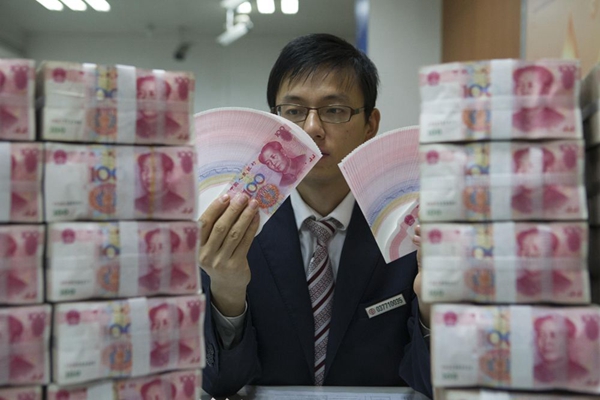
The illegal fundraising schemes involved 4 billion yuan (580 million U.S. dollars). [File Photo]

Chinese police in several provinces arrested more than 430 suspects in connection with internet-based pyramid-style schemes.

Police in Guangdong, Beijing, Zhejiang and Henan busted multiple gangs, said the Public Security Department of Guangdong Province on Thursday.

The illegal fundraising schemes involved 4 billion yuan (580 million U.S. dollars), with victims from across the country, said the department.

Guangdong police began to investigate the cases in March.

Some internet companies in the province organized themselves under the disguise of charities or high-tech biological products with promises of high returns.

In the first quarter, Guangdong police investigated more than 100 illegal fundraising cases and arrested more than 170 suspects, up 18 percent and 26 percent respectively.


Population in Beijing’s central areas drops in 2016

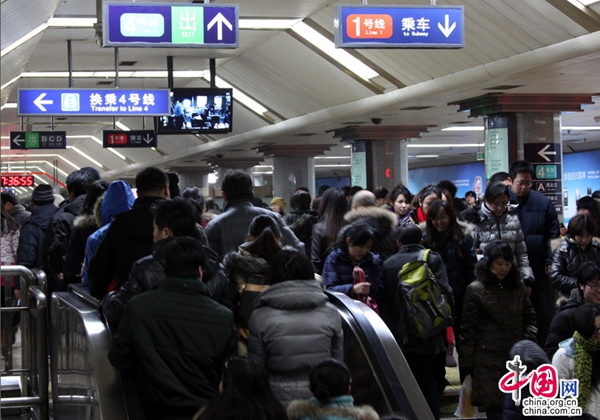
People rush to get a train at the Xidan Station in Beijing Subway. [Photo/China.org.cn]

The number of permanent residents in Beijing’s six main urban districts dropped by about 353,000 last year, according to the municipal bureau of statistics on Thursday.

The reduction is more than the entire population of Iceland.

Beijing plans to cap its population at 23 million by 2020, reducing the population in six core districts by 15 percent from the 2014 level.

The bureau of statistics found residents’ image of the city had improved.

A survey showed that 72.3 percent of those polled had confidence in Beijing’s becoming a high-class livable city, up 2.1 percentage points from the previous year, and 63.3 percent found the city more livable than last year.


Political advisors discuss training more patriotic religious elites

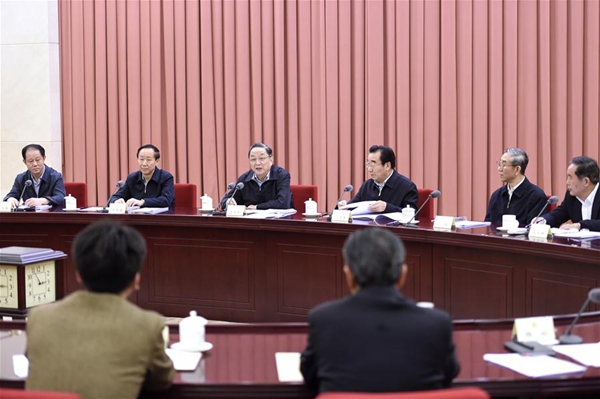
Yu Zhengsheng (3rd L), chairman of the Chinese People’s Political Consultative Conference (CPPCC) National Committee, presides over a biweekly consultation session on cultivation of patriotic young and middle-aged person in the religious group in Beijing, capital of China, April 13, 2017. [Photo/Xinhua]

Chinese political advisors met on Thursday to brainstorm on how to nurture more outstanding people who are both religious and patriotic.

Yu Zhengsheng, chairman of the National Committee of the Chinese People’s Political Consultative Conference (CPPCC), the top advisory body, chaired the biweekly meeting.

Members of the CPPCC National Committee said that generally the country lacks high-caliber and influential personages among various religious groups.

It is an important duty for all religious groups to train more believers that “are politically reliable, accomplished in religious study, moral and can play a role in critical moments.”

Some members suggested government authorities encourage the establishment of more religious education institutions and give them more support in capital and land use.

They also called on religious groups to improve curriculums and training of faculty.

Authorities should improve training and provide more job opportunities for outstanding candidates, and strengthen daily supervision over them, some political advisors suggested.

The country should also improve national education system to make all religious people better educated, some advisors said.


Foreigners easier to get ‘green cards’ in Shanghai FTZ

Permanent residence will enjoy the same rights as Chinese citizens in areas such as investment, housing purchases and schooling. [Photo/Xinhua]

The latest benefit of the Shanghai Free Trade Zone (FTZ) is to its non-Chinese residents, who can apply for permanent residence in China simply with a letter of recommendation from the FTZ authorities.

According to the social security bureau of Shanghai Pudong New Area, the new policy will take effect in mid-April, and apply to both the applicants and their spouses and minor children.

The move was made following 10 rules related to China’s entry and exit policy announced by the Ministry of Public Security (MPS), which authorize Shanghai Zhangjiang National Innovation Demonstration Zone and Shanghai FTZ to recommend high-level foreign staff for permanent residence permits, Chinese “green cards”.

Those with permanent residence will enjoy the same rights as Chinese citizens in areas such as investment, housing purchases and schooling.

The reform is to support Shanghai’s ambition of becoming a world sci-tech innovation hub.

Those who qualify for the fast track application include well-known award winners or high-level talent scheme finalists, such as Nobel laureates, the Chinese government “Friendship Award” and other world-class, national and municipal awards; people in charge of Shanghai FTZ-based national laboratories, engineering laboratories, foreign investment R&D institutions, and top-level talent from innovation and start-up enterprises.

A Chinese green card is one of the hardest to obtain with no more than 7,000 issued since 2004, when the policy was introduced. That compares with about 600,000 foreigners currently living in China, and the application procedure is rather complicated.

In 2016, 1,576 foreigners became permanent Chinese residents, an increase of 163 percent on the previous year, according the MPS.

China has made huge progress in easing its residence and entry policies for foreigners since September 2015, which has helped attract more talent from overseas as well as boosting international exchanges and the economy, according to a ministry statement.

Shanghai saw six times more permanent residence applications from foreigners and their families in 2016 from 2015. The number of such applications in Beijing last year increased 426 percent.