Urdu version of Xi’s book on governance launched in Pakistan
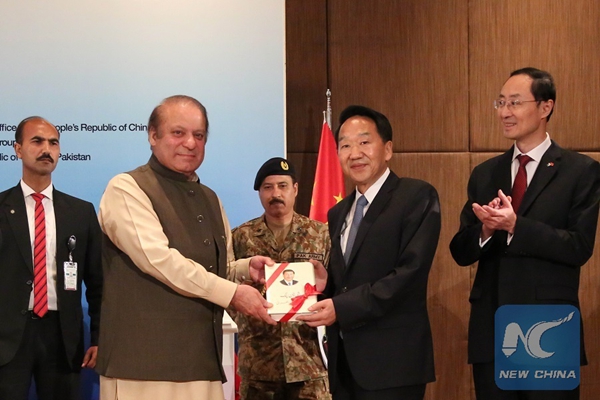
Jiang Jianguo (2nd, R), Vice Head of the Publicity Department of the Central Committee of the Communist Party of China, donates the Urdu version of Chinese President Xi Jinping’s book “Xi Jinping: The Governance of China” to Pakistani Prime Minister Nawaz Sharif (2nd, L) at the release ceremony at the Prime Minister Secretariat in Islamabad, capital of Pakistan on April 14, 2017.(Xinhua/Liu Tian)

The Urdu language edition of the book “Xi Jinping: The Governance of China” was launched here on Friday and the launching ceremony was attended by around 300 Pakistani and Chinese officials, academicians and researchers.

Pakistani Prime Minister Nawaz Sharif and Jiang Jianguo, vice head of the Publicity Department of the Central Committee of the Communist Party of China, participated in the ceremony.

In his speech, Sharif said the rich content of the book is both “enlightening and inspiring” and Chinese President Xi Jinping shares his experiences and thoughts with wisdom, empathy and kindness.

“What has touched me most is that this book is not just about high politics, but also about moving stories of common people, their lives and inspirations about hard work and family values. In our times, the peaceful development of China has stimulated peaceful rise of the entire world,” said Sharif.

He added that “this book is as much about our contemporary world as it is about China. This book is as much about Chinese dream as it is about the global dream to have peaceful, harmonious and connected world.”

For his part, Jiang said in his speech that to create a community of shared future of mankind is an important idea in the book since it aims to build a world with lasting peace, universal security, common prosperity, openness and inclusiveness as well as cleanliness and beauty, adding that this idea points out the direction of the development of the human society and a new method for international problems.

Jiang said Pakistan is China’s good friend, good neighbor, good brother and the prioritized partner of the Belt and Road Initiative, adding that the China-Pakistan Economic Corridor (CPEC) is the flagship project of the initiative and has created more than 10,000 jobs for the locals in Pakistan.

“We fully believe that after our joint cooperation and coordination, a more prosperous and better Pakistan will be presented in front of the world,” said Jiang.

Chinese Ambassador to Pakistan Sun Weidong said the English version of Xi’s book launched here in 2014 was warmly welcomed in the Pakistani society and the Urdu version will facilitate more Pakistani readers to understand Xi’s philosophy of governance, adding that the completion of the Urdu version becomes a new symbol of friendly cooperation between China and Pakistan in the new era.

Mushahid Hussain, chairman of Parliamentary Committee on China-Pakistan Economic Corridor, said Pakistan is grateful to China and Chinese President Xi for reposing faith and confidence in Pakistan and its people through the launch of the China-Pakistan Economic Corridor.

“Because the CPEC today is a factor for national unity and progress and prosperity of the people of Pakistan, the provinces of Pakistan, particularly the less developed regions of Pakistan in the quest to build a better and more prosperous future,” he added.

The book “Xi Jinping: The Governance of China” contains 79 speeches, talks, interviews, notes and letters of the Chinese leader between November 2012 and June 2014. To date, it has been translated into 16 languages and has a distribution of over 6.2 million copies around the world.

The book helps readers around the world better understand China’s development, domestic and foreign policies, and response to the concerns of the international community.

Akram Zaki, former Pakistan ambassador to China, told Xinhua that the Urdu version of the book will help more Pakistanis understand the new level of partnership of the two countries through the CPEC.

“Most of Pakistanis don’t know English and if they want to know what glorious things Chinese leadership is doing, this book will provide to the people who are fond of reading. They all talk about CPEC and China-Pakistan friendship, now they will know the significance of China-Pakistan friendship,” he said.

Farrukh Sohail Goindi, chief of the Jamhoori Publications in charge of the Urdu version’s translation, said it is an honor and pleasure for him to translate a Chinese president’s book in Urdu. “Through this book, we can understand the Chinese politics, the vision of Chinese president and the role of China-Pakistan friendship in the region and all over the world.”

Goindi, who reads the book five to nine times in different periods in different stages, told Xinhua after the ceremony that Urdu is an opinion-making language in Pakistan and through Urdu publication, a commoner can easily understand the role of China, the leadership of China, and the economic and political roles of China.


Good Friday

I attended the all Churches in Wokingham Good Friday service at the Methodist Church this morning. I went on with the congregation to see the Passion play in the town centre.

I would like to congratulate all involved in preparing it and performing in it, and all the helpers who provided hot cross buns at the end.


News story: UK personnel depart for NATO Kosovo role

A team of nearly 30 UK troops has left the UK for Southern Europe to join NATO’s Kosovo Force, helping to maintain safety, security and freedom of movement.

The year-long deployment will bolster the mission’s capability, following a request from NATO for further support to KFOR by allies. Its particular role will be to support KFOR’s ability to carry out intelligence, surveillance and reconnaissance. The UK team will be based in the KFOR headquarters in Pristina.

KFOR began as a peacekeeping force in the late 1990s. Now it has evolved into a smaller, more flexible body of around 4,200 troops, acting as one of the main security providers in Kosovo. Troops are contributed by some 30 countries, including Germany, Italy, Turkey, Poland and the US, as well as the UK.

At the NATO Summit in Warsaw last year, Allies reaffirmed that KFOR would continue to contribute to a safe and secure environment in Kosovo. It will also continue to adapt. As the Warsaw communiqué made clear, changes to the Alliance’s troop presence reflect conditions in the country. The force’s overall goal is to enable self-sufficient security in Kosovo.

Defence Secretary Michael Fallon said:

This deployment of troops demonstrates how we remain committed to supporting security and stability in the Western Balkans region. NATO remains a cornerstone of our defence and by defending the security of Europe we strengthen our security at home.

This deployment follows support the UK provided in Bosnia and Herzegovina in 2015 to the EU Force (EUFOR).

As the Prime Minister has announced the UK will be increasing its engagement in the Western Balkans, including through our hosting of the 2018 Western Balkans Summit.

The UK has more than 3,000 military personnel deployed on operations around the world, clearly demonstrating Britain’s global Defence footprint. The UK continues to meet NATO’s target of spending 2% of GDP on Defence, backed by a Defence budget that will rise every year for the rest of this decade.


Xiongan’s key role is to receive Beijing’s non-capital functions: vice premier

The Xiongan New Area’s most important role is as a new home for Beijing’s “non-capital” functions, according to Vice Premier Zhang Gaoli.

The creation of Xiongan New Area is a major historic and strategic decision that will be crucial for the millennium to come, and President Xi Jinping has been directly engaged in the planning process, Zhang told Xinhua.

The Xiongan New Area will be a green, livable and modern urban area, a region led by innovation-driven development, a demonstration area of balanced development, and a pioneering region of open development, Zhang said.

Quoting Xi, the vice premier said development of the new economic zone should protect the local environment, avoid becoming an industrial hub led by traditional industries and the real estate sector, lift growth of neighboring areas and seek higher levels of opening up, such as participating in the Belt and Road Initiative.

Development of the Xiongan New Area will explore new ways of addressing the problems of big cities, promote innovation and new growth engines, optimize the urban pattern and bridge the gaps in economic growth and public services in the Beijing-Tianjin-Hebei region, Zhang added.

The decision to set up the Xiongan New Area was made in a “scrupulous, prudent, methodical and democratic” manner, with senior officials of the Beijing-Tianjin-Hebei region development team meeting many times to discuss such issues as the restoration and protection of the region’s vast freshwater wetland Baiyangdian, Zhang said.

Zhang outlined key tasks to ensure steady and orderly progress.

The government will use the most advanced planning philosophy and international standards to create a green, smart area.

Development of Xiongan will move on gradually and methodically with no large-scale real estate development or illegal construction.

The government will strive to balance developing infrastructure and receiving Beijing’s non-capital functions.

A clean slate will allow the government to set up a lean, efficient and uniform management body and use market-oriented measures to finance the work, the vice premier said.

The plan for the Xiongan New Area was officially announced on April 1. The new economic zone will span Xiongxian, Rongcheng and Anxin counties in Hebei Province, eventually covering 2,000 square kilometers, with a population of 2 to 2.5 million.

Addressing a central economic meeting at the end of 2014, Xi said that transferring Beijing’s non-capital functions, lowering its population density and promoting economic and social development commensurate with its population and resources must be at the core of coordinated development of the Beijing-Tianjin-Hebei region.

During Communist Party of China (CPC) meetings in April 2015, Xi suggested investigating the possibility of a new city in Hebei, built according to new development concepts.

On March 24, 2016, Xi heard a report on the creation of Beijing’s “subsidiary center” in the eastern suburb of Tongzhou and another area — Xiongan — where non-capital functions would be transferred from Beijing.

On May 27, 2016, Xiongan New Area appeared for the first time in a report reviewed at a Political Bureau meeting of the CPC Central Committee.

Visiting the location on Feb. 23 this year, Xi expressed satisfaction with the location, population and natural resources of Xiongan.

“It’s a good choice, as it will not create too much trouble for locals, involves only a small amount of relocation and something can be achieved in a short time,” said Xi.

According to the president’s plans, the Xiongan New Area will primarily be the receiver of non-capital functions from Beijing, including some administrative and public institutions, company headquarters, financial institutions, higher education institutions and sci-tech units.


News story: Autonomy on the front line: supplying Armed Forces on the battlefield

As part of the MOD’s Innovation Initiative, £3 million has been invested through the Defence and Security Accelerator in the next stage of the Innovation Autonomy Challenge. Focusing on the challenging “last mile” of support, this Challenge aims to find innovative new ways of resupplying troops on the front line, and will be led by the Defence Science and Technology Laboratory (Dstl).

To reduce the risk to troops and improve efficiency, the UK aims to develop autonomous systems for unmanned delivery of combat supplies, drawing on the rapid progress of the private sector in the development of delivery drones and automated deliveries.

Minister for Defence Procurement, Harriett Baldwin said:

Making sure we use the latest technology to keep our personnel safe and have the kit they need is a key part of our £800 million innovation fund. We’re challenging industry and academia to work with us to design ground-breaking autonomous systems that will get supplies to the front line.

Our investment in innovative solutions demonstrates how the Government’s £178 billion equipment plan, supported by a rising Defence budget, will ensure that the UK maintains its military advantage in an increasingly dangerous world.

The Innovation Initiative and £800M Defence Innovation Fund aim to transform Defence to encourage imagination, ingenuity and entrepreneurship. From laser weapons to autonomous vehicles, the MOD is working with small firms, academics, industry, and the new Defence Advisory Panel to find Twenty-first century solutions to defence challenges.

Funding will made available in two tranches, up to £1.5m to develop initial platforms and technology concepts. At least £1.5 million more will then be released to build and test a smaller number of demonstrators, which can then be included in joint UK/US trials from October 2018.

The Challenge is the latest stage in Defence’s investment in unmanned and autonomous systems: In February, the Defence Secretary [announced]( the launch of a two year £8 million second phase of research and development with Leonardo Helicopters, exploring the future of unmanned air systems.

The competition runs until 21 June 2017 and further details of the competition can be found on the competition website.

The Dstl lead for the Innovation Autonomy Challenge Peter Stockel said:

We are particularly keen to reach out and encourage organisations that might not have worked with the defence and security sector before, such as those developing commercial driverless vehicles, drone delivery services and robotic agriculture, to get involved with the challenge and help us rapidly advance the way we deliver tactical military logistics.

The Innovation Autonomy challenge is part of the UK and US’s collaborative approach to innovation announced by Defence Secretary, Sir Michael Fallon, and former US Defense Secretary Ash Carter in 2015. The funding for this competition is focused on:

  • Airborne and ground-based unmanned systems to collect, transport and deliver supplies across challenging terrain.
  • Technology to enable those systems to operate more autonomously in the contested military environment.
  • Technology to autonomously manage logistics supply and demand in the tactical environment.

Defence and Industry Working Together

One of the aims of the Innovation Initiative is to streamline Defence’s work with industry from SME’s to multinationals: making clear what Defence needs from business, but also being open to imaginative and disruptive proposals from any source.

Most recently, over 200 Soldiers, Royal Marines and RAF, including personnel from the US Army, have been putting innovative kit through its paces on Salisbury Plain in the Army Warfighting Experiment 17 (AWE 17). Businesses of all sizes were invited to submit solutions to a range of ‘problems’ set by the AWE team. 72 products – from a tiny surveillance drone to a self-sterilizing water bottle – were selected for testing.

One developer taking part in the experiment produced a two-part lift and pulley system designed to take vital minutes off of the time it takes to get a casualty out of a damaged vehicle and to medical aid. The inventor of the system, Paul Bateman, an ex-soldier of 22 years’ service, now runs his one man business.

Paul said:

“The AWE has given me a unique opportunity to get my product tested in the field.”

Cutting-edge kit is no use unless our troops can use it when and where they need it. To make sure they can, the Minister for Defence Procurement, Harriett Baldwin, formally opened a huge state-of-the-art £83 million MOD logistics centre in Shropshire, which will streamline distribution and storage, delivering savings of around £500 million by 2028.

Beyond the physical battlefield, but at the heart of security, Dstl has also launched the Data Science Challenge, which will bring the brightest minds in data science—not just those in the defence and security sector—together to solve real-world problems, and is sponsored by Dstl, the Government Office for Science, the Secret Intelligence Service and MI5.