Way Back When – Life as an Art Student discussion event

From the Curator of Museum Services, University of Dundee :
Way Back When – Life as an Art Student discussion event

Tuesday 18th April 2017, 5.30pm at the D’Arcy Thompson Lecture Theatre, Tower Building, University of Dundee.

To accompany the exhibition of Walter Simms’ photographs in the Tower Foyer Gallery, this special event will feature Walter and some of his fellow graduates from Duncan of Jordanstone College reminiscing about their experiences as art students in Dundee in the late 1960s and early 1970s. 

Free admission but please book here.


Recording of the week: Akabira for flute ensemble

This week's selection comes from Tom Miles, Metadata Manager and Curator of Europeana Music.

This song, "Akabira", was recorded by Klaus Wachsmann in Kasule, Uganda, in 1954. Nshegu is the name given to an ensemble of flute players: the five members of the ensemble (pictured) each play an end-blown, composite cone-flute with a single note (some flutes have more than one note). By playing in a particular order, the nshegu players are able to create a vibrant, complex web of sound. 

Akabira for flute ensemble

Toro flute set  kasule  uganda  July 1954

Toro Flute Set, Kasule, Uganda, 6 July 1954

This is just one of over 1500 of Wachsmann's recordings which are available on British Library Sounds.

Follow @tommilesz, @BL_WorldTrad and @EuropeanaMusic for all the latest news.


10 killed in bus accident in SW China

Ten people died and five others were injured when a bus plunged into a river in Southwest China’s Guizhou Province Monday, local authorities said.

The accident happened at around 8:30 a.m. in Kaiyang, an outer county of the provincial capital Guiyang, the county government said in a statement.

The 19-seat bus, en route from Kaiyang to Weng’an county in Bouyei-Miao autonomous prefecture of Qiannan, veered off a road bridge on provincial highway S305 and fell into the river, it said. Four people were reported missing in the accident.

Rescue work was continuing as of 12 p.m.

The local government has launched an investigation.


Parliament will be sovereign

Parliament can make mountains out of any molehill in the UK, once we have left the EU. It is curious that those most hostile to our departure from the EU now claim to  be the most protective of the very Parliamentary sovereignty they so wantonly gave away. They need not worry.  Out of the EU,  Parliament can debate and vote on anything it wishes. It can hold government to account and change the law any day it likes.

The synthetic anger over the so called Henry VIII clauses in the Great Repeal Bill are just such a phoney war and a false tenderness towards the UK Parliament. The government has made clear that all substantive changes to EU laws, ranging from a new immigration policy to a  new fishing policy, will of course need primary legislation. Parliament can shape and influence that to its heart content, in a way it could never do when the rules were laid down by the EU.

The so called Henry VIII powers, often used to drive through EU matters, will only be used for government to make technical changes to existing EU law to make sure it does still work as UK law! That surely is something the Remain people should like, as presumably they welcome the continuity of much EU law as UK law.

It is a curious feature of the modern debate that the Remain supporters in Parliament want us to talk about nothing but Brexit the whole time, and then complain that we do not debate and vote on it enough. As one who welcomes Parliamentary scrutiny and debate on the use of power  I have no problem with Parliament doing this. Parliament does, however, need to have some sense of balance and proportion. We need to complement the many hours of debate and scrutiny of the UK’s position on Brexit with proper use of our powers in many other areas, and more debate of the needs and tactics of the rest of the EU.

It is fine for the Opposition to criticise or demand more of the government. It should also be the loyal Opposition, recognising the impact its words may have on the UK’s position in the EU talks.


Shenzhen plans to get tough on use of sharing bikes

Where to leave shared bike? Rules rolling into Shenzhen

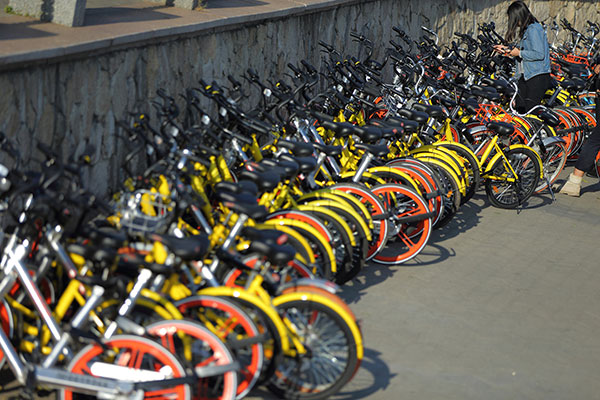
 Bicycles of Mobike and Ofo, two major bike-sharing service providers in China, are parked outside a park in Shenzhen, Guangdong Province. [Photo/China Daily]

China imposes some of the world’s toughest driving restrictions for cars, and now the checks and controls are expanding to the bicycle-sharing industry.

Police in Shenzhen said over the weekend that they are considering restrictions on the use of shared bikes, especially during holidays, to prevent road congestion and public disorder.

Police said that about 520,000 bikes have been put on the streets in the city in the year since bike sharing began.

A growing number of people are taking the colorful two-wheelers to work or using them for recreation, which has brought some challenges. Over the Tomb Sweeping Day holiday earlier this month, for example, paths at a local park became seriously clogged with bikes, while careless parking of shared bikes often blocks traffic.

The police are partnering with bike-sharing companies to monitor the number of bikes in designated areas. Under the plan, if the accumulation of bikes in an area hits a certain number, a warning system will be activated that prohibits bikes from entering, with cyclists notified via a mobile app.

A limit on the number of bikes will be also enforced, along with temporary bans in certain public places during peak seasons.

Bike-sharing companies should be held responsible if their negligence leads to serious accidents, the police said. The companies have been ordered to report to police the number of bikes to be released in key areas before holidays.

The bicycle-sharing industry took off in China about two years ago when startups set out to use internet technology to transform the mobility sector.

A rider typically pays about 1 yuan ($0.15) an hour after unlocking a bicycle with a mobile app. The bike can be dropped off anywhere for the next user. Mobike,  Ofo and Bluegogo are the major service providers.

According to analysis by a Beijing think tank, 18.86 million people in China used a shared bicycle at least once last year. The number is expected to hit 50 million this year, which will bring new headaches for urban management-including random parking.

On Tuesday, Shanghai’s downtown Huangpu district banned the riding or parking of bicycles, whether private or rented, in five busy commercial areas, including the Bund and Nanjing Road Pedestrian Street. On another 22 roads-mostly popular commercial streets without bicycle lanes-bikes can be parked but not ridden, according to the district government.