EU-China relations

Two decades ago, China and Europe traded much less with each other. Today, the EU is China’s biggest trading partner, while China is the EU’s second largest trading partner after the United States. Trade in goods between the EU and China is worth well over €1.5 billion a day, with EU exports amounting to €170 billion and imports to €345 billion in 2016. The EU and China therefore have a significant stake in each other’s prosperity and sustainable growth.

Under the umbrella of the annual High-Level Economic and Trade Dialogue, the last meeting of which happened in October 2016, the EU works together with China on key economic and trade issues of mutual interest, including investment, services, procurement and intellectual property rights. Reciprocity, as well as progress in China’s announced economic reform programme, and in particular those reforms aimed at giving the market a more decisive role and levelling the playing field, are key for our bilateral relationship.

With respect to sectors in overcapacity, notably, the steel sector, China needs to engage constructively in international dialogue and information exchanges on capacity developments, government policies and support measures. The Global Forum on steel overcapacity provides an opportunity to increase transparency and engage constructively with a view to finding sustainable solutions. The EU offers to complement this multilateral avenue of discussion by sharing its wealth of experience in restructuring the steel sector and support China’s on-going efforts in the context of a bilateral steel platform.

In 2014, the EU accounted for nearly 16% of total Foreign Direct Investment (FDI) inflows into China, making it one of the top five FDI providers to the country. There is scope for much more, as China is the destination of only 4.5% of total EU FDI outflows. China’s investment in the EU has grown exponentially in the past decade. In 2014 China’s FDI flows into the EU amounted to €12.1 billion, and by 2015 the EU share of total Chinese FDI flows grew to 19%. This makes the EU the most important destination for Chinese outward investment. The Comprehensive Agreement on Investment, which is currently being negotiated between the two sides, aims to improve the protection of investments, market access and level the playing field.

The EU and China share strong interest in each other’s investment flagship initiatives, namely the Investment Plan for Europe, and the “One Belt, One Road” initiative. The EU and China also support efforts to improve connectivity in Asia for the benefit of all European and Asian partners. The EU-China Connectivity Platform, established in 2015, promotes cooperation in infrastructure, encompassing financing, interoperability, logistics, and maritime and rail links across the Eurasian continent.

Strengthening research and innovation cooperation is central to EU-China relations. In the framework of the High Level Innovation Cooperation Dialogue, the EU and China are working towards ensuring reciprocal access to their research and innovation funding programmes. Developing co-funding mechanisms and flagship initiatives in the context of the EU’s Horizon 2020 is helping promote long-term joint research and innovation partnerships in strategic areas of common interest.

Active people-to-people engagement between the EU and China contributes to fostering inter-cultural dialogue, promoting cultural diversity and civil society participation. Tourism from China to the EU has increased significantly in the past decade, and more than 30,000 people have already benefitted from scholarships to study, work or conduct research in the EU and China. Under the auspices of the High-Level People-to-People Dialogue, the EU and China promote the upgrading of their people-to-people exchanges through youth and culture projects, festivals and dialogues. On 11 October 2016 the first China-EU Education Ministers Conference took place in Beijing, with the Sino-Europe Forum on Education Policy Think Tanks held in the margins. Many topics were discussed, including the progress in the participation of China in the EU-led U-Multirank and Tunin initiatives. Furthermore, steps towards facilitating the use of the legal channels of mobility and to combating irregular migration continue to be successfully taken in the context of the EU-China Mobility and Migration Dialogue, the third meeting of which took place on 17 March 2016. Under the Dialogue the EU is now aiming to soon launch the parallel negotiation of the agreements on visa facilitation and on co-operation in combating illegal migration.


MoU on CCP supervision with Reserve Bank and Financial Markets Authority of New Zealand

Download PDF


Article – Eggs: how the EU is keeping them safe and healthy

Decorating eggs is one of Europe’s most cherished Easter traditions, but are the eggs we buy safe? The European Parliament has worked on different laws to ensure hens and their eggs are healthy. This includes a ban on the use of battery cages for hens and the use of the egg code to inform shoppers how an egg was produced. Watch our video for more information.

Some seven million tonnes of eggs are produced in the EU every year. France, Italy and Germany are the biggest producers and the main markets are Japan, Switzerland and the US.

The average Europeans eats about 200 eggs a year. Not only are eggs rich in protetin, they can also be used in anything from cosmetics to vaccines and glue.


News story: HMS Enterprise returns home after three years on Navy operations

During her time away she helped to stop people smuggling across the globe, saved thousands of lives at sea, and protected Britain’s interests.

Minister of State for the Armed Forces Mike Penning said:

During her three years deployed away from the UK, HMS Enterprise and her ship’s company have helped make the world a safer place.

From disrupting people smuggling in the Mediterranean to assisting in the free flow of trade in the Gulf, and from providing reassurance to our overseas territories to surveying the world’s oceans, she has epitomised how the Royal Navy is protecting the UK’s global interests.

In almost three years she has steamed 150,000 nautical miles, visited 20 countries, and navigated four of the seven seas.

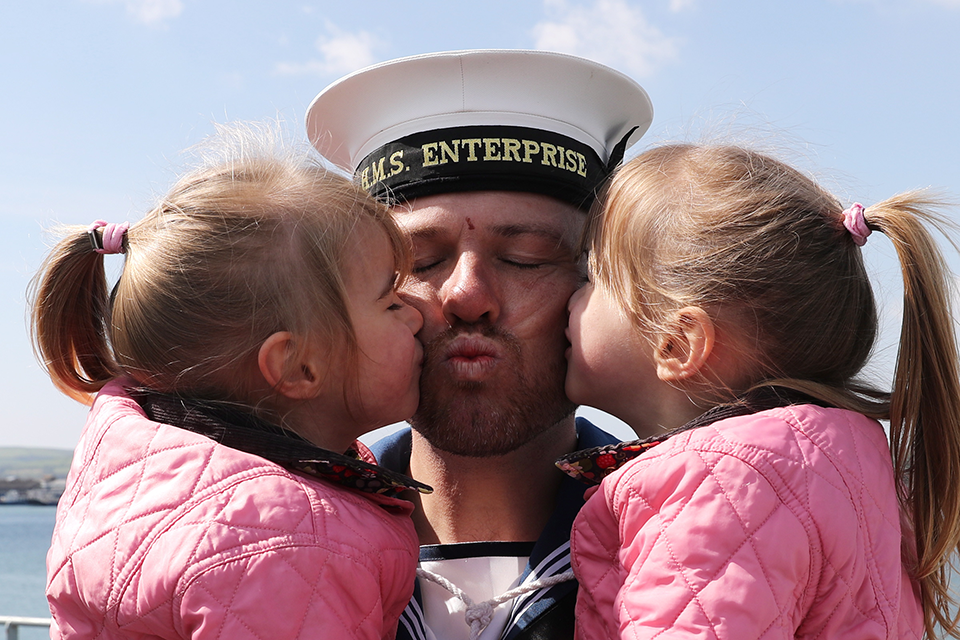
LH Payne with his twins girls Summer and Amelia

HMS Enterprise’s epic deployment began in June 2014, when she headed to the Mediterranean on a routine deployment. At the time, growing unrest in Libya led to the UK government encouraging British citizens to evacuate, and Enterprise was tasked with rescuing more than 200 people from Libya.

She was then tasked with conducting survey operations in the Gulf and southern Red Sea, joining the continuous Royal Navy presence in the region which works to secure some of the most vital shipping lanes in the world and protect Britain’s economy.

It was during this time that teams from the ship volunteered to visit an orphanage in India, helping to refurbish several classrooms, build some swings and even fix a trampoline.

Enterprise later moved to the Mediterranean where she joined the naval force set up to deal with people smuggling. Over the course of the following year, the sailors on board destroyed over 100 unseaworthy craft and rescued over 9000 people. As a result she was awarded the Firmin Sword of Peace, the Naval Capability Prize and the HM Efficiency Award, as well as receiving a personal commendation from the Chief of the Defence Staff.

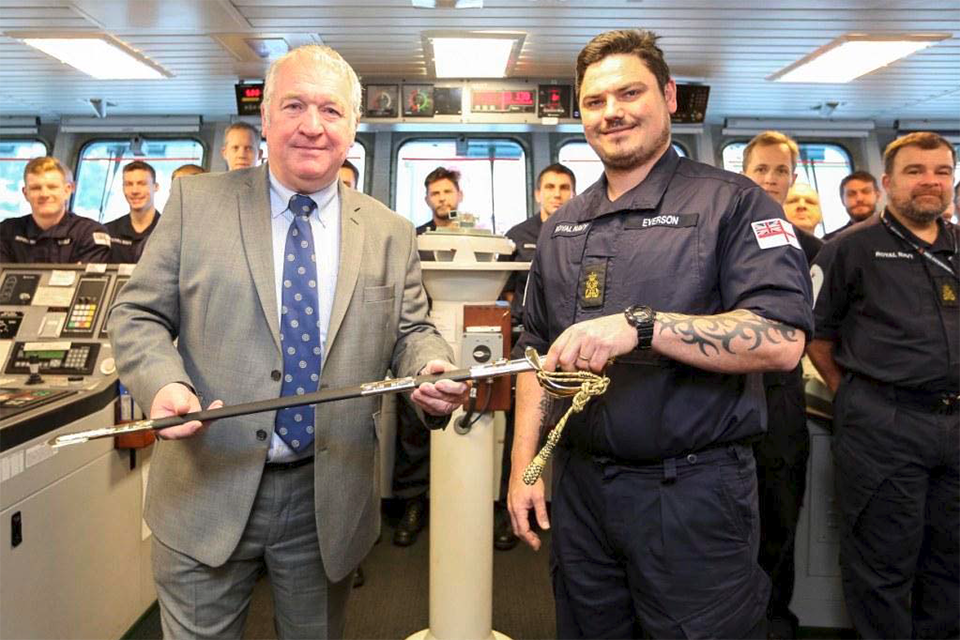
PO Everson accepts the Firmin Sword from Minister for the Armed Forces Mike Penning

Following the heat of the Mediterranean Enterprise was re-tasked to the South Atlantic to stand in for Falkland Islands patrol vessel HMS Clyde during her refit in South Africa.

The ship, and her crew of 78 sailors, returned to Devonport today for the warmest of welcomes from friends and families. Commander Philip Harper, Commanding Officer of HMS Enterprise said;

The crew of HMS Enterprise are justly proud of the work they have done since deploying, and the wide variety of operations will be hard to match in the rest of our careers.

At the same time, we are all really looking forward to coming home. The results of our deployment speak for themselves and we are all eager to spend some time with our families before the ship deploys again later this year.


Press release: More than 400 rod licences checked in Easter crackdown

Environment Agency officers checked more than 400 rod licences in an Easter weekend crackdown on illegal fishing.

Officers patrolling North East river banks checked 421 anglers, reporting 29 offences.

Of these, 21 were for rod licence offences, 7 were byelaw and close season offences and one offence under the Theft Act.

It’s currently the close season for coarse fishing, which means fishing for coarse fish on rivers and streams is not permitted. This is done to protect breeding fish, helping to safeguard stocks for the future.

Kevin Summerson, Fisheries Enforcement Technical Specialist at the Environment Agency, said:

It’s encouraging that the vast majority of anglers abide by the law, but there are still too many that we find during patrols that are fishing illegally.

We take illegal fishing very seriously – it’s not fair on other anglers and endangers the future of the sport.

Our work is intelligence led and we work closely with our partners at the police and Angling Trust to target known hot spots and where illegal fishing is reported to us.

We carry out enforcement work all year round and will be continuing throughout the coming weeks, including the upcoming Bank Holiday weekends.

We really want people to get outdoors and enjoy what is a fantastic sport, and the rod licence is great value for money for all the family.

I’d urge people to help us protect the health of our fisheries by reporting any suspected illegal activity to us.

All the money from rod licence sales goes back into maintaining the health of fisheries and waters, angling projects and much more.

Anyone caught fishing without a valid licence could be fined up to £2,500 and fishing during the close season attracts a fine of up to £50,000.

Coarse fishing is still allowed on most still waters and canals, depending on fishery owner agreement, though a valid fishing licence is still required. You can check which still waters and canals still have a close season in operation by checking the byelaws which apply in your area at https://www.gov.uk/government/collections/local-fishing-byelaws

Anyone who wants to go fishing needs to buy a fishing licence. A full annual licence costs £30 (short term and some concessionary licences are also available) and are available online at www.gov.uk/get-a-fishing-licence.

Environment Agency officers routinely carry out licence checks and anyone with information about illegal fishing activities is urged to report it via the Environment Agency’s Incident Hotline on 0800 80 70 60 or anonymously to Crimestoppers on 0800 555 111.