If Theresa May is so proud of her record, why won’t she debate it? – Jeremy Corbyn

Jeremy Corbyn MP, Leader of the
Labour Party
,
commenting on the news ITV are to host a pre-election debate, said:

“I welcome ITV’s decision to
attempt to hold a TV debate with the Prime Minister. If Theresa May is so proud
of her record, why won’t she debate it?

“She cannot be allowed to run away
from her duty to democracy and refuse to let the British people hear the
arguments directly.”


News story: £1.4 billion deal for Royal Navy’s new attack submarine

The submarine, named Agamemnon, is part of the Astute Class, the largest, most advanced and most powerful attack submarines ever to enter service with the Royal Navy. The submarines are being built by BAE Systems in Barrow-in-Furness, Cumbria, which employs around 8,000 people in its Submarines business, with thousands more working in the UK submarine supply chain.

The new contract guarantees a better deal for the UK taxpayer and for the Armed Forces, with an incentivised contract arrangement that will help to save money and demands the best possible work from industry.

Defence Secretary Sir Michael Fallon said:

This latest investment means we are well on our way to completing our fleet of Astute submarines. These are the most advanced submarines ever operated by the Royal Navy and are already providing unprecedented levels of stealth and attack capability across the world.

Backed by a rising defence budget and a £178 billion equipment plan, Barrow will remain the hub of our submarine build programmes providing high skilled jobs for years to come.

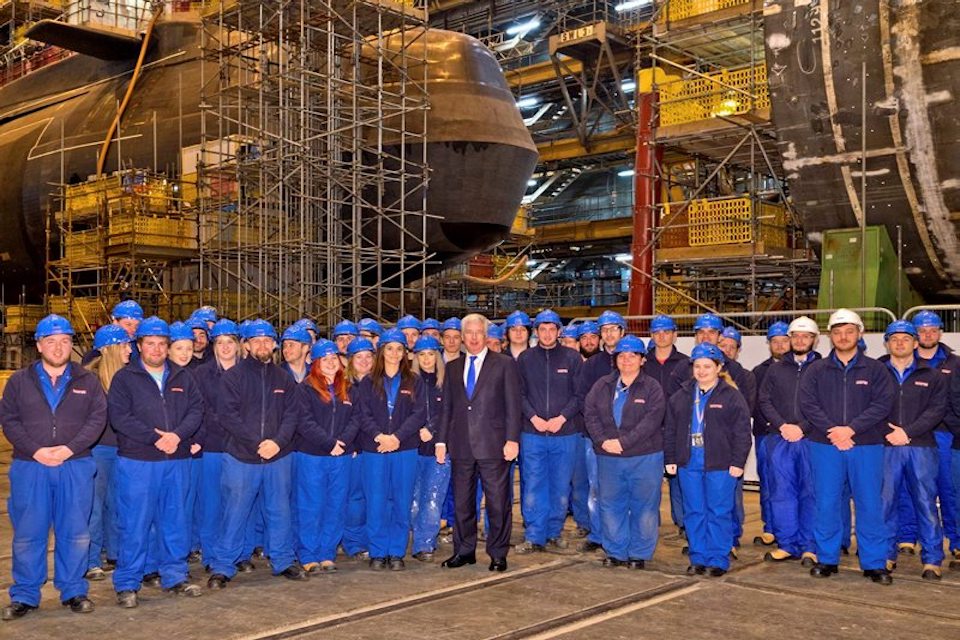
Defence Secretary Sir Michael Fallon with BAE Systems apprentices inside Devonshire Dock Hall where HMS Agamemnon is under construction.
Defence Secretary Sir Michael Fallon with BAE Systems apprentices inside Devonshire Dock Hall where HMS Agamemnon is under construction. Picture: Michael Vallance, BAE Systems.

Construction of the 7,400 tonne, 97-metre long Agamemnon began in 2012, and is well underway in the Devonshire Dock Hall at Barrow, alongside Boat 5 – Anson – and the yet-to-be-named Boat 7. Their sister submarines, HMS Astute, Ambush and Artful are already in service with the Royal Navy, contributing to operations around the globe.

Rear Admiral Paul Methven, Director Submarines Acquisition for the Submarine Delivery Agency, said:

The signature of this contract secures another world-class nuclear submarine for the Royal Navy. These are the most technologically advanced submarines we have ever operated, offering much greater firepower, better communications and more advanced stealth technology than their predecessors.  

Today marks another significant milestone for the Astute programme, that demonstrates the UK’s ability to deliver complex engineering projects, providing a fleet of submarines which will protect the UK’s interests around the globe.

Featuring the latest nuclear-powered technology, the Astute Class submarines can circumnavigate the world submerged, manufacturing the crew’s oxygen from seawater as they go. They also have the ability to operate covertly and remain undetected in almost all circumstances despite being 50 per cent bigger than the Royal Navy’s current Trafalgar Class submarines which are being replaced by the Astute Class.

Will Blamey, Managing Director of BAE Systems Submarines, said:

Securing the contract for the sixth Astute class submarine is a significant milestone for BAE Systems and the result of many years of hard work by our highly skilled workforce. The Astute class submarines are amongst the most highly capable and technologically advanced in the world and we’re immensely proud to build them for the Royal Navy.

Alongside work on the Astute Class, BAE Systems is also the industrial lead for the Dreadnought programme, the Royal Navy’s next generation of nuclear deterrent submarines.


Western Mediterranean: Actions for the sustainable development of the blue economy

The region covers economic hubs like Barcelona, Marseille, Naples and Tunis. It also includes tourist destinations like the Balearic Islands, Sicily and Corsica.

The sea’s biodiversity is under severe pressure with a recent report by scientists from the Joint Research Centre indicating that 50% has been lost in the last 50 years. In addition to this are recent security and safety concerns from the increase in migration from the South to the North.

This initiative will allow EU and neighbouring countries to work together to increase maritime safety and security, promote sustainable blue growth and jobs, and preserve ecosystems and biodiversity.

Karmenu Vella, Commissioner for Environment, Maritime Affairs and Fisheries said: “Millions of holiday makers have a happy association with the Western Mediterranean. Like the millions more who live across the region, they understand the fragile link between conserving national habitats and traditions and ensuring economic viability. Blue economy is important for each of the countries involved and they have recognised the strength of working together.”

Johannes Hahn, Commissioner for European Neighbourhood Policy and Enlargement Negotiations, said: ”This new regional initiative recognises and taps into the economic potential of the Mediterranean Sea and its coast lines to further enhance economic growth, contribute to job creation and eventually the stabilisation of the region. It is an important step towards closer coordination and cooperation among participating countries.”

The initiative is the fruit of years’ of dialogue between ten countries of the Western Mediterranean region who are ready and willing to work together on these shared interests for the region: five EU Member States (France, Italy, Portugal, Spain and Malta), and five Southern partner countries (Algeria, Libya, Mauritania, Morocco and Tunisia). It follows up on the Ministerial Declaration on Blue Economy endorsed by the Union for Mediterranean (UfM) on 17 November 2015.

The goals of the initiative

By fostering cooperation between the ten countries concerned, this initiative has three main goals:

  1. A safer and more secure maritime space
  2. A smart and resilient blue economy
  3. Better governance of the sea.

Gaps and challenges have been identified and a number of priorities and targeted actions have been set for each goal.

For Goal 1 priorities include cooperation between national coast guards and the response to accidents and oil spills. Specific actions will focus on the upgrade of traffic monitoring infrastructure, data sharing and capacity building. For Goal 2 priorities include new data sourcing, biotechnology and coastal tourism. For Goal 3, priority is given to spatial planning, marine knowledge, habitat conservation and sustainable fisheries.

The initiative will be funded by existing international, EU, national and regional funds and financial instruments, which will be coordinated and complementary. This should create leverage and attract funding from other public and private investors

This “Initiative for the sustainable development of the blue economy of the Western Mediterranean” is another example of the EU’s successful neighbourhood policy. Barely three weeks ago, the EU secured a 10-year pledge to save Mediterranean fish stocks. The MedFish4Ever Declaration, signed by Mediterranean ministerial representatives from both Northern and Southern coastlines on 30 March, involves 8 Member States (Spain, France, Italy, Malta, Slovenia, Croatia, Greece, and Cyprus) and 7 third countries (Morocco, Algeria, Tunisia, Egypt, Turkey, Albania, Montenegro). The two projects will enhance each other in protecting the region’s ecological and economic wealth.

Background

The initiative is based on the Commission’s long-standing experience with sea basin and macro-regional strategies (such as the Atlantic Strategy, the EU Strategy for the Baltic Sea Region and the EU Strategy for the Adriatic and Ionian Region). It is also based on over two decades of work within the 5+5 Dialogue, which has created strong ties between the participating countries. Furthermore, the initiative builds on other EU policies linked to the region, such as the European Neighbourhood Policy Review priorities and the recent Communication on International Ocean Governance.

The initiative is presented in two documents. A Communication outlines the main challenges, shortcomings and the possible solutions. A Framework for Action presents the identified priorities, actions and projects in detail, with quantitative targets and deadlines to monitor progress over time. Some of the actions could extend well beyond the countries in question and even beyond the sub-basin.

For More Information

Communication

Framework for Action

MEMO/17/1001

MEDFISH4ever Declaration

Ocean governance

Blue Growth


Western Mediterranean: Actions for the sustainable development of the blue economy

Why do we need an initiative for the sustainable development of the blue economy in the western Mediterranean?

The western Mediterranean Sea has enormous wealth in terms of natural resources, cultural assets and diversity of people and places. The various sectors of the maritime economy have vast potential for development. But despite the major assets, the region faces a number of challenges which give rise to geopolitical instability: a prolonged economic and financial crisis with high youth unemployment in several countries, growing coastal urbanisation, the overexploitation of fish stocks, marine pollution and last but not least the refugee crisis. In addition climate change greatly affects the region and the rise in sea level is a major threat to coastal ecosystems and economies. Other factors such as population growth and ageing, migration and deepening globalisation are bound to magnify these pressures.

How has the initiative for western Mediterranean come about?

This Initiative for the Western Mediterranean follows up on Ministerial Declaration on the Blue Economy endorsed by the Union for Mediterranean on 17 November 2015, which invited the participating countries to explore the added value and the feasibility of appropriate maritime strategies at sub-regional level, and build on the experience of the 5+5 Dialogue. In October 2016, the Foreign Affairs Ministers of Algeria, France, Italy, Libya, Malta, Mauritania, Morocco, Portugal, Spain and Tunisia encouraged further work on an initiative for the sustainable development of the blue economy, together with the Union for the Mediterranean (UfM) Secretariat.

The Initiative results from close cooperation between the European Commission and the national governments, the UfM Secretariat, the region’s stakeholders and regional organisations such as General Fisheries Commission for the Mediterranean, the UN Environmental Programme, the Mediterranean Action Plan and the Conference of Peripheral and Maritime Regions. The process started in February 2016 and culminated a year later with a Stakeholder Conference in Barcelona.

Which countries are involved?

The geographical scope of this strategy is based on the western Mediterranean sub-basin and concerns ten countries: five EU Member States (France, Italy Portugal, Spain and Malta) and five non-EU countries (Algeria, Libya, Mauritania, Morocco and Tunisia). As it concerns both EU and partner countries, it will have to be politically endorsed both in the EU and in the Union for the Mediterranean.

Will it be open to other countries?

The scope of action and the potential benefits of this initiative could easily extend beyond the western Mediterranean sub-basin. Marine and coastal areas are interconnected systems, so depending on the needs to be addressed, actions may involve partners in the central Mediterranean and north-east Atlantic and will remain open to other partners.

What are the main objectives and goals of the Initiative?

By fostering coordination and cooperation among the ten countries, the Initiative aims to increase safety and security; promote sustainable blue growth and jobs; and preserve ecosystems and biodiversity in the western Mediterranean region. It therefore focusses on three main goals (a safer and more secure maritime space, a smart and resilient blue economy and a better governance of the sea) and proposes a number of priority actions to reach those goals. A Framework for Actionidentifies the gaps that need to be filled and the potential added value of the actions proposed.

How is this initiative linked to EU policies? What areas will it cover?

Rather than creating new legislation, this Initiative aims to achieve the Commission’s priorities (‘A New Boost for Jobs, Growth and Investment’, ‘A Resilient Energy Union with a Forward-Looking Climate Change Policy’, ‘Towards a New Policy on Migration’ and ‘A stronger global actor’) by strengthening cross-border cooperation in the region and fostering compliance with EU law. Special emphasis is laid on better synergy between existing funds and on an integrated approach that ties together different policy strands and strongly interconnects EU policies and initiatives.

The Initiative complements the MedFish4Ever Declaration (Malta, 30 March 2017), which sets out a detailed work programme for the next 10 year to save the Mediterranean fish stocks and protect the region’s ecological and economic wealth.

Who will benefit from the Initiative?

All stakeholders in the region will benefit from the Initiative, including local, regional and national administrations, universities, maritime clusters, training institutions, businesses, SMEs, fishermen, civil society organisations and investors. And last but not least the people living in the region.

How will the Initiative be funded?

The Initiative will be funded through the existing international, EU, national and regional funds and financial instruments. As per a conservative estimate, the funds available for implementing this Initiative amount to at least € 4 billion. In addition the EU is envisaging creating a dedicated assistance mechanism for the western Mediterranean and launching focused calls to promote maritime clusters, Maritime Spatial Planning and cooperation between maritime training institutes and between coastal communities on small scale fisheries in the region amounting to about €10 million.

What are the next steps?

The Commission invites the European Parliament and the Council to endorse this Communication. The Commission also invites the Committee of the Regions and the European Economic and Social Committee to provide opinions on this Initiative.

The participating countries will also need to take ownership and define a governance structure to lead and implement this Initiative. Based on their reports, the Commission will in turn report on the implementation to the Council and the European Parliament by 2022.


Daily News 19 / 04 / 2017

President Juncker and Members of the Commission at the IMF/World Bank Spring meetings in Washington DC

As of tomorrow, President Juncker and several Members of the Commission will travel to Washington DC (USA) for the International Monetary Fund and World Bank Spring Meetings on 20-22 April. President Juncker, Vice-President Dombrovskis, Commissioner Hahn, and Commissioner Moscovici will represent the Commission at different events hosted in that framework. The G20 Finance Ministers and Central Bank Governors meetings will also be held in the margins. President Juncker will meet, among others with World Bank Group President Jim Yong Kim, IMF Managing Director Christine Lagarde and United Nations Secretary General António Guterres. He will also have a working dinner with Sir Suma Chakrabarti, President of the European Bank for Reconstruction and Development; Mr. Werner Hoyer, President of the European Investment Bank; Mr. Rolf Wenzel, Governor of the Council of Europe Development Bank; Mr. Jin Liqun, President of the Asian Infrastructure Investment Bank; Mr. Takehiko Nakao, President of the Asian Development Bank; Mr. Akinwumi Adesina, President of the African Development Bank, and Mr. Luis Alberto Moreno, President of the Inter-American Development Bank. The other Members of the Commission present in Washington also have a variety of high-level bilateral meetings, speaking engagements and other commitments. A more detailed calendar is available here. (For more information: Margaritis Schinas – Tel.: +32 229 60524; Annika Breidthardt – Tel.: +32 229 56153)

Commission renews cooperation for sustainable development of the blue economy in the Western Mediterranean

Today, the European Commission launches a new initiative for the sustainable development of the blue economy in the Western Mediterranean region that will increase maritime safety and security, promote sustainable blue growth and jobs, and preserve ecosystems and biodiversity. Karmenu Vella, Commissioner for Environment, Maritime Affairs and Fisheries said: “Millions of holiday makers have a happy association with the Western Mediterranean. Like the millions more who live across the region, they understand the fragile link between conserving national habitats and traditions and ensuring economic viability. Blue economy is important for each of the countries involved and they have recognised the strength of working together.” The initiative is an example of EU’s successful neighbourhood policy as five EU Member States (France, Italy, Portugal, Spain and Malta) and five Southern partner countries (Algeria, Libya, Mauritania, Morocco and Tunisia) will work jointly on their shared interests in the region. Johannes Hahn, Commissioner for European Neighbourhood Policy and Enlargement Negotiations, said: ”This new regional initiative recognises and taps into the economic potential of the Mediterranean Sea and its coast lines to further enhance economic growth, contribute to job creation and eventually the stabilisation of the region. It is an important step towards closer coordination and cooperation among participating countries.” The enhanced cooperation is particularly timely as just three weeks ago the Commission secured a 10-year pledge to save Mediterranean fish stocks in the Ministerial MedFish4Ever Declaration. Among others, the initiative’s targeted actions include cooperation between coast guards, response to accidents and oil spills, habitat conservation, biotechnology, data sharing, marine knowledge and coastal tourism. For more information on the priorities and specific actions of the initiative a full press release and MEMO are online. (For more information: Daniel Rosario – Tel.: + 32 229 56185; Iris Petsa – Tel.: + 32 229 93321)


Commission launches public consultation on how excise duties are applied to alcoholic beverages

The European Commission has today launched a public consultation on how excise duties are applied to alcohol and alcoholic beverages (“excise duty structures”). EU excise duty rules for alcohol aim to prevent trade distortions in the Single Market, ensure fair competition between businesses, and reduce administrative burden for businesses. Concretely, the rules define product categories, methods to charge the duty and provide for reduced rates and exemptions from excise duty. However, these rules have not changed since 1992 and a recent Commission report has recommended clearer tax rules to support small producers of alcoholic beverages and to fight the sale of dangerous counterfeit alcohol. The Commission is also keen to reduce costs for smaller businesses. In December, EU Finance Ministers requested that the Commission carry out the necessary studies to prepare a possible legislative proposal to revise the common rules. The aim now is to identify ways to alleviate the administrative burden for both Member States and business, while reducing distortions in the internal market. Excise duties are indirect taxes on the sale or use of specific products. They are usually applied as an amount per quantity of the product – e.g. per 1,000 litres in the case of alcohol. Revenues from excise duty go directly to the coffers of EU Member States. The consultation will run until 7 July 2017 and is available here. (For more information: Annika Breidthardt – Tel.: +32 229 56153; Patrick McCullough – Tel.: +32 229 87183)


Eurostat: Mars 2017: Le taux d’inflation annuel de la zone euro en baisse à 1,5% – Celui de l’UE en baisse à 1,6%

Le taux d’inflation annuel de la zone euro s’est établi à 1,5% en mars 2017, contre 2,0% en février. Un an auparavant, il était de 0,0%. Le taux d’inflation annuel de l’Union européenne s’est établi à 1,6% en mars 2017, contre 2,0% en février. Un an auparavant, il était de 0,0%. Ces chiffres sont publiés par Eurostat, l’office statistique de l’Union européenne. En mars 2017, les taux annuels les plus faibles ont été observés en Roumanie (0,4%) ainsi qu’en Irlande et aux Pays-Bas (0,6% chacun). Les taux annuels les plus élevés ont été enregistrés en Lettonie (3,3%), en Lituanie (3,2%) et en Estonie (3,0%). Par rapport à février 2017, l’inflation annuelle a baissé dans dix-sept États membres, est restée stable dans six et a augmenté dans cinq autres. Un communiqué de presse est disponible ici. (Pour plus d’informations: Annika Breidthardt – Tél.: +32 229 56153; Juliana Dahl – Tél:+32 229-59914)

Eurostat: Février 2017: Excédent de 17,8 milliards d’euros du commerce international de biens de la zone euro – Excédent de 1,7 mrd d’euros pour l’UE28

D’après les premières estimations pour le mois de février 2017, les exportations de biens de la zone euro (ZE19) vers le reste du monde se sont établies à 170,3 milliards d’euros, en hausse de 4% par rapport à février 2016 (163,2 mrds). Les importations depuis le reste du monde ont quant à elles été de 152,6 mrds d’euros, en hausse de 5% par rapport à février 2016 (144,9 mrds). En conséquence, la zone euro a enregistré en février 2017 un excédent de 17,8 mrds d’euros de son commerce international de biens avec le reste du monde, contre un excédent de 18,2 mrds en février 2016. Le commerce intra-zone euro a progressé à 149,1 mrds d’euros en février 2017, en hausse de 5% par rapport à février 2016. Un communiqué de presse est disponible ici. (Pour plus d’informations: Daniel Rosario – Tel.: + 32 229 56185; Kinga Malinowska- Tel.: +32 229 Kinga 51383)

ANNOUNCEMENTS


First Vice-President Timmermans on a visit to Romania

Tomorrow, First Vice-President Frans Timmermans will travel to Bucharest, Romania, where he will participate in a Citizens’ Dialogue to exchange views with Romanians on the White Paper on the Future of Europe and the 60-year anniversary of the Treaty of Rome. During the visit, the First Vice-President will meet Prime Minister Sorin Mihai Grindeanu, the Minister of Justice, Tudorel Toader, and the Minister of the Interior, Carmen Daniela Dan to discuss progress in bringing forward the Cooperation and Verification Mechanism (CVM) reform. He will also discuss these matters with representatives from the Romanian Parliament including the Speaker of the Senate, Călin Popescu-Tăriceanu, and the Speaker of the Chamber of Deputies, Liviu Dragnea. These meetings will be followed by a joint discussion with members of the Justice and European Affairs Committees of the Chamber of Deputies and Senate. The First Vice-President will also attend a meeting with the leaders of parliamentary opposition parties and will further discuss the CVM with the relevant partners and stakeholders in the field of justice. A joint press conference with the Prime Minister and the Minister of the Interior and First Vice-President is scheduled for 13:00 (local time). The Citizens’ Dialogue will take place at 17:30 (local time) and will be followed by a press doorstep. (For more information: Natasha Bertaud – Tel.: +32 229 67456; Katarzyna Kolanko – Tel.: +32 229 63444)

La Commissaire Thyssen rencontrera les autorités et partenaires sociaux belges dans le cadre du Semestre européen

Demain 20 avril, la Commissaire responsable de l’emploi, des affaires sociales, des compétences et de la mobilité de travailleurs, Marianne Thyssen, sera en Belgique dans le cadre du Semestre européen, le cycle annuel de surveillance budgétaire et socio-économique européenne. Le matin, elle rencontrera d’abord le Premier Ministre Charles Michel et le Vice Premier Ministre Kris Peeters. Cette rencontre sera suivie d’une conférence de presse qui sera diffusée ici. Le discours de la Commissaire sera publié ici. La Commissaire Thyssen participera ensuite à un échange de vues au parlement fédéral avec les comités budgets et finances et affaires sociales et avec le comité d’avis sur les affaires européennes. Son discours sera publié ici. L’après-midi est réservé à une rencontre avec les Ministres régionaux et communautaires de l’emploi et à une discussion avec les partenaires sociaux interprofessionnels au sein du Conseil national de travail et du Conseil central de l’économie. L’objectif de cette journée de rencontres est de préparer les recommandations spécifiques par pays que la Commission européenne proposera en mai au Conseil. (Pour plus d’informations: Nathalie Vandystadt – Tel.: +32 229 67083; Sara Soumillion – Tel.: + 32 229 67094)

Upcoming events of the European Commission (ex-Top News)