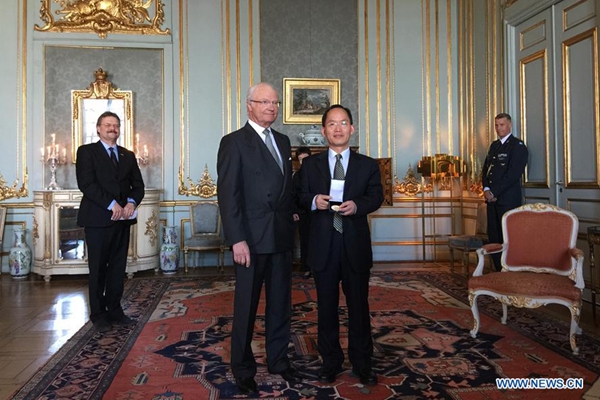
Chinese scientist receives 2017 Vega Medal in Stockholm

Swedish King Carl XVI Gustaf (L, front) poses with Chinese scientist Yao Tandong (R, front) after awarding 2017 Vega Medal to Yao at the Royal Palace of Stockholm, capital of Sweden, on April 19, 2017. [Photo/Xinhua]

Chinese scientist Yao Tandong received 2017 Vega Medal in Stockholm on Wednesday, recognizing his contributions to research on glaciers and the environment on the Tibetan Plateau.

Swedish King Carl XVI Gustaf awarded 2017 Vega Medal to Prof. Yao at the Royal Palace of Stockholm on Wednesday afternoon, and congratulated him personally for his outstanding achievements.

Sten Hagberg, chairman of Swedish Society for Anthropology and Geography (SSAG) said that Yao’s “basic researches on ‘the Third Pole’, monsoon and glaciers” are crucial to the understanding of the process of climate change. “His researches also concerns more than two billion population, it is a global topic”, Hagberg added.

Earlier, SSAG announced Professor Yao as 2017 Vega Medal laureate, for his outstanding contributions to glacier research and to the society at large.

His research focuses on glaciers and environment on the Tibetan Plateau, especially within the cryospheric research field.

Yao is internationally acknowledged as one of the most accomplished scientists in the field of cryospheric study. He has led several research programs — often together with American, French, German and Japanese scientists — in the last 20 years.

One of his later works shows that global warming, as causing the decline of glaciers on the Tibetan Plateau, interact with Indian monsoon winds and westerly winds. The research program Third Pole Environment (TPE) which is led by Professor Yao, has become internationally significant.


China gets tougher with officials’ personal information declaration

China has published stricter regulations on officials’ personal information declarations, requiring them to report to the Communist Party of China (CPC) their personal and family assets and investments, marital status and overseas travel, among others.

The rules, jointly issued by the General Office of the CPC Central Committee and the General Office of the State Council, are a further attempt to curb corruption.

According to the revised regulation on leading cadres’ personal information declarations, officials at deputy county level or above are required to report information, including their marital status, overseas travel, criminal records, wages and other earnings, family properties, stocks, funds, insurance and other investment.

The revised rule has specified verification of such reports, including the methods and the sampling rate for random checks. The rate for random verification has been increased to one in 10.

Punishments have been stipulated for false declarations and deliberate concealment of personal information.

The report of personal information is an important assessment of loyalty to the Party and commitment to the CPC code of conduct. It should be linked to promotion by Party committees and departments, the Organization Department of the Central Committee of the CPC said in a statement.

More than 9,100 officials have been overlooked for promotion after they were found to have concealed personal information, while 124,800 have been punished for making false declarations.

Stipulating the consequences of false declarations and concealment is a clear warning to officials and is crucial for the mechanism, according to the statement.

It called on CPC committees at various levels to implement the rules strictly and treat it as an important political mission of strengthening Party self-governance.

In addition, it also urged leading officials to be loyal and honest, and put themselves under organizational supervision in accordance with the rules.


Strengthening the Integrity of Australian Citizenship

The Turnbull Government will strengthen Australian citizenship by putting Australian values at the heart of citizenship processes and requirements.

Our reforms will ensure applicants are competent in English, have been a permanent resident for at least four years and commit to embracing Australian values.

Australia is an immigration nation. We are the most successful multicultural society in the world. More than 130,000 people from around 210 countries are invited to become Australian citizens each year. We welcome the contribution, opportunities and energy they bring to our community.

Membership of the Australian family is a privilege and should be granted to those who support our values, respect our laws and want to work hard by integrating and contributing to an even better Australia.

Citizenship is at the heart of our national identity. It is the foundation of our democracy. We must ensure that our citizenship program is conducted in our national interest. The reforms will include:

  • Requiring all applicants to pass a stand-alone English test, involving reading, writing, listening and speaking;
  • Requiring applicants to have lived in Australia as a permanent resident for at least four years (instead of one year at present);
  • Strengthening the citizenship test itself with new and more meaningful questions that assess an applicant’s understanding of – and commitment to – our shared values and responsibilities;
  • Requiring applicants to show the steps they have taken to integrate into and contribute to the Australian community. Examples would include evidence of employment, membership of community organisations and school enrolment for all eligible children.
  • Limiting the number of times an applicant can fail the citizenship test to three (at present there is no limit to the number of times an applicant can fail the test);
  • Introducing an automatic fail for applicants who cheat during the citizenship test.

In our democracy, the most important title is “Australian citizen”. Citizenship brings with it great privileges and responsibilities and so deserves respect and commitment from those who seek it, as well as those who are granted it.

Those who choose to become Australian citizens are making a solemn commitment to our democracy, to our way of life. And that commitment, made by 5 million since 1949, has helped secure and enrich our nation.

English language proficiency is essential for economic participation. It promotes integration into the Australian community and social cohesion. Relevant exemptions will apply, such as for permanent or enduring incapacity and for those under 16 years of age.

Any conduct that is inconsistent with Australian values will be considered as part of this process. For example, criminal activity, including violence against women and children, involvement in gangs or organised crime, is thoroughly inconsistent with Australian values.

These changes have been informed by the feedback received from the National Consultation on Citizenship, conducted by Senator the Hon Concetta Fierravanti-Wells and the Hon Philip Ruddock MP in 2015 and the 2016 Productivity Commission Report Migrant Intake into Australia.

The new requirements will apply to all new applications for Australian citizenship.


Gas Supply

The Turnbull Government is repairing gas markets, making sure more and more affordable gas is delivered to Australian homes and businesses.

The Prime Minister, Deputy Prime Minister and Ministers Frydenberg, Canavan and Sinodinos today met with gas industry executives and the Australian Energy Market Operator (AEMO) Chief Executive, to work through both the short term and long term challenges facing households and business in getting access to gas at reasonable prices.

The meeting heard that that the industry, including pipeline operators and generators, with AEMO, have developed a framework to make sure gas is delivered at times of peak electricity demand to prevent blackouts. The arrangement will be in place by 1 October this year well in time to prepare for the next summer.

The gas industry has also revised supply and production figures which, subject to further study by AEMO, will help address projected shortfalls. 

The meeting also discussed the agreement of the COAG Energy Council to accelerate gas market and pipeline reforms with rollout to commence from 1 July 2017. The meeting further noted the critical role of the states and territories in enabling gas exploration and development.

To verify the progress in gas supply, the Treasurer has today directed the ACCC to establish a monitoring regime by using its inquiry powers to compel the gas industry to provide information, to underpin a new transparency in the gas market to the benefit of consumers.

This new measure will shine a light on transactions with the Australian gas market and help it operate more fairly and efficiently. 

This work will run over three years, with regular public reporting, and will give the ACCC and market participants a complete picture of the gas market. It will increase transparency, facilitate competition and ensure the gas market is operating well.

While this progress is encouraging a lot more needs to be done.

The Government remains concerned that the east coast export LNG operators have not yet clearly articulated how Australian households and business will get adequate supply at reasonable prices.

The Government has asked the exporters to provide further information, in the context of possible regulatory options to address the short term market issues.


Mergers: Commission clears acquisition of smart card maker Morpho by Advent International, subject to conditions

Morpho is the identity and security solutions business of the Safran group. Advent International, a private equity firm, controls smart card and digital security provider Oberthur. Both Oberthur and Morpho develop and supply identification and security solutions, including smart cards for the banking sector, telecommunication sector and identity document sector.

The Commission’s investigation found that in France there are currently only three viable suppliers of payment smart cards holding the necessary national certifications and production sites to effectively supply French banks. The takeover would reduce that number to only two, which would significantly reduce competition.

The Commission’s competition concerns

The Commission’s investigation focused in particular on the parties’ overlapping activities in smart card markets.

For SIM cards and electronic ID documents (e.g. e-passports, e-ID cards, e-health cards) the Commission concluded that the merged entity would continue to face a number of credible competitors.

However, the investigation found that for payment smart cards, the proposed transaction, as initially notified, would have significantly reduced competition in the market for payment smart cards in France. This market is particularly difficult to enter, reducing the ability of suppliers not currently active in France to compete effectively.

The Commission found that in order to supply payment smart cards in France, manufacturers need to obtain and maintain certification for the domestic debit card scheme Cartes Bancaires (CB), on top of the global EMV certification standard. In addition, to compete effectively, suppliers must run in France a CB-certified manufacturing site for the personalisation of CB-certified cards.

Based on the results of its extensive market investigation, the Commission considered that the transaction, as notified, raised serious doubts as to its compatibility with the Single Market with regard to the market for payment smart cards in France.

The proposed commitments

In order to address these concerns, the parties offered to divest Morpho’s French subsidiary CPS, which supplies and personalises CB-certified payment smart cards to banking customers in France.

In view of the remedies proposed, the Commission concluded that the proposed transaction, as modified, would not significantly reduce competition in the European Economic Area (EEA) or any substantial part of it, including France. The Commission’s decision is conditional upon full compliance with the commitments.

Companies and products

Advent International is a US based private equity firm with holdings in various sectors.

Oberthur, a portfolio company controlled by Advent International, is a global digital security provider based in France which is active in the payment, identity and telecommunication sectors.

Morpho (Safran Identity & Security) is a global provider of identity and security solutions based in France. Morpho provides solutions and services to manage citizen identities, applications in the area of public security, and connectivity and security solutions, in particular smart cards, to serve banks, telecom operators and other commercial service providers.

Merger control rules and procedure

The transaction was notified to the Commission on 24 February 2017.

The Commission has the duty to assess mergers and acquisitions involvingcompanies with a turnover above certain thresholds (see Article 1 of the Merger Regulation) and to prevent concentrations that would significantly impede effective competition in the EEA or any substantial part of it.     

The vast majority of notified mergers do not pose competition problems and are cleared after a routine review. From the moment a transaction is notified, the Commission generally has a total of 25 working days to decide whether to grant approval (Phase I) or to start an in-depth investigation (Phase II). This deadline is extended to 35 working days in case remedies are submitted by the parties, such as in this case.

More information on this case will be available on the Commission’s competition website, in the public case register under the case number M.8258.