China shames rogue firms amid anti-pollution push
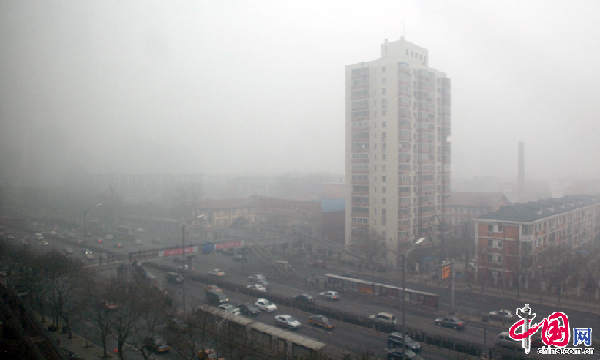
Heavy smog hits Beijing. [Photo/China.org.cn]

In a show of anti-pollution resolve, China has begun shaming rogue firms that had allegedly polluted environment and even blocked government inspections.

The Ministry of Environmental Protection made details of the first case public over the weekend and later listed others. Obstruction of law enforcement was found to be common.

In the update, three more cases were reported in provinces of Hebei, Henan and Shandong where the central government had dispatched the largest air pollution inspection team in history, involving 5,600 people.

In Liaocheng city, inspectors were locked out of a steel company that had allegedly discharged excessive waste water.

In Xingtai, a city with one of the worst air quality records, the inspection team’s credentials were taken away by force.

In Puyang city, a textile factory halted operations and ignored inspectors when they came knocking.

Altogether, six people were detained for allegedly obstructing inspectors in these cases.

“It is not just to warn offenders. The action shows inspectors will leave no stone unturned,” said Fu Qiang, an environmental lawyer.

China is fighting an uphill battle against pollution. Air pollution, particularly smog, often occurs in north China in winter. A high concentration of heavy industry, use of coal, growth of private car use and climate change are all cited as causes. The battle will not be won without enforcing emission limits on factories.

In early April, 28 teams were sent to cities around Beijing to find polluters. In less than three weeks, the teams checked 405 firms and found 286 of them did not comply with national environmental standards.

The current furor only emerged after the manager of a clean energy firm in Shandong locked up inspectors for an hour. Lyujie Environmental Protection and Energy Saving Technology was accused of using an obsolete boiler and lacking proper emission treatment facilities, resulting in dust and noise.

When inspectors visited last Saturday, the company’s general manager Wang Kaisheng refused to allow them to look at the plant, claiming that their credentials were fake. He later refused to allow them to leave the premises. The firm was founded by retired Shandong provincial official Xue Hongmin in 2005 to produce energy-saving boilers, coolers and other environmentally friendly products.

Ma Jijiang, a local environmental protection official, said the firm has not obtained permit for its boiler. The boiler has since been removed. Further investigation is underway to decide if there was any collusion between government officials and the company.

Jinan-based lawyer Cui Lianwei advises enforcers to beware of local protectionism. “Protectionism in some areas is the key cause of poor enforcement in environmental protection, and joint inspection efforts will help improve the effect and efficiency of enforcement,” he said.


Average Chinese reads 8 books in 2016

Students from a primary school in An County in southeast China's Jiangxi Province hold books donated to them by China's Publishers Association on April 14, 2017.[Photo: people.com.cn]

Students from a primary school in An County in southeast China’s Jiangxi Province hold books donated to them by China’s Publishers Association on April 14, 2017.[Photo/people.com.cn]

The average Chinese read 7.86 books last year, including 4.65 printed books and 3.21 eBooks, according to an annual poll released by the Chinese Academy of Press and Publication on Tuesday.

79.9% of China’s population was identified as readers in 2016, which remained fairly similar compared to the 79.6% from the previous year, the 14th National Reading Survey shows.

The poll shows that the Chinese still preferred printed books to eBooks, as 51.6 % of the surveyed said they preferred to “hold a printed book” in their hands, while 33.8 % said they liked reading via mobile phones better. 9.8 % said they preferred to read online, and 3.8 % said they loved reading via e-book readers.

Xu Shengguo, Director of China Academy of Press and Publication Research Institute, said going back to hard-copy books is a worldwide trend, which has appeared in countries such as the U.S., the UK and France.

“Although digital reading is quick and convenient, it’s only suitable for fragmented reading practices, while reading hard-copy books are conducive to in-depth reading,” Xu said.

68.2 % of the surveyed said they had read on digital devices (including online, mobile phones and electronic readers) last year, up 4.2 % from the figure of 2015.

66.1 % read on mobile phones last year, a sharp increase of 6.1 % compared to 2015. The figure has been growing for eight consecutive years.

7.8 % said they read on an e-book reader, and 10.6 % said they had read on an iPad.

62.4 % of the adults surveyed said they read through WeChat, a popular Chinese messaging app, in 2016, a 10.5-percentage-point rise compared to the year earlier.

The annual survey was conducted nationwide, covering a sample size of 22,415 people from 52 cities.

Globally, French people read 15 books a year on average in 2013, according to figures released by the Paris Book Fair. Their U.S. counterparts read 12 books a year on average, according to pewinternet.org.


China drafts law on public libraries

People read books in a public library at Gongshu District of Hangzhou, capital of east China's Zhejiang Province, Dec. 28, 2016.[Photo: Xinhua/Long Wei]

People read books in a public library at Gongshu District of Hangzhou, capital of east China’s Zhejiang Province, Dec. 28, 2016. [Photo/ Xinhua]

China approved a draft law on public libraries at a State Council executive meeting on Wednesday, which will be forwarded to the Standing Committee of the National People’s Congress for deliberation.

The draft law illustrates the government’s role in strengthening the library functions, and encourages more social support in the responsibilities of libraries.

The new functions of libraries, such as digital resources and online services, are also included in the draft.

“It’s an important step to further institutionalize public cultural services in China,” said Li Guoxin, member of the national panel for the public cultural service system.

“It will better combine guidance of the government and the support of the public,” he added.

According to the Ministry of Culture, a network of libraries covering both urban and rural areas had 838 million books around the country at the end of 2015.

Also, a total of 404 million yuan (59 million U.S. dollars) were earmarked by the central government to support free public libraries in 2015.

China has been improving public cultural services, with a law on public cultural services taking effect on March 1.


Student opens 1st unwatched flower shop in Beijing

An unsupervised flower shop operated by a college student in Beijing is attracting many young customers, Chinese media reported.

Different from traditional shops in the capital, the young storekeeper surnamed Wang opened the first unsupervized flower shop where people can select flowers and pay via mobile payment systems including WeChat and Alipay.

Born after 1995 and a lover of fiction, the young man said he began the startup because it will not take up his time. “People go to flower shops at any time,” he said. “I cannot focus on reading when I have to serve customers.” So Wang opened the self-service flower shop after doing market research.

Most young customers like shopping in a free environment, and hate promotion from clerks, he explained, adding that customers can have their questions answered about categories and names of flowers through mobile apps.

Even though there is no shopkeeper, the operation has attracted many young customers and proved to be a success, at least for now.

Although he does not sell flowers in the shop in person, Wang said he would call at it at odd intervals everyday.

“It is a business with small investment, and it cannot cause a huge loss if a burglary occurs,” he said, adding that he trusts people.


Harbin tech students send tiny satellite into orbit

Harbin tech students send tiny satellite into orbit

LilacSat-1, a satellite developed by students at the Harbin Institute of Technology. [Photo/China Daily]

A nanosatellite made by students at the Harbin Institute of Technology was launched in the United States on Tuesday as part of a mission to the International Space Station.

The satellite, LilacSat-1, was on a Cygnus cargo spacecraft launched atop an Atlas 5 rocket from Cape Canaveral in Florida at 11:11 am, according to Wei Mingchuan, the 26-year-old team leader and a second-year PhD candidate in astronautics at the institute in Heilongjiang Province.

LilacSat-1 consists of two conjoined cube units, each with a side length of 10 centimeters. The 2-kilogram satellite will be deployed at a height of about 400 kilometers above the ground from the space station within three months of docking with the cargo craft. Docking is scheduled for Saturday.

In its three-month life span in orbit, the satellite will conduct investigations on Earth’s mid-lower thermosphere, a section of the upper atmosphere about 200 to 400 kilometers above the ground.

“We will take measurements of the upper layers of the atmosphere using an ion-neutral mass spectrometer,” Wei said. “In addition, we have a new type of radio repeater to provide two-way communication resources to amateur radio operators, as well as a CMOS camera to take photos from space.”

Nanosatellites are small satellites that weigh between 1 and 10 kg, according to the team.

Lifted along with LilacSat-1 were 27 other nanosatellites of the QB50 project, a European Union-funded miniaturized satellite constellation created by students in more than 20 countries.

“This project is the very first international, real-time, coordinated study of thermosphere phenomena,” said Davide Masutti, QB50 project manager at the Von Karman Institute, a scientific organization based in Belgium.

Wei said the data retrieved by LilacSat-1 would be shared by the science community and amateurs, as the programs will be released as open-source and require no special tools.