Theresa May’s refusal to commit the Tories to maintaining the pensions triple lock only further proves the Tories are abandoning older people – John McDonnell
John
McDonnell MP, Labour’s Shadow Chancellor, responding to Theresa May failing to
commit the Tories to maintaining the pensions triple lock if she wins the
general election, said:
“Only
four days into the Tory campaign and Theresa May has refused to commit to
maintaining the pensions triple lock, just as Philip Hammond refused to commit
to it on Tuesday.
“Theresa
May’s refusal to commit the Tories to maintaining the pensions triple lock only
further proves the Tories are abandoning older people. It’s now clear pensions
protections are now in jeopardy.
“Labour
will stand up for older people by maintaining the pensions triple lock and by
keeping the winter fuel allowance and free bus passes so that the elderly can
go about their lives with the dignity they deserve.”
ESMA advises Commission on fees for trade repositories
ESMA, in order to ensure a level playing field across EMIR and SFTR, is also proposing some changes to the way ESMA’s fees for TRs are calculated under the European Market Infrastructure Regulation (EMIR).
TRs have to pay fees on specific administrative actions such as registration, extension of registration or recognition, and an annual fee for on-going supervision which is proportionate to the level of turnover of the TRs. ESMA also advises to simplify the way of determining the turnover of TRs for the purposes of calculating the annual supervisory fees by including revenues only and excluding activity figures.
ESMA also proposes lower fees in the case of extension of registration under SFTR, or in the case of concurrent application under both regimes. ESMA has also proposed the calculation of fees for recognition of third country TRs and the reimbursement of the cost to NCAs in the case of delegation of tasks.
HR/VP Federica Mogherini holds bilateral meetings during her visit to India
Federica Mogherini, the High Representative for Foreign Affairs and Security Policy/Vice-President of the European Commission (HR/VP), is today and tomorrow on an official visit to New Delhi and met with the Prime Minister of India, Mr Narendra Modi. HR/VP Mogherini also met with the Minister of External Affairs, Smt. Sushma Swaraj, and with the Minister of State for External Affairs, Mr. M J Akbar.
During the talks the two sides discussed in depth a broad range of issues of common interest. The European Union and India are natural partners, they share fundamental values of democracy and diversity, economic interests and robust trade relations, common security challenges, and a direct interest in the stabilisation of many fragile areas, from the Korean Peninsula to Afghanistan.
The EU and India expressed their common interest and commitment to strengthen their cooperation on the world stage, both bilaterally and in multilateral fora, on common priorities such as multilateralism, climate change, sustainable development, free and fair trade, security and defence – notably on maritime security – and counterterrorism.
In view of the 14th bilateral India-EU Summit to be held later this year in New Delhi, the European Union and India agreed to further strengthen and deepen their bilateral relations. In particular, taking stock of progress made on decisions taken last year at the 13th EU-India Summit in Brussels, it has been agreed to deepen cooperation in foreign policy, security and defence, trade, investments, climate change, water, new and renewable energy, environment, ICT, space, research and technology, urbanisation, and to strengthen people-to-people contacts, including student exchanges through the Erasmus programme.
During her visit, Mogherini opened the EU@60 Treaty of Rome Exhibition at the Italian Institute of Culture. This year, the EU celebrates the 60th anniversary of the Treaties of Rome, which paved the way for the European Union that we know today: a reunited continent of peace, founded on the values of solidarity, democracy and the rule of law.
ESMA advises Commission on fees for trade repositories
ESMA, in order to ensure a level playing field across EMIR and SFTR, is also proposing some changes to the way ESMA’s fees for TRs are calculated under the European Market Infrastructure Regulation (EMIR).
TRs have to pay fees on specific administrative actions such as registration, extension of registration or recognition, and an annual fee for on-going supervision which is proportionate to the level of turnover of the TRs. ESMA also advises to simplify the way of determining the turnover of TRs for the purposes of calculating the annual supervisory fees by including revenues only and excluding activity figures.
ESMA also proposes lower fees in the case of extension of registration under SFTR, or in the case of concurrent application under both regimes. ESMA has also proposed the calculation of fees for recognition of third country TRs and the reimbursement of the cost to NCAs in the case of delegation of tasks.
News story: Grave of Northumberland born World War 2 prisoner of war finally rededicated
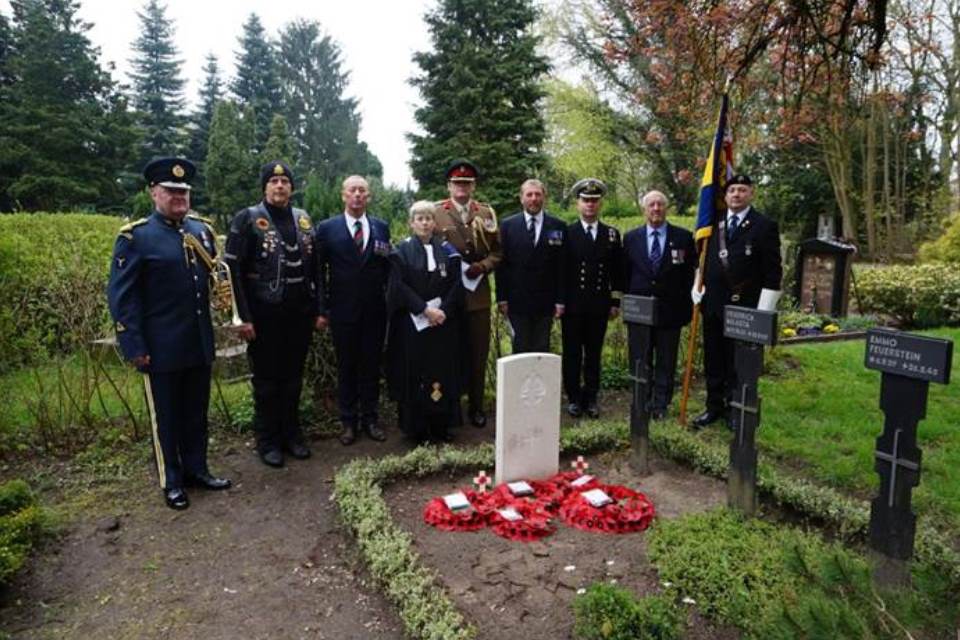
A new headstone has been installed and a rededication service took place in a moving ceremony on Friday 21 April 2017 at Wittenburg Cemetery, Germany.
The service, arranged by the MOD’s Joint Casualty & Compassionate Centre (JCCC), part of Defence Business Services was led by the Reverend Heather Rendell (Chaplain to the Forces), Regimental Chaplain, HQ Westfalen Garrison.
(L to R) Phil Richards, Alan Culshaw, Major Pat Ralph, Reverend Heather Rendell, Colonel David Moreton, Steve Foster, Cdr Ian Harrop, Bob Jones, Keith Orton, Crown Copyright, All rights reserved
Nicola Nash, JCCC said:
Private Thompson and his comrades were faced with a tortuous march after years of captivity. We are glad to be able to confirm his final resting place and honour him as he so richly deserves.
Private Thompson was born on 4 April 1919 at Tynemouth, Northumberland. Before enlisting, he was recorded as working as a glazier and lived with his sister, Elizabeth, on Penman Street in North Shields. George enlisted on 16 October 1939 and was sent, as a Private, to France on 28 February 1940 as part of the British Expeditionary Force.
He was reported missing on 19 June 1940 after being captured at Athies, France. His status as a Prisoner of War (POW) was confirmed a month later.
Pte Thompson was sent to Stalag XXA, located in Toruń, Poland. He was imprisoned for nearly 5 years, until in early 1945 and with the threat of the advancing Russians, the Germans forced the POWs to march towards the West. This ‘Long March’ was a tortuous undertaking for men that were already weakened from years of imprisonment.
It was one of the worse winters on record, with temperatures dropping as low as -25°C. The men were without adequate clothing, supplies or medical equipment and were forced to march up to 40 kilometres a day, many succumbed to hypothermia, disease and death. Tragically, George lost his life during this march and having suffered dysentery, he passed away near the town of Wittenburg, Germany on 3 March 1945.
Private Thompson was just 25 years old when he died.
(L to R) Phil Richards, Alan Culshaw, Major Pat Ralph, Reverend Heather Rendell, Colonel David Moreton, Steve Foster, Cdr Ian Harrop, Bob Jones, Keith Orton, Crown Copyright, All rights reserved
Reverend Heather Rendell said:
It was a privilege to give a name to the grave of a soldier that died in conditions that should never happen again.
A record of these POWs, including George, was kept by Staff Sergeant (S/Sgt) Aitken of the Royal Army Ordnance Corps. He kept a list of each man that died and where they were buried. He also attempted to intervene with the German guards to get better treatment of his men.
George’s burial place had remained unknown, until the grave of an ‘Unbekampt Englander Soldat’ (Unknown English Soldier) was found at a civilian cemetery in Wittenburg, where George’s burial place had been listed by S/Sgt Aitken.
This grave was brought to the attention of the Ministry of Defence by researcher, Steve Foster who has spent many years researching the final resting places of the POWs on S/Sgt Aitken’s list.
After extensive historical research by Mr Foster and the JCCC into this unknown grave and the circumstances surrounding George’s death, the MOD have now confirmed that this Unknown Soldier is actually Private George Henry Thompson.
Steve Foster said:
It was an honour to help find the grave of Private Thompson 70 years after he died in dreadful circumstance.
A new headstone bearing Private Thompson’s name has been provided by the Commonwealth War Graves Commission, who will now care for his final resting place in perpetuity.