Press release – Opening – European Parliament President highlights ‘Girls in ICT’ Day

President Tajani highlighted the international “Girls in ICT” Day, to be held on Thursday. This aims to encourage young women to study and take up careers in science, technology, engineering and mathematics.

 In Europe, only 29 women per thousand graduate in these fields, compared with 95 men, he noted.

This gender gap grows as you go up the hierarchical scale, added Mr Tajani, urging EU countries and companies to do their bit to close this gap, in line with the Millennium Development Goals.


Agenda changes


Wednesday 26 April


– The order of the second and third items will be reversed, so that the Commission Statement on the “Decision adopted on the European Pillar of Social Rights and work-life balance initiative” will be taken as the second point, after the Commission statement on “Situation in Hungary”.

– The debate on the Commission statement on “Situation in Hungary” will be wound up by a resolution, to be voted in the May I part-session

Thursday 27 April

– The immunity report (A8-0163/2017) by MEP Gilles Lebreton on MEP António Marinho e Pinto is added to the votes (Rule 9.8).

– A motion objecting to the Commission Delegated Regulation amending Annex II to Regulation (EU) No 978/2012, applying a scheme of generalised tariff preferences, is added to the votes.

Immunity waivers

The President announced that the European Parliament had received requests from the Financial Department of the High Court of Paris to lift the immunity of Marine Le Pen and Marie-Christine Boutonnet and pursuant to rule 9(1), he had referred the requests to the Legal Affairs Committee.

Requests by committees to start negotiations with Council and Commission


Decisions by several committees to enter into inter-institutional negotiations (Rule 69c) are published on the plenary website. If no request for a vote in Parliament on the decision to enter into negotiations is made within 24 hours, the committees may start negotiations.


Safety-Security-of-Europe-Estonian-Prime-Minister-in-eu-LISA

The Prime Minister of the Republic of Estonia Jüri Ratas met today with the Executive Director of eu-LISA Krum Garkov in the headquarters of the Agency in Tallinn, Estonia. The purpose of the meeting was to discuss the role that large-scale IT systems play in contributing to safety and security in Europe and preparations for the upcoming Estonian EU Presidency.

Krum Garkov welcomed Prime Minister Ratas and thanked him on behalf of the Agency for the interest and support shown with the high-level visit. The Executive Director and Prime Minister exchanged views on transformations in the area of EU freedom, security and justice, which relies increasingly on modern technologies and information sharing.  Mr Garkov elaborated on eu-LISA’s 2017 priorities related to the evolution of the existing IT systems and integration of new ones in line with their respective legal basis. The revision of the Agency’s mandate and the legal proposals that are currently being negotiated at EU institutional level were also discussed.  In addition the Prime Minister and the Executive Director talked about the ongoing preparations for the EU Presidency that Estonia will take over from Malta for the second half of this year.

During a brief tour of the current headquarters, located in the EU House in Tallinn, the Prime Minister and the Executive Director spoke about the progress of the new headquarters building that will, in the not too distant future, house eu-LISA in Tallinn.

Prime Minister Ratas also spoke with staff, addressing the Strasbourg and Brussels office too via video conferencing.

Links:

Contact:

Mare Haab

Head of External and Internal Communication

e-mail: press@eulisa.europa.eu

mob: +372 588 78 668

for general information: info@eulisa.europa.eu


Safety-Security-of-Europe-Estonian-Prime-Minister-in-eu-LISA

The Prime Minister of the Republic of Estonia Jüri Ratas met today with the Executive Director of eu-LISA Krum Garkov in the headquarters of the Agency in Tallinn, Estonia. The purpose of the meeting was to discuss the role that large-scale IT systems play in contributing to safety and security in Europe and preparations for the upcoming Estonian EU Presidency.

Krum Garkov welcomed Prime Minister Ratas and thanked him on behalf of the Agency for the interest and support shown with the high-level visit. The Executive Director and Prime Minister exchanged views on transformations in the area of EU freedom, security and justice, which relies increasingly on modern technologies and information sharing.  Mr Garkov elaborated on eu-LISA’s 2017 priorities related to the evolution of the existing IT systems and integration of new ones in line with their respective legal basis. The revision of the Agency’s mandate and the legal proposals that are currently being negotiated at EU institutional level were also discussed.  In addition the Prime Minister and the Executive Director talked about the ongoing preparations for the EU Presidency that Estonia will take over from Malta for the second half of this year.

During a brief tour of the current headquarters, located in the EU House in Tallinn, the Prime Minister and the Executive Director spoke about the progress of the new headquarters building that will, in the not too distant future, house eu-LISA in Tallinn.

Prime Minister Ratas also spoke with staff, addressing the Strasbourg and Brussels office too via video conferencing.

Links:

Contact:

Mare Haab

Head of External and Internal Communication

e-mail: press@eulisa.europa.eu

mob: +372 588 78 668

for general information: info@eulisa.europa.eu


Chinese media unite against news copyright infringement

Ten of China’s major news agencies and websites formed a union in Beijing on Wednesday in order to provide better copyright protection for the media.

The union was set up at a conference on internet copyright protection, where a declaration of the union was read by Zhou Xisheng, CEO of ChinaSo, a search engine set up by the country’s major news organizations, and a founding member of the union.

According to the declaration, the union will play a significant part in issues including the unified management of news copyright, and will support its members to uphold their own copyrights.

The declaration also criticized misconduct in the news business, such as piracy, incorrect or fake quotes and unauthorized reprints, which severely hurt the enthusiasm of journalists and negatively affect the sustainable development of the business.

The union has called for the society to respect and protect news copyrights, and has asked for more news organizations to join the union to improve the situation.

A total of 115 media outlets released a joint statement at the conference, also calling for better copyright protection in the news business.

China has been emphasizing the importance of copyright protection recently, as a national copyright monitoring website was set up on April 20, which was seen as a step forward in the nation’s crackdown on piracy.

The website, www.12426.cn, is managed by the Copyright Monitoring Center under the Copyright Society of China, providing identification, security monitoring, early warning and rights infringement solution services for registered copyright owners.


Chinese submersible Jiaolong completes S. China Sea dive

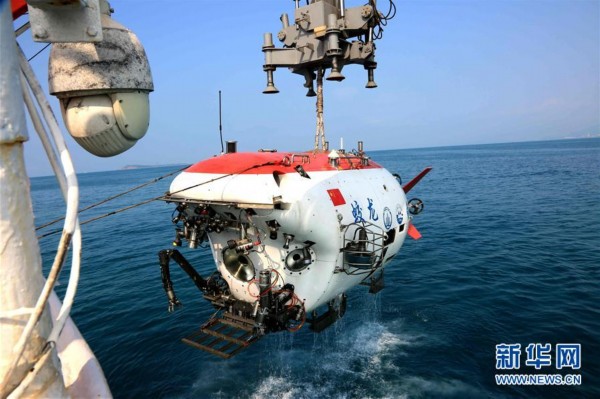
Jiaolong submersible goes through a dive simulation in Sanya, Hainan Province, on April 22. [Photo/Xinhua]

Jiaolong, China’s manned submersible, completed a dive Wednesday in the South China Sea.

Departing its mother ship Xiangyanghong 09 at around 7 a.m., Jiaolong stayed underwater for nine hours and twelve minutes for the dive before returning at around 4:19 p.m.

It managed to bring 16 liters of sea water samples collected near the seabed, eight sediment samples and two rock samples back to Xiangyanghong 09, in addition to high-definition photos and video footage shot during the mission.

Wednesday’s dive marks the first dive by Jiaolong in the second stage of China’s 38th ocean scientific expedition, which will last until May 13.

The maximum depth of the Jiaolong mission on Wednesday was 1,741 meters below sea level, and the submersible spent some seven hours on the seabed.

Three staff, including one seasoned crew member, Tang Jialing, and two interns, Liu Xiaohui and Yang Yifan, were on board the submersible.

“This is almost Jiaolong’s longest underwater mission,” said Tang.

In an interview with Xinhua prior to the drive, Yang Yaomin, chief scientist for the second stage expedition, said experts had planned to choose a site for experimenting with the collection of polymetallic nodules during the mission.

“We are working to avoid damaging the marine environment in mining,” said Yang. “The expedition will help develop technology for environmentally friendly deep-sea mining.”

Polymetallic nodules are mineral resources that are generally deposited more than 4,000 meters deep beneath the sea’s surface and contain manganese, iron, copper, nickel, cobalt as well as rare earth elements.

During the expedition, manned deep-sea submergence was also conducted in the seamount chain and continental slope areas in the South China Sea, according to scientist Shi Xuefa.

“We plan to carry out geological and biological surveys in the region,” said Shi. “The submersible will take photos of the distribution of polymetallic nodules, deep-sea life and seafloor terrain.”

The rock samples collected from the seamount will be used in research in chronology, mineralogy and geochemistry on the South China Sea, advancing the study of the region’s structural evolution, according to Shi.

The 38th oceanic scientific expedition started on Feb. 6. Jiaolong completed a dive in the northwestern Indian Ocean earlier this year in the mission’s first stage. It will also conduct surveys in the Yap Trench and the Mariana Trench in the third stage.

Named after a mythical dragon, Jiaolong reached its deepest depth of 7,062 meters in the Mariana Trench in June 2012.