Anti-poverty effort wins world’s plaudits

Anti-poverty effort wins world's plaudits

Fabric artist Duan Yinkai (right) speaks to foreign guests who attended a meeting in Beijing on China’s poverty alleviation efforts on Thursday. [Photo/China Daily]

Foreign governmental and private representatives lauded China’s progress in poverty reduction as the International Department of the Communist Party of China Central Committee hosted an event in Beijing showing how the country has done it.

The event, using the example of the CPC Yunnan provincial committee since 2012, attracted about 400 diplomats, foreign politicians and representatives of international organizations on Thursday.

“China’s tremendous success in lifting the majority of the underprivileged people out of poverty in over a little more than 30 years is a feat that is unparalleled and truly inspiring,” said Mark van den Boogaard, senior policy adviser for the United Nations Development Programme.

Van den Boogaard, who has recently returned from a research trip to Yunnan, said the country’s goal to pull all people out of poverty by 2020 is “ambitious” but “realistic”.

“From what we have seen in the north of Yunnan, under the leadership of the CPC, the Chinese authorities are clearly on the right track.” Van den Boogaard cited the “duel approach” of targeted poverty reduction and intervention on one hand, and the nation’s idea of leaving no one behind on the other.

Lennart Nilsson, counselor for agricultural affairs with the Swedish embassy, said the figures for China’s poverty relief are impressive.

“Yunnan province has a fantastic environment. It is also important for the authorities to preserve the ethnic culture and protect the environment during the poverty reduction process,” he said.

Song Tao, head of the International Department of the CPC Central Committee, said at the event that the CPC is willing to share its experience in poverty reduction with the international community and help its neighbors and developing countries to explore their own ways to eradicate poverty.

“Facts have shown that the fundamental strategies by General Secretary Xi Jinping on targeted poverty alleviation are the golden key for China to realize its poverty eradication targets,” he said.

China lifted 55.6 million people out of poverty between 2013 and 2016.

However, more than 40 million still live in poverty, which means that in the coming four years, China would have to pull an average of 10 million people each year out of poverty to reach its target of eradicating poverty by 2020, according to the State Council Leading Group Office of Poverty Alleviation and Development.

Chen Hao, secretary of the CPC Yunnan provincial committee, said provincial authorities have prioritized the preservation of the traditional culture of ethnic groups and the protection of the ecology and environment while reducing poverty. Yunnan’s environmental efforts are crucial since it is the source of a number of important national and international rivers, he said.

The province has managed to reduce its impoverished population from 8 million in 2012 to 3.6 million in 2016.
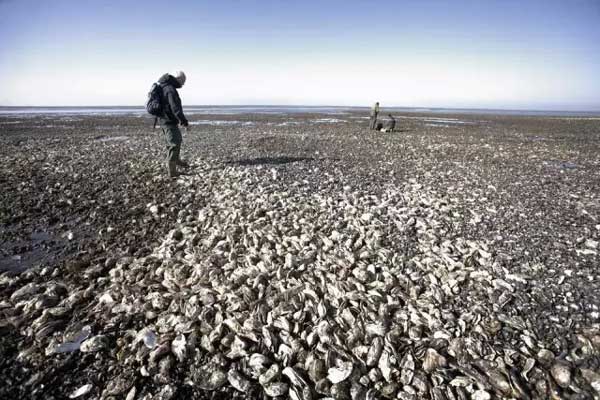


Chinese bombard Denmark with oyster crisis solutions

Chinese bombard Denmark with oyster crisis solutions

Oysters wreak havoc on Denmark’s seashore. [Photo/Weibo.com]

Danish people would never expect that the oyster crisis confronting their country may turn into a food-lovers’ bonanza in China. The European country’s dilemma may be the last thing Chinese people would ever understand as they see the abundance of seafood as a treat, rather than a problem.

The Danish Embassy published a story on Monday evening on its official Sina Weibo account, China’s twitter-like social network, about the problems for their country caused by an invasion of the exotic oysters. Chinese internet users enthusiastically responded with much discussion about ways to address the issue on Weibo, then WeChat, another popular social media network.

The embassy makes a small joke in the post to invite Chinese people to eat oysters in Denmark which triggered heated debate. Apparently, when it comes to eating, Chinese people are very serious and they already started to make plans for their oyster journey.

The most popular comment came from someone suggesting oyster visas should be issued “with 10 years’ unlimited round trips and one-month-long stay and I can eat up them all in five years” received over 10,000 likes. There are people even recommending visa-free and oyster immigration policies in China.

The oysters, known as Pacific oysters, are a new species in Denmark and have caused huge damage to the seashore’s ecological environment. Their proliferation is unstoppable since they have no natural enemies there. People have to get across them in shoes before swimming. What’s worse, their occupation leads to the endangerment of the Limfjord, a Danish local oyster.

Scientists and fishermen made numerous complaints to the nation’s conservation authority but the thorny issue remains unsolved. They also encouraged local people to bring them to their dining tables and few were motivated.

The Danish Embassy is very grateful for Chinese people’s innovative advice such as building oyster sauce factories and organizing oyster-dining journeys. It also said as long as China permits, they’d love to export oysters to China.


Anti-graft agency hunts 946 fugitives

China’s top graft buster said on Thursday that 946 corrupt fugitives are still at large in foreign countries, and China hopes those nations will support its war against corruption.

Thursday’s disclosure was the first time China has released the exact number of corrupt fugitives abroad.

Of the 946, most of whom are corrupt officials, Chinese law enforcement officers have a good idea of where 365 are. But the whereabouts of the other 581 are unknown, according to the Communist Party of China’s Central Commission for Discipline Inspection.

“These corrupt fugitives used illegal means to grab a large amount of public funds and escaped abroad to avoid punishment, which has seriously harmed people’s interests and undermined our credibility and social justice,” said Liu Jianchao, director of the CCDI’s International Cooperation Bureau.

“We hope the public will provide clues about the fugitives, as well as report corrupt officials who intend to flee,” he said.

Liu also called for countries harboring such fugitives to adhere to international conventions on fighting corruption and actively assist Chinese law enforcement authorities.

Feng Jingyou, a senior official in the CCDI’s International Cooperation Bureau, said China respects different legal systems in other countries, but hopes that such countries would not shelter corrupt Chinese fugitives, nor facilitate their asset transfers.

“We urge some individual countries-which have ignored the suspects’ corruption crimes and issued them visas under investment immigration policies in return for economic benefits-to tighten the management of visas and revoke the visas already issued,” Feng said.

Liu said the fugitives should return to China to confess their crimes and seek lenient punishment as soon as possible. “We have the resolve and ability to uphold the law, … and we’ll make every effort to bring them back to face justice, and never will allow them to get away with no legal penalty.”

In recent years, a large number of corrupt Chinese officials have escaped abroad, especially to the United States and Canada, because of a lack of extradition treaties and legal differences, Liu said. Some of them have obtained permanent residence in those countries, he said.

“We hope that overseas Chinese and foreign friends recognize the nature of these fugitives and expose them to drive them away,” Liu said.

China launched a massive crackdown on corruption in November 2012 and in 2014 started an operation called Sky Net to hunt for corrupt fugitives abroad.

In April 2015, Interpol issued “red notices”-requests to locate and provisionally arrest an individual pending repatriation-for the 100 most-wanted corrupt Chinese officials. So far, 40 have returned from more than 16 countries and regions, while half of the remaining fugitives are still on the run in Western countries, CCDI figures show.

On Thursday, the CCDI also made public detailed information about 22 high-profile Chinese fugitives, 15 of whom are in the US and Canada. The information included suspects’ photos, ID numbers, passport numbers, suspected crimes, the date they fled China and their suspected current location.

The 22 people are considered high priority cases because of the difficulty that Chinese law enforcement authorities have encountered in their attempts to locate and return them, according to the CCDI.


China’s cargo spacecraft completes in-orbit refueling

China’s Tianzhou-1 cargo spacecraft and Tiangong-2 space lab completed their first in-orbit refueling at 7:07 p.m. Thursday, another success of the Tianzhou-1 mission.

Mastering the technique of refueling in space will help the country to build a permanent space station.

China is the third country, besides Russia and the United States, to master refueling in space.

The in-orbit refueling, under control of technicians on Earth, takes about five days, as the propellant is transmitted from the cargo spacecraft to the space lab.

A second refueling in space will be conducted after the cargo ship’s second docking with the space lab in June, which aims to test the ability of the cargo ship to dock with the space station from different directions.

In the last docking, Tianzhou-1 will use fast-docking technology. Previously, it took China about two days to dock, while fast docking will take about six hours, according to Bai Mingsheng, chief designer of the cargo ship.

Tianzhou-1, China’s first cargo spacecraft, was launched on April 20 from Wenchang Space Launch Center in south China’s Hainan Province.

It completed its first automated docking with the orbiting Tiangong-2 space lab on April 22.

The Central Military Commission (CMC) sent a congratulatory letter to the staff of China’s manned space program on the success of the Tianzhou-1 mission, speaking highly of the contributions they have made to the country’s space industry.

“It means a lot in realizing our unremitting space dream, and will inspire us to break new ground,” the CMC said in the letter.

In 1992, the central authority approved a three-step manned space program, with the final step marking the ability to operate a permanent manned space station, which is planned to be put into orbit around 2022.

As the International Space Station is set to retire in 2024, the Chinese space station will offer a promising alternative, and China will be the only country with a permanent space station.


Fewer rural migrant workers leave home provinces

The number of Chinese rural migrant workers who worked outside their home provincial regions dropped last year amid government moves to encourage them to return home, according to data released Friday.

About 76.66 million rural people moved across provinces to work in towns and cities in 2016, down 1 percent year on year, the National Bureau of Statistics said in a report.

Cross-province workers accounted for 45.3 percent of all rural workers leaving their own hometowns to make a living, falling from a share of 45.9 percent in 2015.

The growth in migrant workers leaving their towns has seen a continuous decrease in the past six years, down from 3.4 percent in 2011 to just 0.3 percent in 2016, the report said.

The drop came amid government moves to encourage rural migrant workers to return to their hometowns and start businesses.

At the end of 2016, the number of rural migrant workers in China totaled 281.71 million, up 1.5 percent year on year.