Chinese expected to make 130 mln trips during coming holiday

About one-tenth of China’s population is expected to travel over the holiday long weekend, official data showed Friday.

About 130 million trips are expected to be made during the International Labor Day holiday from April 29 to May 1, up 11 percent year on year, according to data from the China National Tourism Administration.

Domestic tourism could take in 78 billion yuan (US$11.3 billion) in revenue over the weekend, up 13 percent year on year.

Previous surveys showed that over half of Chinese people planned to travel during the upcoming holiday and in May, most of them preferring suburban areas and nearby provinces.

When it comes to traveling overseas, Hong Kong, Macao, Singapore, Thailand and Vietnam were the top destinations, the survey showed.


Former Shanghai vice mayor sentenced to 17 years for graft

Former vice mayor of Shanghai Ai Baojun was sentenced to 17 years in prison for bribery and embezzlement of public funds by a court in east China’s Fujian Province on Friday.

Personal assets worth 5.8 million yuan (US$841,421) held by Ai, a former member of the Standing Committee of the Communist Party of China Shanghai Municipal Committee, were confiscated, according to a statement from Zhangzhou Intermediate People’s Court in Fujian.

The court ruled that his illicit gains through bribe-taking shall be turned over to the state treasury and those through embezzlement returned to Baosteel Group and to the Shanghai municipal government.

Ai was found to have accepted bribes worth more than 43.2 million yuan while holding a series of offices in Shanghai between 2000 and 2014.

The court said Ai abused his positions as vice general manager of Baosteel Group and vice mayor of Shanghai to embezzle public assets worth more than 7.5 million yuan from 2001 to 2009.

Ai had been given relatively lenient treatment as he cooperated with investigators, surrendered all his illicit gains, admitted his guilt and repented.


China arrests over 4,200 for personal information fraud in 2016

Chinese police caught over 4,200 suspects for theft of personal information in 2016, with over 1,800 cases solved, according to the Ministry of Public Security (MPS).

The police also managed to track more than 30 billion stolen personal information items last year, while nearly 100 of the suspects were hackers.

The leakage of personal information is against the country’s Civil Law, as Article 111 of the law states that the personal information of citizens shall be protected by law.

Leaking personal information has become a public nuisance in China and a crack down is necessary, said Wang Liming, a civil law expert with the China Law Society.

On a number of occasions, suspects have sent fraudulent messages to phone numbers obtained via websites that leaked the personal information of their customers.

Xu Yuyu, a high school graduate in Linyi of east China’s Shandong Province, died of cardiac arrest in August 2016 after losing 9,900 yuan (US$1,440) of her university tuition fees to telecom fraudsters.

The case aroused shock and anger among Chinese people, drawing attention to the protection of personal information.


Endorsing one-China principle only way to break deadlock in cross-strait ties: spokesperson

A Chinese mainland spokesman on Friday urged Taiwan authorities to accept the 1992 Consensus, which acknowledges that both sides across the Taiwan Strait belong to one China, saying it is the only way to break the current deadlock in cross-strait ties.

The undermining of the 1992 Consensus — the common political foundation for cross-Strait exchanges — since May last year has been the most fundamental change in cross-strait ties, said Ma Xiaoguang, a mainland spokesperson with the Taiwan Affairs Office of the State Council.

Taiwan leader Tsai Ing-wen took office in May 2016. Her administration has not recognized the 1992 Consensus, which has led to suspension of cross-strait communication mechanisms.

“Whoever undermined that (common political) foundation should be held accountable for the current deadlock across the Taiwan Strait,” Ma said.

He went on to say that the administration of Tsai’s Democratic Progressive Party (DPP) has not only failed to accept the 1992 Consensus and that both the Chinese mainland and Taiwan belong to one China, but has also indulged and supported a series of activities aimed at “de-sinicization” and “Taiwan independence.” It has also obstructed cross-strait exchanges and sought to turn people from both sides against each other.

“These are the biggest obstacle for cross-strait ties at the moment,” Ma said.

He said the Chinese mainland’s Taiwan policy has been consistent and clear.

“We stick to the 1992 Consensus, which sets out the one-China principle, and work to protect and promote peaceful development of cross-strait ties. But we will never allow our country to split,” Ma said.


SOEs have potential in mass entrepreneurship, innovation: Premier

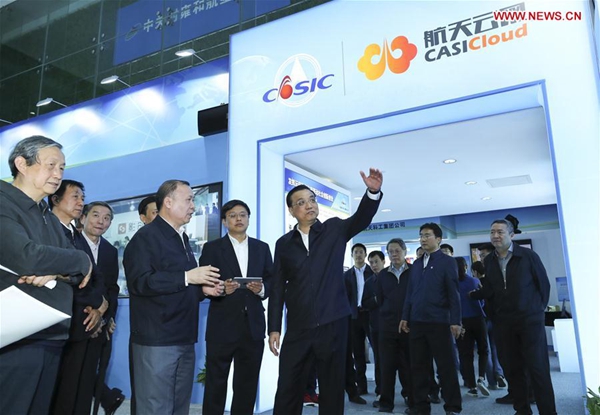
Chinese Premier Li Keqiang (C) inspects China Aerospace Science and Industry Corporation (CASIC) in Beijing, capital of China, April 27, 2017. (Xinhua/Xie Huanchi)

China’s centrally-administered state-owned enterprises (SOEs) have a promising future in boosting mass entrepreneurship and innovation, Premier Li Keqiang has said.

Premier Li said he believes centrally-administered SOEs have more potential and opportunity in implementing mass entrepreneurship and innovation as they are rich in technology, talent, capital and resources.

China Aerospace Science & Industry Corp. is among the leading SOEs in the area. Its web-based innovation platform has attracted more than 2,000 teams of makers, which generates ideas and products and sets an example for innovators across the country.

During an inspection at the company’s science park on Thursday, Li applauded the efforts, saying mass entrepreneurship and innovation will be a way to success for both small firms and industry giants.

“The mass entrepreneurship and innovation initiative is a reform in essence,” said Li, explaining that it taps human potential in improving productivity and uses Internet technology to match businesses with makers.

It will substantially stimulate economic and social development, Li said.

He encouraged other SOEs to build platforms to invite small firms to entrepreneurship and innovation as a new means of integrated development among large, medium and small companies.

The premier also listened to reports from other SOEs, including Aviation Industry Corporation of China and China Mobile.

In a meeting held following the tour, Li called on SOEs to strengthen efforts to reform and restructure.

SOEs, especially centrally-administered SOEs, should continue to focus on improving growth quality and efficiency by advancing reforms, carrying out the innovation-driven development strategy, and building a modern corporate system, Li said, urging them to maintain profit increases and help the economic recovery.

SOEs’ profit growth accelerated to 37.3 percent from a year ago in the first quarter, compared with the 13.8-percent decline registered in Q1 of 2016 and the increase of 1.7 percent over the whole year, data from the Ministry of Finance showed.

Li said centrally-administered SOEs should serve as vanguards in revitalizing the real economy by developing new growth engines and advancing industrial upgrades.

To meet the nation’s strategic needs and implement the “Made in China 2025” strategy, centrally-administered SOEs should move up the industrial and value chains and increase their presence in emerging sectors, through developing revolutionary new technologies and new business models that bring into full play China’s unique advantage of having a vast market, according to Li.

They should also use Internet and other new technologies to upgrade their production, management and marketing models so as to revive traditional sectors, Li said.

To facilitate overhauls of SOEs, governments should implement favorable measures to create a sound business environment, by reducing red tape, increasing fiscal and financial support, and improving supervision, Li added.