Death toll from Inner Mongolia road accident rises to 12


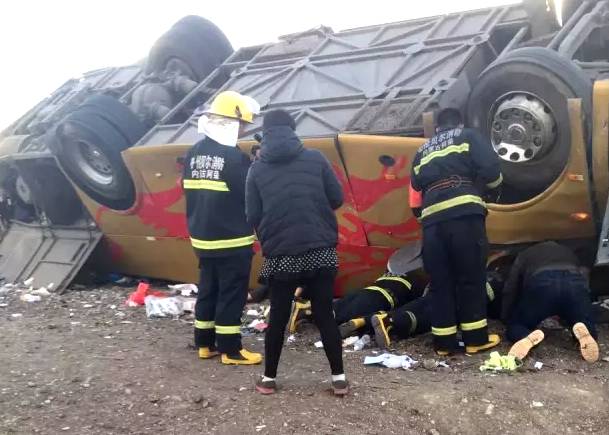
An unregistered car crashed with a bus on a section of a national road in Arun Banner, Hulun Buir City. [Photo/Sina Weibo]

Death toll from the car-bus collision in north China’s Inner Mongolia Autonomous Region has risen to 12, said local authorities on Sunday.

Three people who were seriously injured died in hospital on the early morning of Sunday, confirmed the regional administration of work safety.

The accident happened at about 5:20 p.m. when an unregistered car crashed with a bus on a section of a national road in Arun Banner, Hulun Buir City.

Nine people were found dead at the scene. Thirteen others were injured, including four in critical condition.

A team formed by the public security, transportation, health and civil affairs authorities is taking care of the relatives.

Cause of the accident is under investigation.


The EU mellows its negotiating position a bit

The formal statement from the EU 27 after their Brexit discussions this week had some sensible and positive points in it. They talk of their “wish to have  the UK as a close partner in the future”. They ask for a single financial settlement but  do not put any figures in it. They wish this to include sorting out the shareholdings we have in the European Investment Bank and the ECB which must be our credits. They say they are ready “to initiate an agreement on trade, to be finalised and concluded once the UK is no longer a member state”. They want agreements that go wider than trade, to include security. They seem to accept in principle reciprocal rights for EU citizens in the UK and UK citizens in the EU.

They make much of how unified the EU is and will be over their negotiating position. The UK is not trying to cause division, as we are well aware that it is easier if there is one negotiator for them and they will all sign up to anything the central team agree. They seem unsure that they can hold it together as single voice and view, so they tell the other member states that they are not to talk Brexit with the UK individually. This seems both petty and unenforceable. A willingness to talk to partners is important, but does not mean the EU position will automatically fall apart. It might just be better informed and better reflect its member states views.

There are still some less helpful statements from the EU point of view in the official words. We are told at the beginning “Citizens who have built their lives on the basis of rights flowing from the British membership of the EU face the prospect of losing their rights”. It is difficult to see how this can be true, as the UK has made clear it wishes to ensure full rights to stay and work in the UK for all EU citizens who have legally done so, as long as UK citizens get the same treatment. Further down the document it implies that will be the EU’s view. We are told a trade agreement cannot be discussed until the leaving agreement has been hammered out, yet they also say there can be talks about it in parallel to the second phase of the leaving Agreement. They also say nothing is agreed until all is agreed, so the UK could require preliminary agreement on trade or countries in the EU at risk of high farm tariffs might want the EU to sort that out. Clearly the EU wants to run the risk of damaging its exports to the UK by tariffs.

The language on Ireland, Cyprus and Gibraltar is not as  inflammatory as some reports or interested parties seem to suggest.

All in all it seems to me to be a working document that the UK can respond to. Both sides accept the UK will be leaving the EU, its internal market and customs union. Of course the UK should pay its bills on leaving, but no-one has set out any  bill with financial and legal credibility  that goes beyond our regular contributions up to withdrawal date.


China-made large amphibious aircraft finishes first glide test

An amphibious aircraft AG600 is displayed for the 11th China International Aviation and Aerospace Exhibition in Zhuhai, South China’s Guangdong province, Oct 30, 2016. [Photo/Xinhua] 

China’s large amphibious aircraft AG600 on Saturday successfully conducted its first glide test in the southern Chinese city of Zhuhai as it is preparing for its maiden flight.

Other tests and check-ups are under way, according to the China Aviation Industry General Aircraft Co., Ltd.

Designed to be the world’s largest amphibious aircraft, the 37-meter AG600, with a wingspan of 38.8 meters, has a maximum take-off weight of 53.5 tonnes. It can collect 12 tonnes of water in 20 seconds, and transport up to 370 tonnes of water on a single tank of fuel.

With excellent maneuverability and a relatively wide search scope range, the AG600 will be mainly used for maritime rescue, forest fire fighting, marine environment monitoring and protection.

Aviation Industry Corp. of China said in March that AG600 would embark on its maiden flight over land in late May and on water in the second half of 2017.

The aircraft developer has received orders for 17 AG600s.


Jiaolong retrieves seamount sample in S. China Sea

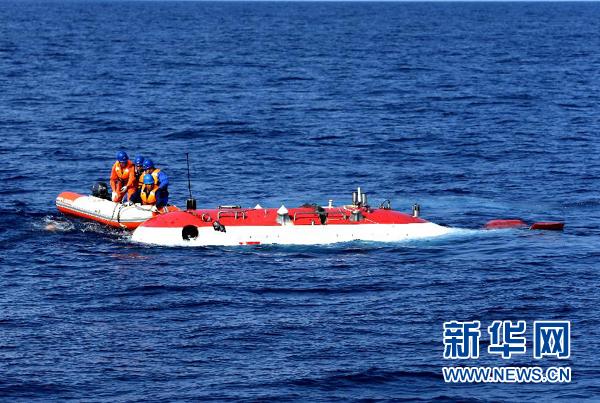
Jiaolong, China’s manned submersible, retrieved a basalt sample from the Zhenbei Seamount in the South China Sea. [Photo/Xinhua] 

Jiaolong, China’s manned submersible on Saturday retrieved a basalt sample from the Zhenbei Seamount in the South China Sea which scientists say could shed light on the formation and evolution of seamounts in the area.

Jiaolong stayed underwater for nine and a half hours in its third dive in the second stage of China’s 38th ocean scientific expedition, which will last until May 13.

The maximum depth of the dive was 2,930 meters beneath the sea surface.

Aside from the five-kilogram basalt sample, it also brought back samples of sediments and seawater near the seabed as well as biosamples, in addition to high-definition photos and video footages.

“It is not easy (to acquire such a basalt sample). This valuable ‘rock’ will lay the foundation for our study of formation and evolvement of seamounts in the South China Sea during the Cenozoic period,” said Shi Xuefa, a researcher with the State Oceanic Administration.

“It is very important for the study of the region’s structural evolution,” Shi said.

Jiaolong has already completed two dives in the South China Sea on Wednesday and Thursday. A fourth dive has been planned on Sunday. The 38th oceanic scientific expedition started on Feb. 6. Jiaolong completed a dive in the northwestern Indian Ocean earlier this year in the mission’s first stage. It will also conduct surveys in the Yap Trench and the Mariana Trench in the third stage.

Named after a mythical dragon, Jiaolong reached its deepest depth of 7,062 meters in the Mariana Trench in June 2012.


The next Labour government will transform the workplace

Labour’s 20 point plan to end the ‘rigged economy’ in work

Labour is backing a comprehensive programme to strengthen rights
at work, make sure new jobs are good jobs, and end the race to the bottom in
pay, conditions and job security.

Low pay and insecurity have mushroomed under the Conservatives.
Labour will invest in the jobs and industries of the future, and take action to
enforce a floor under employment standards across the board – so that all jobs
are decent jobs.

The next Labour government will bring in a 20 point plan for
security and equality at work:

·  Give
all workers equal rights from day one, whether part-time or full-time,
temporary or permanent
– so that all workers have the same
rights and protections whatever kind of job they have

·  Ban
zero hours contracts
– so that every worker gets a guaranteed number of hours each
week

·  Ensure
that any employer wishing to recruit labour from abroad does not undercut
workers at home
– because it causes divisions when one workforce is used against
another

·  Repeal
the Trade Union Act and roll out sectoral collective bargaining

because the most effective way to maintain good rights at work is through a
trade union

·  Guarantee
trade unions a right to access workplaces
– so that unions can
speak to members and potential members

·  Introduce
four new Bank Holidays
– we’ll bring our country together with
new holidays to mark our four national patron saints’ days, so that workers in
Britain get the same proper breaks as in other countries.

·  Raise
the minimum wage
to the level of the living wage (expected to be at least £10 per
hour by 2020) – so that no one in work gets poverty pay

·  End
the public sector pay cap
– because public sector wages have
fallen and our public sector workers deserve a pay rise

·  Amend
the takeover code to ensure every takeover proposal has a clear plan in place
to protect workers and pensioners
– because workers shouldn’t
suffer when a company is sold

·  Roll
out maximum pay ratios
– of 20:1 in the public sector and
companies bidding for public contracts – because it cannot be right that wages
at the top keep rising while everyone else’s stagnates

·  Ban
unpaid internships
– because it’s not fair for some to get a leg up when others
can’t afford to

·  Enforce
all workers’ rights to trade union representation at work
– so
that all workers can be supported when negotiating with their employer

·  Abolish
employment tribunal fees –
so that people have access to justice

·  Double
paid paternity leave to four weeks and increase paternity pay

because fathers are parents too and deserve to spend more time with their new
babies

·  Strengthen
protections for women against unfair redundancy

because no one should be penalised for having children

·  Hold
a public inquiry into blacklisting
– to ensure that
blacklisting truly becomes and remains a thing of the past

·  Give
equalities reps statutory rights
– so they have time to
protect workers from discrimination

·  Reinstate
protection against third party harassment
– because everyone
deserves to be safe at work

·  Use
public spending power to drive up standards
, including only awarding
public contracts to companies which recognise trade unions

·  Introduce
a civil enforcement system to ensure compliance with
gender pay auditing
– so that all workers have fair access to employment and promotion
opportunities and are treated fairly at work

 John McDonnell MP, Labour’s Shadow Chancellor, said:

 “These policies will be the cornerstone of the next Labour
government’s programme to bring an end to the rigged economy that many
experience in workplaces across Britain.

“The scandal of six million people earning less than the living
wage, and four million children growing up in poverty are not inevitable. It
only takes a change of government to bring these outrages to an end.

“The measures we are planning will make that possible, update our
country for the 21st century and prepare us for the economic
challenges ahead.

“They will also underpin the values we want to see in the British
economy, and underline the scale of Labour’s plans to transform the workplace
from the shop-floor up to the boardroom.

“When voters go to the polls on 8th June they
should know that if they vote Labour, they will be voting for a change in the
balance of power not only in society but in their places of work.

“It will mean tearing up the Tory status quo that allows most
people’s wages to fall behind prices, and allow them to start to share in the
wealth they help to create.

“Only a Labour government led by Jeremy Corbyn will stand up for
the many in our offices and factories, while the Tories are only prepared to
protect big business and a wealthy few.”

Rebecca Long-Bailey, Shadow Secretary of State for Business,
Energy and Industrial Strategy, said:

“Labour’s 20 point plan on employment rights seeks not only
to extend the rights of workers but enforce them too. For too long people have
fallen through the gaps in the law or suffered because the law is simply
inadequate, we intend to stop this. This election offers a clear choice: do you
want a labour market run for the many or the few.”