China’s 2nd heavy rocket transported by sea ahead of launch

The second Long March 5, China’s own heavy-lift launch vehicle (HLLV), has arrived at southern China’s Wenchang city, where it will be launched in June.

The rocket was transported from its factory in Tianjin to Wenchang by sea in six days, longer than expected as a result of a sudden weather change.

The rocket is scheduled to launch in June, sending the Shijian-18 communication satellite into Earth’s orbit.

Long March 5 has a payload capacity of 25 tons in low-Earth orbit, and 14 tons in geostationary orbit. Chinese people nicknamed the rocket “Chubby-5” for its large size.

The first Long March 5 was launched last November, also from Wenchang.

The space launch center in Wenchang is China’s fourth rocket launch site. It is where China’s first space cargo ship, the Tianzhou-1, was launched on April 20.


Recording of the week: the Woodlark

This week's selection comes from Richard Ranft, Head of Sound and Vision.

Between February to June on southern and south-eastern English heathlands you may be lucky enough to hear a Woodlark singing. The bird emits a cascade of sweet liquid warbles, often in a large circular display flight some 50-100 metres up in the air above its territory. On windy sunny days in early spring, as we have now, its beautiful notes come and go out of hearing range when heard from a distance, giving the heathland habitat an ethereal quality. 

Song of a Woodlark (Lullula arborea), recorded by Lawrence Shove in 1960s 

Nederlandsche_vogelen_(KB)_-_Lullula_arborea_(350b)

Woodlark and Crested lark (On top: Woodlark; below: Crested lark) from Nederlandsche vogelen (Dutch birds) by Nozeman and Sepp (1770-1829)

Many more recordings of British wildlife can be found on British Library Sounds. To learn more about how and why birds communicate, visit our recently revamped Language of Birds online resource.

Follow @soundarchive for all the latest news.


May day

On 1 May 1707 the Act of Union between England and Scotland came into affect. Today, 310 years on, what is the state of the Union?

It feels from the polling that Scotland is happy with the way she made up her mind in the recent referendum to stay in the union of the UK.  The polls to remain have been fairly steady ever since the vote.

The case for Independence floundered on three main worries. The first was what currency would an “independent” Scotland use? Those in favour of independence strangely wanted to stay dependent on the Bank of England and retain access to the liquidity and credit lines of that central Bank, when the rest of us said if you leave the Union clearly you can no longer be an inside member of the Bank of England system with full facilities for all your banks. There was a marked reluctance to accept the Euro and no fervour for an independent currency to make Scotland properly independent.

The second problem was the financial arithmetic on spending, taxing and borrowing. The referendum took place against a background of oil over $100 a barrel. Even at those prices the fast run off in the volumes of oil thanks to the maturity of the Scottish oil province meant a strain to afford all the present spending levels. Since the vote the price of oil has halved, meaning there are no oil revenues to take back from the Union. This would leave Scotland with high increasing borrowings and or in need of tax rises on some scale.

The third problem was quite a lot of the SNP seemed in reality to be in favour of  Devo max, more control over law making and spending in Scotland whilst remaining a member of the UK.  Their idea of Devo Max went beyond what any of the Union parties thought feasible or sensible.

Many Scots have now decided they are Unionists. Others have decided now is  not the time  to cut loose. They see there are no plans they believe on currency and finance that make sense.

We may discover the state of the Union is healthier than the SNP wish. It is interesting how the SNP attempt to use the EU referendum result to shift opinion does not seem to have worked. It has also left them arguing both that leaving the EU is economically damaging, but leaving the UK is not, which is quite a contortion to bring off.


Small plane crash kills two in north China

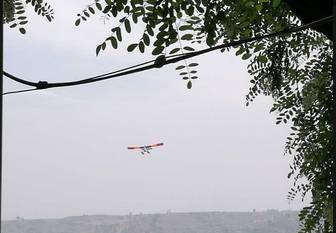
The photo taken by a netizen shows the recreational airplane before crashing into a tree, killing two people and injuring another on April 30, 2017, in north China’s Shanxi Province. [Photo: Wechat]

A small recreational airplane crashed into a tree, killing two people and injuring another on Sunday in north China’s Shanxi Province, local authorities said.

The accident occurred at 5:41 p.m., when the airplane carrying two passengers attempted to land following a sight-seeing trip above the Huihe reservoir in Quwo County, according to the county government.

A person on the ground was injured by the crash.

The cause of the accident is under investigation.


Police seize 12 kilograms of drug in southwest China

Police in southwest China’s Yunnan province have seized more than 12 kilograms of crystal methamphetamine, said local authorities on Sunday.

According to a statement by the public security bureau of Ximeng Wa autonomous county, police found a man driving an unlicensed motorcycle last Wednesday who appeared suspicious. When police asked him to stop for a check, the man ran off.

Police didn’t catch him, but found a blue bag he dropped with 12.43 kilograms of the drug inside.

Police are still hunting for the man.

The Ximeng county, on the border of China with Myanmar, is close to the opium-producing Golden Triangle.