Insurance regulator chief removed from office

The State Council announced Friday the removal of Xiang Junbo from the post of the chairman of China Insurance Regulatory Commission.

Xiang is being investigated for suspected serious violation of the Party’s code of conduct, according to an announcement from the top anti-graft authority on April 9.

The council also appointed Zheng Shanjie as a deputy director of its Taiwan affairs office, replacing Li Yafei.

Zheng’s previous post was deputy head of the National Energy Administration.


Meeting with the Hon. Donald J Trump, President of the United States of America

PRIME MINISTER:

Congratulations on your vote today.

PRESIDENT OF THE UNITED STATES OF AMERICA:

Thank you very much. It was great. Big day.

PRIME MINISTER:

Big day. Every vote counts.

PRESIDENT OF THE UNITED STATES OF AMERICA:

You got it. We had a couple left over and we wanted them, we didn’t need them. It was a very big day. Really – I appreciate your waiting.

PRIME MINISTER:

Well, I know the feeling. We have challenges with our parliament too. We have only 29 seats in a Senate of 76 so you need a lot of work to get legislation through.

PRESIDENT OF THE UNITED STATES OF AMERICA:

That means you’re doing a good job.

PRIME MINISTER:

When you get it passed, you are. Yeah that’s right.

PRESIDENT OF THE UNITED STATES OF AMERICA:

It’s great to be with you.

JOURNALIST:

How are you getting along?

PRESIDENT OF THE UNITED STATES OF AMERICA:

We get along great. We get along great. Always have.

JOURNALIST:

How important is the relationship with Australia Mr President?

PRESIDENT OF THE UNITED STATES OF AMERICA:

I love Australia. We have a fantastic relationship. But I love Australia, always have. Greg Norman is here today, a friend of ours. We have a lot of friends here tonight.

PRIME MINISTER:

A lot of friends in common.

PRESIDENT OF THE UNITED STATES OF AMERICA:

A lot of friends in common.

JOURNALIST:

Do you think you can you put the refugee deal behind you and move on?

PRESIDENT OF THE UNITED STATES OF AMERICA:

Oh yeah sure. That’s all worked out. That has been worked out for a long time.

JOURNALIST:

Telephone calls going will be good in future?

PRESIDENT OF THE UNITED STATES OF AMERICA:

We had a good telephone call.

PRIME MINISTER:

We had a great call.

PRESIDENT OF THE UNITED STATES OF AMERICA:

You guys exaggerated that call. That was a big exaggeration. We had a great call. I mean, we’re not babies. (Laughter) But we had a great call. Right?

PRIME MINISTER:

Young at heart – young at heart.

PRESIDENT OF THE UNITED STATES OF AMERICA:

We had a very, very good call. It was a little bit of fake news – that’s the expression.

PRIME MINISTER:

Exactly right.

JOURNALIST:

When can we expect you in Australia Mr Trump?

PRESIDENT OF THE UNITED STATES OF AMERICA:

That will happen. One of the great, great places. One of the most beautiful places on earth. I have so many friends there. I will be there. We will be there – absolutely we will be there.

PRIME MINISTER:

We are looking forward to it.

JOURNALIST:

You’re here celebrating the Battle of the Coral Sea, how important is the event tonight?

PRESIDENT OF THE UNITED STATES OF AMERICA:

Great, I will be speaking about the Battle of the Coral Sea tonight. That was some battle. That was a very important battle for both of us.

PRIME MINISTER:

It was.

PRESIDENT OF THE UNITED STATES OF AMERICA:

We did it together.

PRIME MINISTER:

We did. It saved Australia and it was the turning point in the war. I was just up on the flight deck with some of the veterans, American and Australian veterans. They were teenagers when they turned the war, the tide of war-

PRESIDENT OF THE UNITED STATES OF AMERICA:

Turned it around.

PRIME MINISTER:

And Australia and America started to win.

PRESIDENT OF THE UNITED STATES OF AMERICA:

So we have been allies for 99 years. Can you imagine that? 99 years and never a bad time. It is a great, great thing.

JOURNALIST:

Mr President, how hard is it going to be to get that health care deal through the Senate?

PRESIDENT OF THE UNITED STATES OF AMERICA:

I think we will get it through. The Republicans are very united like seldom before. I mean you have seen that today. The Republicans came together all of a sudden two days ago and it was like magic. They just came together. They are very, very united. Every group from Freedom Caucus to Tuesday to every single group. A lot of groups. A lot of great people. But they are very very united. You saw that today and you will see it again. The Senate is looking forward to getting it. Mitch McConnell knows how to do things. And I think we are going to have some really great healthcare for a long time.

JOURNALIST:

President Trump, what do you say to some of the congressmen who are concerned about how it will change in the Senate?

PRESIDENT OF THE UNITED STATES OF AMERICA:

Well it could change a little bit. It could get maybe even better. It is a very good bill right now. The premiums are going to come down very substantially. The deductibles are going to come down. It is going to be fantastic healthcare.

Right now Obamacare is failing. We have a failing healthcare. I shouldn’t say this to our great gentleman and my friend from Australia, because you have better health care than we do. But we are going to have great healthcare very soon. Obamacare is failing. The insurance companies are leaving, Aetna announced they are out from Obamacare. Some states, you look at a lot of states, a lot of different states, you look at Tennessee, you look at Kentucky is now trouble, Iowa is in trouble. The insurance companies are all leaving. Obamacare is dead. So when you compare something to Obamacare, Obamacare is no longer living. We have something that is going to be, I think, one of the best anywhere in the world and we look forward to it.

JOURNALIST:

Mr President, can I ask you about your tweet on foreign policy and international issues. It’s unconventional for a President, is it an asset or a liability for your foreign policy?

PRESIDENT OF THE UNITED STATES OF AMERICA:

Social media is the way to go. I have got over 100 million people watching and social media to me is the way to go. This way, if somebody’s not treating you properly or if you do have indeed fake media – not all of it is fake, some of it is fantastic actually – but you can just sort of circumvent. But you know, I find, I don’t know if you find that but I find social media is the way to go between the different forums. There are many different forums but it is a fast way of getting the word out. I really think it helped today in healthcare. I think it is a great way to communicate and it is a modern way to communicate.

Thank you very much.

[ENDS]


Young, alone, no house and not much sex

While most watchers of Chinese society are focusing their attention on the aging population, some have turned their eyes in another direction, to an emerging group in big cities-younger men and women who live alone.

Reports say there are 50 million of them. If they were a province, it would be the 11th-most populated. Observers even created a term for this group in Chinese-kongchaoqingnian-literally “young empty-nester”.

Kongchao, or empty-nest, has been used mainly in reference to parents whose children are gone. But thanks to the media’s wordplay, young empty-nesters include those from 20 to 39 years old who work far from their hometown and eat and sleep on their own.

That’s the definition used by Taobao, a leading e-commerce platform, which issued a wide-ranging report on Wednesday based on its trade database about this group.

They are not necessarily otaku, a Japanese concept referring to those who tend to stay at home all day and drown themselves in computer animation, comics and games. Some actually have pretty good social lives and enjoy hanging out with friends.

They do not have to be “single dogs”, either-a Chinese word created to mock those who are single beyond a certain age. Some maintain long-term romances.

Neither can they be simply categorized as kenlaozu, or boomerang children, media jargon referring to those who are economically dependent on their parents. Some, though not all, earn salaries way above average.

But one thing is for sure: They feel empty. That’s where the indication of the adjective kongchao, or empty nest, grabs their hearts.

As many as 68 percent of them say they have felt lonely in the past week, according to a recent survey by NetEase, a Chinese online portal website. The results were released on Thursday. Only 14 percent say they never feel empty.

The survey interviewed 5,000 young empty-nesters and looked into big data from NetEase’s news service and two other online social service providers-Tantan and Blued, the latter focusing on the gay community.

Young men seem more likely to become empty-nesters than their female counterparts, at least based on the current available surveys, representing 64 percent of the respondents in the survey.

Sexual relations, too, have become a luxury. Nearly half of the young empty-nesters had only one sexual encounter in the past year. Another 31 percent made love once in the past six months. Only 5 percent said they have sex more than 10 times per month. On the other hand, 64 percent of the gay empty-nesters said they have sex at least once every month.

That said, only 1 percent of all respondents placed a sexless or low-sex life as their biggest concern. Their top three concerns: no house, no partner and no hope.


Security risk management to be highlighted in China schools

Chinese authorities will list security risk management as a measure for assessing primary and middle schools and kindergartens, an official with the Ministry of Education said Thursday.

Schools and kindergartens will be told to install anti-collision facilities at school gates should conditions allow, Wang Daquan told a press conference, adding that heads of schools and kindergartens should be held accountable for school safety.

Educational departments should coordinate with relevant departments to map out guidebooks preventing and controlling bullying and violence, Wang said, citing a guideline recently issued by the State Council.

Wang said that schools should purchase liability insurance, while social organizations are encouraged to establish risk funds on school safety or student aid funds.


Beijing holds security cooperation dialogue on B&R Initiative

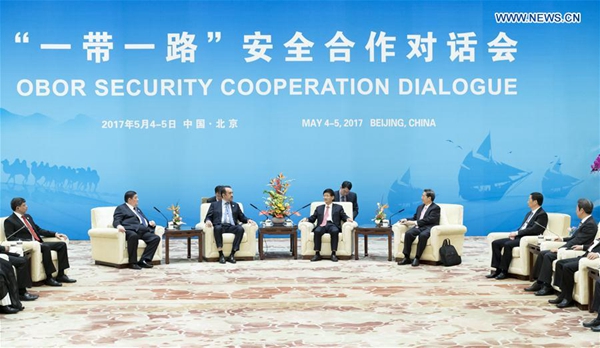
Meng Jianzhu, head of the Commission for Political and Legal Affairs of the Communist Party of China (CPC) Central Committee, meets with officials attending a security cooperation dialogue on the Belt and Road Initiative, in Beijing, capital of China, May 4, 2017. [Photo/Xinhua]

A security cooperation dialogue on the Belt and Road Initiative, attended by officials from more than 20 countries, was held Thursday in Beijing.

Enhancing international cooperation to tackle risks and safeguard security for the Belt and Road Initiative is the common task for all countries, said Meng Jianzhu, head of the Commission for Political and Legal Affairs of the Communist Party of China (CPC) Central Committee.

Meng called on attendees to make full use of the dialogue to enhance exchanges of information and deepen security and law-enforcement cooperation.

More than 100 countries and international organizations have already joined the Belt and Road Initiative, a China-proposed trade and infrastructure plan connecting Asia with Europe and Africa.

“Cooperation in trade, investment, and infrastructure have been growing, thanks to the Belt and Road initiative, ” Meng said, adding that the forthcoming Belt and Road Forum for International Cooperation will push for further cooperation.

The high-profile forum, which will be held from May 14 to 15 in Beijing, will see at least 28 heads of state and government.

“We hope that all sides would foster the concept of common and cooperative security, and establish a sound security cooperation mechanism for the Belt and Road Initiative,” China’s Public Security Minister Guo Shengkun said at the opening ceremony of the dialogue.

Guo called for stepping up pragmatic cooperation in such areas as public security, anti-terrorism, and protecting overseas interests.

Participants attending the dialogue pledged to strengthen security cooperation with China for the Belt and Road Initiative.