Emmanuel Macron elected French President

The Australian Government congratulates Emmanuel Macron on his election as the President of the Republic of France.

Australia enjoys a strong relationship with France, underpinned by common values and a shared vision for a secure and more prosperous future. Our people-to-people links continue to grow and Australia’s 100,000-strong French community makes a vibrant contribution to our nation. 

Our security and defence partnership was forged on the battlefields of World War I and has been the cornerstone of our relationship for a century. Australia’s Future Submarine Program continues this partnership.

We signed a Joint Statement of Enhanced Strategic Partnership during Foreign Minister Ayrault’s visit to Australia in March, enhancing cooperation between our two countries on a range of global challenges including terrorism, transnational, serious and organised crime, proliferation, and climate change.

Australia and France also have a substantial trade and investment relationship, with two-way trade valued at $8.7 billion in 2015-16. Over 500 French companies operate in Australia, employing an estimated 60,000 people. 

The Australian Government looks forward to working with President-elect Macron to further bolster French-Australian relations. We thank outgoing President Francois Hollande for his commitment to enhancing the already close ties between our countries including through his 2014 visit to Australia, the first by a sitting French President.


Recording of the week: Parental warning

This week's selection comes from Andrea Zarza, Curator of World and Traditional Music.

Ethnomusicologist Bryony Harris (née Pearson) spent 2002 doing field work in Uganda to record the drumming styles of the Busoga and Buganda as part of research for her dissertation "Towards a notation for African dance drumming, focusing on the Baganda and Basoga of Uganda". The recording featured this week [collection C1079] was part of that research and in a recent e-mail exchange, she gave us some more insight into its making –

“This is such a rich layering of instruments and textures. It was a very humbling experience to attempt to learn something of the history, tradition and drumming technique in a snapshot of time. I arrived with my western preconceptions, a 20 year old English girl trained in western music, but completely out of my depth with the complexities of this traditional music.

Bryony Harris_Uganda

This recording is of the Kalalu village 'Balongo' group of musicians. Kalalu is a very rural village, a bumpy bicycle ride from Jinja in Busoga, where some of the children were fascinated / scared of my white skin. They were very welcoming but keen to be paid for their expertise – and rightly so, in hindsight. As it was something I hadn't really budgeted for however, we got the group to play together for my recording by arranging to produce a cassette for them. The market for cassettes was still going strong in 2002 Uganda as they were cheap to produce and buy. We took photographs of them in their blue t-shirt uniform and they decided on their best songs.”

According to the catalogue entry, based on the recordist’s notes, the song warns parents of the dangers of cursing their children stating they will be affected and face trouble in the future. For such a serious warning, it is a joyful song featuring the following instruments: endere (flutes), ndingidi (string fiddle), nkwanzi (panpipes), embaire (small xylophone), ensaasi (flat metal shaker), endumi (small drum), engabe (long drum), tamenaibuga / irongo drum.

Abazaire Abatukolima – 'Parents Cursing their Children'

Upon re-listening to the recording, Bryony reflected –

“The quality of the song is judged by the lyrics and the singer – the competence of the musicians is taken for granted. I think I did move around with my microphone a little during the recording, as you can hear different instruments stronger at different points. Thoughts that return to me on listening to it again: Firstly – where is the beat? The need to focus on the shaker to hear it – but then the drums always put me off when they enter! I was trying to focus my learning on the drums, but they were so different to any West African rhythms I'd played previously. Seeing the drums signal the dancers to change their amazing rapid hip movements. Where does the cycle of notes start? How do they know where to come in? The phenomenal speed of the interlocking xylophone, where different patterns spring out at you the more you listen. The cyclical nature of the melody and the variety in texture and colour. This music, which is made of fairly simple, repetitive parts is elusive. The more you listen the more there is to hear.”

Follow @BL_WorldTrad and @soundarchive for all the latest news.


Bird flu hits Taipei poultry market

A poultry market in Taipei was to be the source of an outbreak of the H5 subtype of avian influenza virus, the city’s animal protection office said Monday.

The market culled 304 chickens and suspended operation for 24 hours so that the premises could be disinfected, after birds suspected to be carrying the virus were found in five batches of chickens transported to the market Sunday.

The birds were confirmed to have the virus Monday, although the exact strain has yet to be determined.

The infected birds were from four farms in Kaohsiung, Miaoli, Pingtung and Yunlin, the office added.


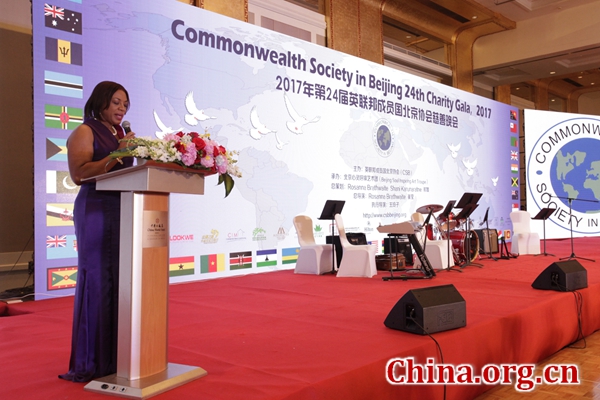
Commonwealth Society in Beijing hosts annual charity gala

CSB President Madam Rosanna Brathwaite delivers a speech during the gala. [Photo courtesy of CSB]

The 24th Charity Gala of the Commonwealth Society in Beijing (CSB) was held at the China World Hotel on May 6.

Some 600 guests were present, including ambassadors from South Africa, Indonesia, Cuba, Guyana, Grenada, Barbados, Cyprus etc., diplomats from both Commonwealth and non-Commonwealth countries, entrepreneurs, sponsors and other dignitaries.

The CSB Charity Gala is an annual fundraising event for supporting local charities.

Proceeds were raised through ticket sales, donations, raffles and silent auctions, among other activities. The money will be distributed to eligible charity organizations identified by the All China Women’s Federation and the social volunteers’ organization roundabout.

Participants were also treated to guest performances by renowned entertainers from the Americas & Caribbean, Europe, Asia, Africa and Pacific regions.

“We must open our eyes, our ears and our hearts and, in whatever way we can, dig deeper and answer the call of communities that are in need,” said CSB President Madam Rosanna Brathwaite during the gala.

“Through our partnerships, we have been able to help women and children, promote education initiatives among the young, and continue to support persons who are advocating health and wellness in China,” she added.

The CSB was founded in 1993 by female diplomats from the Commonwealth, all of whom have been diligently working for the strengthening of bonds between Commonwealth countries and China by engaging in various social welfare projects across the nation.

Statistics show that CSB donated over 3 million yuan (about US$430,000) to several under-privileged communities in China between 2012 and 2016. The Society serves to specifically assist children, women and the elderly.


Health and social care

For many years and under many governments the UK has puzzled over the relationship between social care and the NHS. All governments would like a seamless transition from the one to the other for patients who need both. All have looked at whether some administrative or management reform would make all the difference. No-one so far has come up with a perfect solution.

Some now say the answer is to put social care under the control of the NHS. Others say the local NHS in each area needs to work more closely alongside the Council’s social service department. There are concerns that the boundaries do not work well, with some Councils not moving quickly enough to provide social care placing greater strains on hospitals with elderly patients.

It is tempting to think we could reorganise to remove any boundaries between different public bodies providing services. Then maybe the unified budgets would lead to more optimal outcomes for both patient and taxpayer. However, it is difficult to see how you can avoid a boundary. If you put social care into the NHS you just shift the boundary to the one with Council provided care homes and sheltered housing. If you transferred local NHS control to Councils you would find it much more difficult to get benefits from national NHS policies, purchasing power and hospital planning. There would be a bigger tension between national and local NHS, with all the money coming from the national level.

As someone who has thought a lot about this problem as a former government adviser and someone helping with past Manifestoes there is no easy answer. I conclude it is best to start from what we have, and build in incentives and requirements for good conduct by both the NHS and local social care.What we want is a wide range of provision, with choice and capacity available for each different and often difficult case.

Someone in social care needs access to a good GP and or to a hospital Consultant for a worrying condition. Admission to hospital when needed is not normally a problem. Decent supervision of an elderly person should enable better management of any medical condition without emergencies or alarms in many cases.

Discharging an elderly person from hospital requires appraisal of their needs and prompt and helpful action by social services, housing and other relevant departments. This is where local accountability and Councillor supervision should wish to shine.

Promoted by Fraser McFarland on behalf of John Redwood, both at 30 Rose Street Wokingham RG40 1XU