Cyberspace authority warns of ransomware attack

China’s cyberspace authority Monday warned computer users to install and upgrade security software to avoid being hit by the global ransomware attack.

A statement issued by the cybersecurity coordination bureau of the Cyberspace Administration of China said the “WannaCry” ransomware attack, which began to spread worldwide Friday, has affected some enterprises and government offices in China.

Police, authorities in the industry, information technology, education, banking and cyberspace sectors as well as some computer security companies have taken response measures, the statement said.

Media reports have also helped increase public awareness of the virus and contain the spread of the attack, it added.

The authority said this global cyberattack has once again shown the unprecedented internet security challenges, calling on all sectors to address to cybersecurity issues.
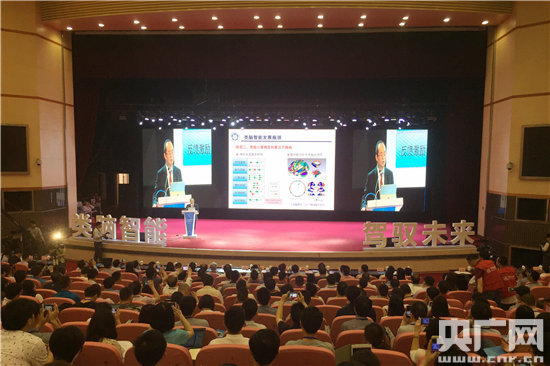


China sets up national lab developing brain-like AI technology

China’s first national laboratory for brain-like artificial intelligence (AI) technology is inaugurated Saturday in Hefei. [Photo/cnr.cn]

China’s first national laboratory for brain-like artificial intelligence (AI) technology was inaugurated Saturday in Hefei, capital of East China’s Anhui Province, to pool the country’s top research talent and boost the technology.

Approved by the National Development and Reform Commission in January, the lab, based in China University of Science and Technology (USTC), aims to develop a brain-like computing paradigm and applications.

The university, known for its leading role in developing quantum communication technology, hosts the national lab in collaboration with a number of the country’s top research bodies such as Fudan University, Shenyang Institute of Automation of the Chinese Academy of Sciences as well as Baidu, operator of China’s biggest online search engine.

Wan Lijun, president of USTC and chairman of the national lab, said the ability to mimic the human brain’s ability in sorting out information will help build a complete AI technology development paradigm.

The lab will carry out research to guide machine learning such as recognizing messages and using visual neural networks to solve problems. It will also focus on developing new applications with technological achievements.


Remarks by Jyrki Katainen, Vice President of the European Commission at the High Level Dialogue Session of the Belt and Road Forum for International Cooperation

It is a pleasure to be here to discuss Connectivity – the driving force of the twenty-first century.

The Asian Development Bank estimates that Asia faces a $26tn infrastructure gap until 2030. Done the right way, more investment in cross-border infrastructure links could boost sustainable growth for all. That is why it is in Europe’s interest to be part of this Initiative. China is at one end of the Belt and Road – Europe at the other. Our Trans-European Networks (TEN-T) are already extending East and South. We want to be better connected to our neighbours and partners. We want to build bridges – not walls. As China and the EU are both developing transport initiatives, coordination between us is essential.

This is the role of the EU-China Connectivity Platform. Looking ahead we should ensure that any ambitious scheme to connect Europe and Asia should adhere to the following eight principles – “Eight” being a homonym for prosperity in Chinese:

First, transparency on plans and activities, together with open, rules-based public tenders and reciprocal market access. Second, inclusiveness by ensuring that all parties and countries have a fair say on priorities. We should use multilateral frameworks, like ASEM, to make this a reality. Third, long term vision. We cannot deliver with a piecemeal approach. We need a robust feasibility study with a strong focus on economic and environmental aspects. Fourth, this will help to avoid the mistakes of the past. We have learnt the hard way how to assess the impact on the environment and on the local communities who will be most directly affected. Fifth, we must mainstream the principle of sustainability in line with the 2030 Agenda.The Paris Agreement provides Asia and Europe with opportunities to invent new and better ways to produce, consume, invest and trade. Sixth, cost effectiveness. Transparent, non-discriminatory and open procurement will minimise the fiscal burden, reduce the risk of misappropriation and ensure a level playing field. We need to apply global standard lending disciplines but also bring in a more innovative approach to financing, including public-private partnerships and risk sharing. Seventh, we must involve multilateral banks like the European Investment Bank, the European Bank for Reconstruction and Development, the Asian Development Bank or the World Bank. Their decades of experience make them an invaluable partner for new institutions like the Asian Infrastructure Investment Bank.

Finally our eighth and perhaps most important principle should be reciprocal benefits for all. Not only for countries, but also a fair chance for economic operators from all sides.


Building a better Scotland

This week marks 10 years since the SNP first took office.


We will honour Britain’s commitment to international development

As part of the coalition, the Lib Dems managed to secure 0.7% of Britain’s gross national income for international development. It was one of our final acts in government, and it’s one we’re most proud of.

Since then, 0.7% has been a legal requirement, which has prevented the Conservatives and UKIP from stopping these vital funds getting to the world’s most vulnerable people.

Now, in the face of yet more callous opposition from the government, who are attempting to reduce the funding – the Lib Dems are making a stand.

The British people don’t have to settle for Theresa May’s cold, mean-spirited Britain.

Today, we have vowed to protect our 0.7% legacy and ensure that the UK continues to alleviate poverty across the world, helping to build a more secure and stable international community.

Why? Because UK aid prevents unimaginable suffering. It allows girls to stay in school, stops babies from dying from preventable illnesses, and ensures that farmers can sell their crops at a fair price.

And because a healthier, safer and more stable world is better for Britain. We should all be proud of our outward-looking, modern, progressive record as a global leader in international development.

If you want to fight for Britain’s legacy and protect the 0.7% pledge, support us today: