7% university students report harassment on campus

More than seven percent of university students surveyed said that they have experienced harassment from unidentified people on their college campuses.

The survey, which polled 601 students from over 100 Chinese universities, revealed that 7.58 percent of the respondents had experienced harassment, according to an article in Monday’s edition of China Youth Daily.

Moreover, about 65.24 percent said they had heard of similar situations experienced by their classmates.

However, the article quoted some students as saying that in many cases victims dare not to directly confront their harassers and many felt ashamed to tell their families or teachers.

Students surveyed also said that enhanced security is required on university campuses. A total of 58.81 percent of the students said their campuses allow members of the public to enter freely, while 81.38 percent said universities should take measures to control entry.


Global Think Tank Summit opens in Beijing

The Fifth Global Think Tank Summit opened in Beijing on Monday with more than 100 academics from home and abroad gathered to discuss sustainable development.

Hosted by China Center for International Economic Exchange (CCIEE),the summit covered topics including globalization, sustainable development, the Belt and Road Initiative, and regional and global security.

Researchers must be aware of the new circumstances facing globalization, and promote global governance and reform of international rules, said Chen Yuan, vice chairman of the National Committee of the Chinese People’s Political Consultative Conference (CPPCC), at the opening session.

Chen called on academics to participate in the Belt and Road Initiative and put forward plans to deal with real global challenges.

Participants noted that globalization is the requirement of growing social productivity, and is a natural outcome of scientific and technological progress. It has powered global growth and should not be blamed for the world’s problems, they said.

CCIEE director Zeng Peiyan attended the summit.


Recording of the Week: a musical family

This week's selection comes from Jonathan Summers, Curator of Classical Music Recordings.

Jacob Collier has been creating a stir in the musical world recently, winning two Grammys in February at the age of twenty-two. His grandfather Derek made his first broadcasts for the BBC at the same age, in 1949. Here he is in a work by Handel arranged for solo violin by the great Hungarian violinist and teacher Jenő Hubay.

Handel Larghetto from Op. 1 arranged by Hubay

Collier b+w photo 

Derek Collier (courtesy of Suzie Collier)

Over 100 recordings from the Derek Collier collection can be found on British Library Sounds

Follow @BL_Classical and @soundarchive for all the latest news.


Mr Macron flies to Berlin

Mr Macron promised to rebuild the Franco-German alliance and to seek to strengthen the role of the EU in his country. To do so he has to fly to Berlin to show Mrs Merkel he agrees with her and will be helpful to her prior to the German election.

He will find in Berlin beneath the public courtesy a very different view of what the problems are, let alone what the future answers should be. There will of course be some goodwill born of relief that Mme Le Pen failed, but the reality of German interests will soon reassert.

The main German preoccupations will be to avoid any new spending commitments by the EU that Germany might have to pay for, and to keep the austerity pressure on the heavily borrowed countries of the Union. France will want to speak for a higher spending and borrowing federal EU government which Germany will dislike. Both countries say they want a political union, but France wants that to include sharing the money whilst Berlin wants it to be governed by teutonic controls on spending, borrowing and printing money.

Mrs Merkel may offer her new suitor warm words, but is unlikely to loosen the German or EU purse strings. Germany will be conscious that her 830 bn Euro deposits in the ECB are already lent on at no interest to countries who will struggle to repay.

Published and promotoed by Fraser Mc Farland on behalf of John Redwood both at 30 Rose Street Wokingham GR40 1XU


Cleanup on world’s highest mountain

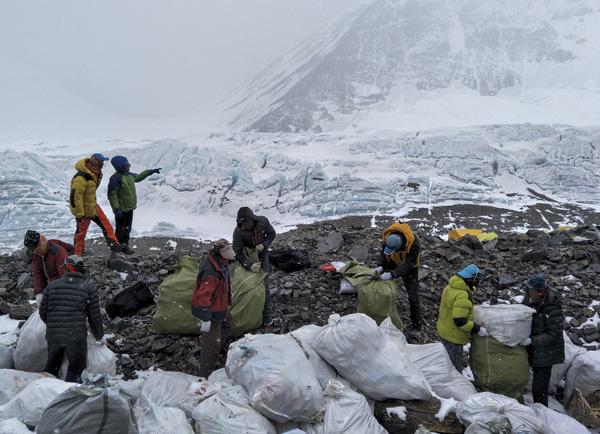
Volunteers sort garbage on the north slope of Qomolangma in the Tibet autonomous region on May 8, 2017. [Photo/Xinhua]

More than 100 climbers have collected 4.5 metric tons of garbage on the north slope of Qomolangma, known as Mount Everest in the West, in an annual cleanup campaign.

The volunteers, including local Tibetans, domestic and overseas mountaineers, and staff of Tibet’s mountaineering work units, have been working at altitudes of between 5,200 and 6,500 meters since May 6.

Pema Trinley, deputy secretary of the Tibet Mountaineering Association, said the mountaineers are from more than 20 countries, such as the United States, Italy, Spain, the United Kingdom and Switzerland.

Kari Kobler, president of Swiss outfitter Kobler & Partner and one of the volunteers, was reported by Xinhua News Agency to have lauded the cleanup campaign as a sign of China’s increased environmental awareness. The 62-year-old climbing enthusiast said he has climbed the mountain many times over the past 17 years.

The campaign is expected to wrap up in mid-May.

With a height of 8,844 meters, Qomolangma is the world’s highest mountain and attracts thousands of visitors, hikers and mountaineers every year from around the world.

“The altitude between 5,200 to 6,500 meters is where most of the human activities such as mountaineering and training take place, and so it has the most waste,” said Pema Trinley.

Of the 4.5 tons collected so far, about one-third is tin cans. Other solid waste left by mountaineers include plastic bags, oxygen tanks and mountaineering ropes.

The organizers-the China Mountaineering Association and the Tibet Sports Bureau-have arranged 102 yaks to carry the waste down to the base camp at an altitude of 5,200 meters for sorting. The garbage is then trucked to Dingri county for further treatment.

The cleanup work on the north slope started in 1997. But this year’s efforts have reached a higher altitude than past efforts.

Nyima Tsering, deputy director of the Tibet Sports Bureau, said the bureau has plans to install sorting, recycling and degradation stations along the campsites on the north slope.

The bureau is also considering cleanup campaigns at higher altitudes, probably reaching 8,300 meters, starting next year, he said.

“We are considering establishing a professional cleanup team that can remove waste and participate in rescue operations when necessary,” Nyima Tsering added.