Courts plan for more global cases

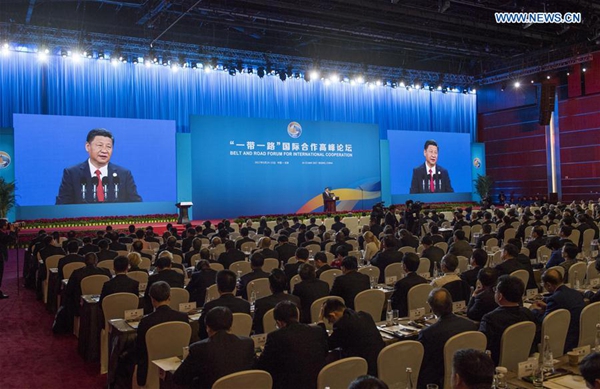
Chinese President Xi Jinping delivers a keynote speech at the opening ceremony of the Belt and Road Forum for International Cooperation in Beijing, capital of China, May 14, 2017. [Photo/Xinhua]

Chinese courts will make further efforts to ensure justice during the development of the Belt and Road Initiative with improved judicial services for legal disputes involving foreign entities.

The Supreme People’s Court plans to set up a dispute resolution center for cases related to the Initiative, and further develop its international maritime judicial research institute, Liu Jingdong, deputy head of the fourth civil division of the top court, said on Monday.

The Belt and Road Initiative, put forward by President Xi Jinping in 2013, aims to promote free trade, infrastructure construction and people-to-people exchanges among different continents. More than 100 countries and international organizations are participating in it.

However, more interactions with foreign entities have also resulted in an increase in foreign-related disputes.

Figures from the top court show that since last year, more disputes have involved Asian, Middle Eastern and European countries, including Singapore, India, Malaysia, Russia and Kazakhstan, and many have involved cross-border contract projects and international logistics.

This year, judicial services will be further improved to safeguard the development of the Belt and Road Initiative, Liu said, adding that the top court plans to draft more legal interpretations on laws applied in cases concerning foreign entities as well as related judicial principles to facilitate judges’ rulings.

For example, detailed guidelines will be put together on how to recognize and enforce foreign rulings in civil and commercial cases, on how to handle labor disputes involving maritime crews, and on how to manage damages and compensation for maritime resources and ecological pollution.

The procedure on loss assessments for maritime pollution will be standardized and the application of laws on waterway transport will be pinned down, according to the top court.

To better guide courts across the country in handling foreign-related cases, the top court on Monday also made public 10 typical lawsuits. They cover areas such as marine pollution, the enforcement of brokerage contracts among companies in foreign locations, and the recognition and enforcement of a foreign court ruling.




Subway line carries message of love

Passengers enjoy a light moment in a compartment prepared especially for singles on Line 1 of the Shenzhen Subway in Guangdong Province on May 8. [Photo/Xinhua]

Commuters in Shenzhen, Guangdong province, can get a feeling of love during their daily journey on a special train covered with sweet words and wishes.

The decorated train, on Line 1 of the city’s subway, began operating on May 8 and will run for a month.

Compartments are painted pink, with hundreds of riders’ posts on the walls and floor. Some express love for a girlfriend or boyfriend, some for parents, and others for the city.

“Dear Mom and Dad, it has been a long time since I last came home,” reads one message. “I miss you so much. Hope you are healthy and happy. I will continue to work hard and bring you to Shenzhen. Love you and miss you.”

The train also has a compartment prepared especially for singles. One side of the compartment is painted blue and the other pink, and it is filled with sweet words from singles to future partners.

The event, organized by Shenzhen Metro Group and Shenzhen Press Group Metro Media, is held to coincide with the time around May 20-known as 520 in China. Since the pronunciation of “520” is close to “I love you” in Chinese, many consider it a day of love.

“The aim of the move is to spread positive energy and love across the city,” said Zhou Xinhua, head of the cultural promotion department at Shenzhen Metro Group’s resources development unit, which is responsible for organizing the event.

“Every day, 4 million to 5 million people travel on the Shenzhen Metro. It is a window and carrier for promoting spiritual culture. In addition to this event, we will organize other cultural activities in the metro in the future to contribute to the construction of a spiritual civilization.”

People interviewed in Shenzhen hailed the move, calling it meaningful.

“The event is warm and encouraging. It shows that Shenzhen is not only a city with high economic growth, but also a city full of love,” said Pan Qiyun, a 28-year-old working at a local startup.

Liu Yuanyuan, who works as an accountant, said the event is particularly meaningful in a first-tier city where most people are busy with work and often neglect to show and express their love.

“I hope similar events will be held to strengthen the sense of belonging among people working and living in the city,” Liu said.


China to strengthen legislation to prevent financial risks

China Banking Regulatory Commission. [File Photo: jrj.com]

China’s banking regulator said Monday it will bring in new legislation this year to plug regulatory loopholes and step up supervision to guard against financial risks.

Law-making shall strengthen key fields including shareholding entrustment, fund supervision and financial services, according to the China Banking Regulatory Commission.

Legislation should pay more attention to ensuring there will be no systematic financial risk.

The commission plans to complete 46 legislative programs in 2017, covering risk management on bankruptcy and liquidity of commercial banks as well as on cross products services.

Research will be made on another 16 programs including microfinance company supervision and trust company liquidity management, according to the commission’s work plan.


5.6-magnitude quake jolts Taiwan

A 5.6-magnitude earthquake hit Taiwan’s Taitung County at about 7:12 a.m. Tuesday Beijing Time, according to the measurement of the China Earthquake Networks Center (CENC).

The epicenter was monitored at 23.31 degrees north latitude and 121.49 degrees east longitude, with a depth of 10 kilometers, according to CENC.

Reports of damage and casualties are not immediately available.


Securing Australia’s Naval Shipbuilding and Sustainment Industry

The Turnbull Government has released Australia’s first Naval Shipbuilding Plan, outlining the nation’s largest ever programme of naval shipbuilding and sustainment.

The plan includes a massive injection of funds – $1.3 billion – to develop vital infrastructure in the nation’s shipyards so that we can build the Navy’s next generation of naval vessels here in Australia.

The Naval Shipbuilding Plan will end the boom-bust cycle that has afflicted the industry for many years, providing certainty for local businesses and shipbuilding workers.

The Turnbull Government is investing around $90 billion in the rolling acquisition of new submarines and the continuous build of major ships such as future frigates, as well as minor naval vessels.

This Plan will ensure delivery of these modern defence capabilities set out in the 2016 Defence White Paper, creating thousands of jobs and securing the naval shipbuilding and sustainment industry for future generations of Australians.

We are embarking on a great national endeavour. We will transform our naval shipbuilding and sustainment industry here in Australia, with Australian workers, in Australian shipyards, using Australian resources.

In total, the Turnbull Government will invest more than $1.3 billion to modernise construction shipyards in South Australia and Western Australia.

Work will commence this year on the development of infrastructure at the Osborne Naval Shipyard in South Australia. The Henderson Maritime Precinct in WA will also be upgraded.

This will encompass construction of new cranes and heavy lift transportation capability, welding stations and upgrades to workshops and storage facilities including new steel framed sheds.
The plan is a pathway to prosperity in naval shipbuilding and represents a major milestone for the nation’s defence industry.

The Government is delivering on its unwavering commitment to both national security and economic prosperity through the continuous building of naval vessels in Australia, while also strengthening the nation’s advanced manufacturing industrial base.

The Centre for Defence Industry Capability, opened by Government in December 2016, is based in Adelaide and has a national presence.  The Centre will play a critical role in developing the national supply chains to support the naval shipbuilding programs.

Modern shipbuilding facilities and processes will play an important role in the transformation of Australia’s naval shipbuilding industry.

The naval shipbuilding workforce is expected to grow to around 5,200 workers by the mid to late 2020s, with more than double this number of workers in sustainment activities and throughout supply chains across Australia.

The Naval Shipbuilding College announced on 24 March 2017 will commence operation in early 2018, working with existing education centres to expand and develop the pool of available skilled workers to meet the growing demand.

The Naval Shipbuilding Plan is available at the Department of Defence website.