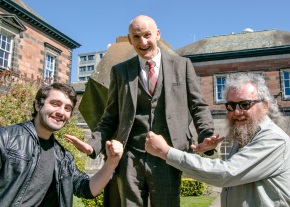
MR ROSS VASTA MP, MEMBER FOR BONNER:
Well good morning everyone, it’s great to have the Prime Minister here in the electorate of Bonner. And we are at Australian Innovative Systems, this Elena’s great factory here and this company has gone from strength to strength and it’s great to have the Prime Minister here to see firsthand the innovation in the water technologies. This is a great Australian company which employs local people as the local RNV here and is about to expand with the great announcements of the budget. So Prime Minister thank you for being here in the electorate of Bonner, we’re grateful for you to come here. Budget has been an overwhelming success in the electorate of Bonner. Business’s like this and the other businesses that you’ve seen like (inaudible) and Australian (inaudible), so Prime Minister thank you again for being here, keep up the good work and you’re always welcome back in Queensland in the electorate of Bonner.
PRIME MINISTER:
Thanks Ross, thank you and thank you for your passion. For industries and particularly small businesses, small innovative entrepreneurial businesses. These are the enterprise, these are the businesses, these are the enterprises that are at the heart of Australia’s economic future. Their commitment, their courage and determination, like Elena’s to keep on innovating, to finding the new products that she can design and manufacture here in Australia and export around the world.
This is what it is all about. This is what innovation, enterprise investment is all about. And that is why our Budget is encouraging businesses like these. Because we are reducing the company tax rate for small to medium businesses. Already we’ve legislated for up to business of a turnover of up to $50 million bringing it down to 27. 5 per cent and then going forward to 25 per cent. We want to do more and I have to tell you, we need to do more. Around the world, company taxes, business taxes are coming down. You heard Donald Trump proposing a 15 per cent company tax rate. We have got to be competitive.
Britain is going to 18 per cent, 17 per cent in fact is their target and only last night I was talking to the new President of France, Emmanuel Macron, and I congratulated him on his election and we talked about a whole range of issues, counter-terrorism, security but we also talked about economic issues. He is committed to bringing France’s company tax rate down from 33 per cent down to 25 per cent. So you can see this is a global trend. So that’s is why we are committed to making sure Australian businesses can compete. Now in order to compete, we want them to invest and so we have extended the instant asset write-off for plant and equipment up to $20,000 up for another year for businesses with a turnover of under $10 million. That is so important for all of these businesses but of course it is especially important for their customers.
As Elena was talking about just a moment ago, so many swim schools are buying pumps and filtration systems. $17,000, $18,000 from her, this is a great incentive for them to upgrade. It is also very important for Barton’s of course vehicles, so when they are buying a new truck or new car, new light van, obviously that is a very important part of the incentive. So that’s our commitment.
Now as you have seen, Elena employs, and all these companies employ apprentices. Training is at the heart of our whole skills program. So we are abolishing the 457 visas, replacing them with a better targeted system for temporary skilled migration and also introducing a new training fund which we will ensure does more of what these companies are already doing, which is training new employees, training apprentices in order to provide – offer the skilled opportunities for Australians. We will always have skilled workers coming in from overseas where there are skilled gaps in Australia. But as far as possible, every job, every opportunity should be filled first by an Australian. That is our commitment, training is at the heart of it and we are putting additional resources behind training in this Budget.
So this budget of ours is one for growth, it’s for investment, it’s backing enterprise, it’s backing innovation, it’s backing the great Queensland companies we have just been with this morning.
JOURNALIST:
Prime Minister there are reports overnight that the intelligence Donald Trump shared with the Russian’s wasn’t even shared with Five Eyes allies, including Australia and New Zealand. Is that the case?
PRIME MINISTER:
I won’t comment on intelligence sharing other than to say that we have a very close intelligence-sharing relationship with the United States and our other Five Eyes partners. It is as close as it possibly could be. But I won’t comment on those allegations press…
JOURNALIST:
It’s a very serious allegation though, that Russia has intelligence Australia doesn’t, does that concern you?
PRIME MINISTER:
I can assure you that the relationship between Australia and the United States in terms of intelligence sharing is as close as it possibly could be. And we have no concerns about any other country having access – having privileged access to information we don’t have.
JOURNALIST:
PM can you divulge whether [inaudible].
PRIME MINISTER:
I can, again, I am not going to comment on that, but I don’t think that has even been suggested in the media. But, look, I know it is – intelligence matters and spies are always of great interest.
In my youth, I spent a bit of time in a trial involving an old MI5 agent. But I have to say as Prime Minister, protecting our national security in the national interest. I have to be circumspect and discreet on matters of national security. It is my highest priority. My job is not to feed speculative commentary in the media. My job is to ensure that Australians are safe. No government has invested more in national security in peace time than mine.
You saw the announcement of our naval shipbuilding plan earlier in the week. You have seen our commitment with the new Centre of Excellence to be built at the Western Sydney airport with Northrop Grumman, the big contractor who’s expanding its Australian supply chain all the time. Our investment and support for the AFP, for ASIO, all of our intelligence and security services are at greater and greater heights all the time. Cybersecurity, a big issue over the last few days, you can see the priority and attention we give that.
So, my job as Prime Minister, and the Government’s job, is to keep Australians safe. That means, sometimes, I will be more discreet than you would like me to be.
JOURNALIST:
What about laptop bans? You talked about the possibility of that? Is that because of IS?
PRIME MINISTER:
As you know, there have been some developments in terms of procedures the United States are taking. We have upgraded some of our security procedures out of some airports. We are constantly reviewing aviation security. It is a very dynamic area.
Again, the priority is to make sure that Australians and all of the travelling public are kept safe. We work very closely with our partners around the world in that respect. As and when any decisions to make changes regarding devices of one kind or another are made, they will be announced.
JOURNALIST:
Just on the laptop restrictions, did the US warn Australia, or did we receive intelligence from elsewhere?
PRIME MINISTER:
Again, I am not going to comment on sources of intelligence. But well done asking!
JOURNALIST:
John Zakhariev in Bulgaria, have you been briefed about him. Is assistance being provided to him?
PRIME MINISTER:
Yes, the gentleman referred to that you’ve mention in Bulgaria is provided with consular support in the usual way. As all Australians are when they find themselves in legal difficulties, but again, I don’t want to comment on that case or any other particular case. Again, I stress, as I always do, that when Australians are overseas, they must obey the laws of the country they are in. There is a limit to what we can do. We can provide some consular assistance but the law is the law and it is up to the legal system of the country you are visiting. So it is not something that we can change from here.
JOURNALIST:
In terms of Cross River Rail, is it fair to say the earliest you’d be able to get funding is 2019 and the states will be able to apply for the national rail fund?
PRIME MINISTER:
Well, the states are able to apply and discuss these matters with us right now. Paul Fletcher, the Minister for Urban Infrastructure has been having extensive discussions with the Queensland government, and indeed the Brisbane city government. I have had discussions with the Queensland government and the city government.
We are certainly looking at Cross River Rail very carefully. In fact, we provided $10 million to the State Government to enable them to do a proper business case, a business plan for Cross River Rail, particularly examining how it can operate, interact with the transport solution proposed by the Lord Mayor. It is very important that these projects are properly planned. There it is an enormous opportunity to make the government dollars work harder and achieve more. But to do that, you’ve got to plan it right, you have got to make sure that whenever possible you can capture some of the increase in land value occasioned by the construction of the new transport infrastructure. We have got to have a much more sophisticated and more of an investment approach to infrastructure in Australia. That’s one of the big changes I have made as Prime Minister. We have got to make those scarce government dollars, and they are scarce, you have seen the challenges we face with our budget, we have got to make sure those dollars go further.
So yes, we’re looking at it very closely.
JOURNALIST:
So the state says you have the business case. Is it fair to say you’re not convinced this project stacks up?
PRIME MINISTER:
It is yet to be finalised. We do not have, there is not a final completed business case. There is a proposal.
(Phone rings)
I think that’s me. There you go, it’s off. Sorry about that. But I can say that state governments have tended to treat the Commonwealth government as an ATM; just a dispenser of cash. That is not the way it is working anymore. Obviously, we will continue to make grants but on big projects we expect to be more involved. Where we can make an investment, we will. I think we need to get better value out of our infrastructure investment than we have in the past. So you can see we are making direct investments.
For example, the Western Sydney airport is a good example, where we‘ll build the airport, a piece of infrastructure that has been talked about as long ago as Federation, I understand, well over a century. The Inland Rail between Melbourne and Brisbane will make a big difference, a very big, positive difference to the Queensland economy.
Imagine the significance of that; a new transport route linking Melbourne and Brisbane, coming through the Great Dividing Range, this is a big, huge project. We are committing $8 billion to build that. What we need to be doing is investing more and treating these taxpayer dollars with more respect, so that we get the maximum output from it, rather than just treating the Commonwealth government like a cash dispenser machine. Which I regret to say, is how state governments have often described us.
JOURNALIST:
How would you describe your relationship with Annastacia Palaszczuk? The last we spoke to her about that, she said it was at an all-time low?
PRIME MINISTER:
I was a bit nonplussed by those remarks, because all of my interaction with her has been perfectly courteous. Both before she made those remarks and subsequently. So really she’s … I was surprised, surprised by those comments that she made.
JOURNALIST:
Prime Minister, figures released just today are set to show wage growth is at a record low, how confident then are you about those figures going up and [inaudible] help the budget return to surplus.
PRIME MINISTER:
Well, the budget returning to surplus is a key objective as you know. We have taken some tough decisions, including raising new taxes to ensure it does. But equally and more importantly, we want to make sure that more Australians are employed and more Australians are earning better wages, so that wages are going up.
So, that is why our budget and our policies are all focussed to encourage businesses. You see Elena here and a number of the other employees we have spoken to this morning with Ross. They are going [inaudible]. They’re investing and taking advantage of the incentives we provided both by reducing company tax and by the incentives for the instant asset write-off, research and development incentives right across the board. Everything we are doing is designed to encourage great businesses like these to invest more and employ more.
Now, the benefit of reducing company tax, the overwhelming bulk of that flows to workers. It will add, over time, $750 a year – it’s been estimated – to the wage package of the average Australian worker, our company tax plan. That’s why governments around the world are doing it. France is just a good example, the new President-elect with a two-thirds majority and his commitment is to bring France’s company tax down to 25%. France has had a tradition of being a very high-tax country compared to many others. But they recognise, just like the British recognise, the Americans recognise, that you have got to ensure that businesses have greater incentive to invest. Because if they do invest more they employ more and then workers benefits.
JOURNALIST:
The big four banks are asking for an expansion of the levy to foreign banks. Is that something you’d consider?
PRIME MINISTER:
No, what we are doing is delivering on the commitment we made in the Budget. So, I can understand why the big banks would want to delay that or resist it. But we need to proceed with this. It is vitally important to return the budget to balance. It is a fair commitment that we are asking the banks to make. It is consistent with levies in other jurisdictions, including in the United Kingdom.
You saw the CEO of one of the British banks making the observation just in the press today, that he thought it was a perfectly fair levy, given the immense support, extremely valuable support, that the big banks get from the Australian government and our very stable financial system, which prevails here in Australia. It is a very big finance advantage they have. What we are asking is they make a contribution. It is a fair contribution, recognised by the Australian people as fair. We look forward to that legislation being passed in the form it was presented in the budget as soon as possible.
JOURNALIST:
[Inaudible] the levy and fees being passed on to consumers. Are you confident that you or even us, will know if it is happened or not?
PRIME MINISTER:
We will certainly know what the banks do because they will have to declare what changes they are making, if any. The ACCC is monitoring their conduct very carefully. They are certainly able to absorb this levy themselves.
Again, I would refer you to what Mr Duffy, the new head of the Clyesdale Bank in in the UK, he used to work for the NAB of course, observations he’s made about the British experience. So this is a very conventional approach, this has been gone about, designed in a very conventional manner and the banks are well able to absorb it. But if they seek to jack up interest rates or charges on the basis of this, the ACCC will be watching them very carefully. Yes, it’s six basis points, 0.06% on their liabilities. That is much less, for example, than a 25 basis point increase in interest rates, which you often see from time to time, 25 basis point movement. So they are well able to afford this. It is $1.5 billion a year, against $33 billion of after tax profits. The big Australian banks are the most profitable banks in the world, in the world. With a very high return on equity. They are certainly well able to afford it, given the benefit that they receive from the government, from the taxpayer, from our financial system, which is recognised as having a huge value. This is a reasonable request, requirement, I should say, to make of them in order to bring the budget back into balance, which we will do by 2020/21.
We are forecasting a return to surplus of $7.4 billion. That is vital because as we have seen with the reminder with little Bella, the youngest member of Elena’s family business, it’s very important that we live within our means and don’t throw a mountain of debt on to the shoulders of our children and grandchildren.
Thank you all very much.
[ENDS]