Antarctic capacity will be boosted

Research vessel and icebreaker Xuelong (Snow Dragon) on a mission in Antarctic on Dec 5, 2016. [Photo/CCTV] 

China published its first white paper on its Antarctic explorations on Monday, pledging to boost its capabilities in the exploration and study of the continent.

The paper says China will build a new permanent station and advanced icebreakers, develop aerial capability for survey and transportation, and design scientific apparatuses for the Antarctic environment. However, it does not elaborate on schedules and details.

The white paper, China’s Antarctic Programs, was produced by the State Oceanic Administration and released in Beijing on Monday, a day ahead of the 40th Antarctic Treaty Consultative Meeting, being held in the capital from Tuesday to June 1.

About 400 delegates from 42 countries and 10 international organizations planned to take part in the meeting, which is an annual decision-making session established under the Antarctic Treaty. It will be China’s first time to be host.

Vice-Premier Zhang Gaoli will attend the meeting’s opening on Tuesday and will address the group, Foreign Ministry Spokeswoman Hua Chunying said at a news conference last week.

The main topics are to include the implementation of the Antarctic Treaty system, climate change’s impacts, tourism, and special protection and management regions, Hua said.

China signed the Antarctic Treaty in 1983 and became a consultative member two years later. It sent its first Antarctic expedition in 1984 and set up its first permanent station the next year. It now maintains four Antarctic stations-Changcheng, Zhongshan, Taishan and Kunlun, and has sent 33 expeditions.

Chinese scientists have chosen a site for China’s fifth Antarctic station, which will be near the Ross Sea, in the Southern Ocean, Lin Shanqing, deputy head of the State Oceanic Administration, said in April. He said that experts had inspected five locations including Inexpressible Island and the Brown Peninsula during the 33rd Antarctic expedition, which concluded in April.

Preparation work for the new station has been completed and construction will start as soon as 2018, Lin said.

China has also finished the site selection and survey for its first airfield in Antarctica, and construction is planned to start as early as the end of this year.

The airfield will be able to handle fixed-wing aircraft. At first there will be only one runway and fixed-wing aircraft will need to be equipped with a pair of runners to land, said Sun Bo, deputy director of the administration’s Polar Research Institute of China. Other planned runways in the same area will be flatter and thus capable of handling large airplanes not equipped with runners.


New rules cause hassles for fliers

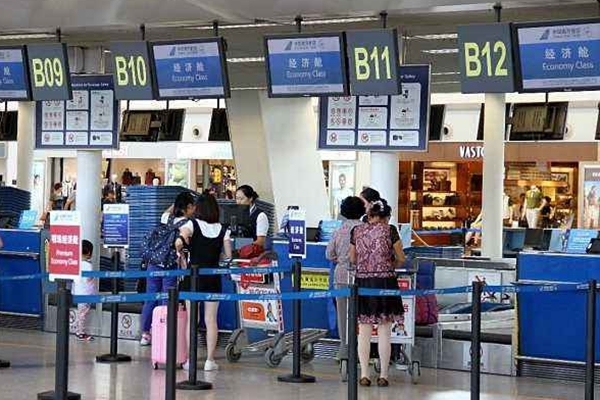
Check-in desks at Terminal 2 of Beijing Capital International Airport [File Photo]

Several airports have started requiring Chinese passengers to present their ID cards to board domestic flights despite the fact they made the bookings with passports, causing confusion among fliers.

The new security rule had been introduced without notice at several airports by Monday afternoon.

According to customer service employees at airports that have adopted the rule, including Shanghai Hongqiao and Guangzhou Baiyun international airports, the practice started on May 8 and is a result of new guidelines from the Civil Aviation Administration of China.

China Daily reporters contacted 29 airports in the four municipalities as well as 24 provincial and regional capitals on Monday. Customer service employees at 13 airports said Chinese passengers must present ID cards to fly domestically, even as a stopover on an international flight that was booked with a passport.

Details of the guidelines remain unknown, and the CAAC declined to comment.

The change has affected many passengers, including those who earlier traveled abroad with only a passport yet found they had to wait up to several hours for a temporary travel permit before they were allowed to transfer onto a domestic flight.

Chinese people who work and study abroad are among those affected.

“Many students, including me, usually leave our Chinese ID cards at home because they are no use in the U.S. and we can board domestic flights in China with our passports,” said Li Ye, 21, who is studying in New York.

“Many of my friends have decided to fly directly or stop over in foreign cities to bypass the new rule,” she said.

Customer service employees at Shanghai Pudong and Beijing capital international airports said Chinese passengers could still travel on domestic flights with passports, as they had not received any orders to the contrary.

“We strongly suggest people carry their ID cards if they plan to travel with their passports because the new rule may come into effect soon,” a security officer at Shanghai Pudong International Airport said on Monday.


China stresses law enforcement on solid waste management

Zhang Dejiang (3rd L), chairman of the Standing Committee of the National People’s Congress (NPC), presides over a meeting on monitoring the implementation of a solid waste control law in Beijing, capital of China, May 22, 2017. [Xinhua]

At a Monday meeting, China’s top legislature emphasized monitoring the implementation of a solid waste control law.

Zhang Dejiang, chairman of the Standing Committee of the National People’s Congress (NPC), presided over the meeting.

The solid waste control law is important to the country’s environmental protection to improve national health, protect the environment and promote sustainable development, said Zhang.

He underlined the need for the government to strongly punish any violation of the law.

The NPC Standing Committee will dispatch teams to monitor the implementation of the law between May and August.

Zhang said the NPC should intensify publicity and education on the solid waste control law and elevate public awareness of solid waste management.

The NPC will also launch a nationwide survey on the implementation of the solid waste control law on the websites of the NPC, Xinhua News Agency and People’s Daily.


EU-Cuba High-level discussion on human rights in Brussels

On 22 May, the EU and Cuba held their third high-level discussion on human rights in Brussels.

The EU delegation was headed by EU Special Representative for Human Rights, Stavros Lambrinidis and included the Managing Director for the Americas of the European External Action Service (EEAS), Edita Hrdá, as well as other representatives of the EEAS, the European Commission and the EU Delegation to Cuba. Rodolfo Reyes Rodríguez, Director General for Multilateral Issues and International Law of the Cuban Ministry for Foreign Affairs led the Cuban side, and was accompanied by Cuban Ambassador / Head of the Mission to the EU Norma Goicochea Estenoz, as well as other officials of the Cuban Ministry of Foreign Affairs.

Both sides had an extensive discussion on constitutional, legal and administrative aspects of citizens’ participation in public affairs, notably with regard to the recent and forthcoming elections in the EU and in Cuba, where municipal elections will take place in 2017 and a new President will be elected in 2018. The EU underlined the importance of complying with international human rights electoral standards, including free access to media and to information, freedoms of expression, association and assembly so that voices from different parts of the political spectrum can be heard and  participate.

In the area of economic and social rights, the EU and Cuba addressed the coverage of social protection systems and the promotion of social dialogue. The respect for core labour standards, the fight against discrimination and the inclusion of disadvantaged groups were also raised.

The two sides moreover discussed the protection of human rights of migrants and refugees in the context of migration flows implicating Cuba and the EU, and the promotion and protection of the right to health, in particular for persons in vulnerable situations. Both sides agreed to explore the possibility of setting up a sectoral dialogue on social issues, as well as trilateral cooperation on global health in line with the 2030 Agenda on Sustainable Development. In follow-up to the last high-level discussion on human rights, they also addressed the situation of freedom of association and expression, including ways of engagement with peaceful civil society activists in Cuba and the EU, as well as on possibilities of all civil society to freely participate in public life. Finally, the two sides explored opportunities for closer EU-Cuba cooperation in multilateral human rights fora.

The talks reconfirmed the wish of both sides to deepen their dialogue and understanding in the area of human rights, with a view to developing cooperation to attain the objectives of the EU-Cuba partnership. The EU and Cuba affirmed their commitment for even closer engagement under the EU-Cuba Agreement on Political Dialogue and Cooperation.

Background

High Representative / Vice-President Federica Mogherini and the Foreign Minister of Cuba Bruno Rodriguez agreed in April 2015 to start EU-Cuba human rights consultations, anticipating on the negotiations of a bilateral Political Dialogue and Cooperation Agreement. The Agreement, which was signed in December 2016, will open a new chapter in EU-Cuban relations and contains detailed provisions on the promotion of human rights, an essential element of the bilateral partnership. It notably foresees the establishment of a structured Human Rights Dialogue that will allow both sides to share experiences and best practices, build capacities, and provide training or technical cooperation to address specific issues. The application of the PDCA should thus provide significantly enhanced opportunities for further discussions and dialogue in this and all other areas covered by the Agreement.

The Agreement is currently being reviewed by the European Parliament and should soon be applied provisionally, pending its ratification by Cuba and the EU and its Member States.


Address to Menzies Research Centre, ‘The Forgotten People’ 75th Anniversary Dinner

PRIME MINISTER:

Alan, former Prime Minister John Howard, Janette Howard, Tony Abbott, my many ministerial colleagues and Parliamentary colleagues, dear friends, admirers of Robert Menzies one and all – and above all, Heather. I was reading again, the letter your father wrote to you. His wit and his affection for you and his love for you, the dedication he showed over all those years, inspire us today. So we’re so honoured that you’re here with us tonight.

Menzies gave these radio talks in 1942 and the most famous one, the ‘Forgotten People’ which we shall shortly hear, was given on this day, this evening, 75 years ago.

This was a time that Churchill described as the ‘hinge of fate’, 1942. It was as though one catastrophe was being piled onto another. Pearl Harbour had been bombed, the pride of the American Navy had been sunk or disabled, save its aircraft carriers mercifully. Singapore had fallen. 22,000 Australian soldiers were prisoners of the Japanese. Those that weren’t, were in the most part in the Middle East.

The Japanese seemed as irresistible and just two weeks before Menzies gave this broadcast which we’ll hear tonight, there was the Battle of the Coral Sea. For the first time, the hinge of fate started to turn. Australians and Americans of the United States Navy and the Royal Australian Navy, serving together under a joint command, succeeded in turning back the Japanese.

So on this day 75 years ago, Australians could begin cooly to consider, in the absence of bravado, that the tide had turned. This speech we’re going to hear tonight of Menzies’ is not the first. But more than any other, it summoned up all of his characteristically eloquent and principled vision for Australia beyond the war. 

Liberal democracies in those years seemed caught between the hammer of fascism and the anvil of communism, each offering the vision of the mighty all-knowing State. So as Menzies spoke in the broadcast, and in the other 36 broadcasts he did so with the sound reason of a generous and liberal mind.

He spoke up for the foot soldiers in Edmund Burke’s small platoons, equally forgotten in the boardrooms of the mighty corporations and in the back rooms of the Trades Hall.

With a common sense that resonates right up today, indeed this very night, he dismissed those who try to wage a hate-filled class war and divide Australians and turn them on each other. He steered resolutely to the centre ground and put his faith in the good will, the common sense and the enterprise of his fellow Australians.

Menzies believed, as we his successors believe today, that the task of government is not as Labor would say, to tell Australians what is best but rather to enable them to do their best.

To increase their opportunities. Expand their horizons. So that they can pursue their dreams for themselves and for their children – like the Scottish ploughman and the Scottish farmer of whom we will hear in just a moment.

Menzies had not long lost the Prime Ministership. Politically this was his wilderness period, but there is no rancour or bitterness in his broadcasts. He is as calm as he is considered, as elegant as he is erudite.

His humour shines through. In one broadcast, asked whether so much war and destruction showed Christianity has failed, he suggests we should try practising it first.

He resisted populism when state premiers were condemned for challenging in the courts the federal takeover of income tax, he defended their constitutional right to do so and spoke up for the rule of law.

Security under the law, in Erskine’s phrase he said: “is not something precariously dependent upon the whim of a mob. It is that security to which a man may confidently and calmly appeal, even though every other’s hand may be against him. The law’s greatest benefits are for the minority man; the individual”.

And when he introduced as Prime Minister in the previous year, the national security bill that gave sweeping powers to the Government to control the economy, he did so with this sober warning;

“The greatest tragedy that could overcome a country, would be for it to fight a successful war in defence of liberty and lose its own liberty in the process.”

In April 1942 – before the Battle of the Coral Sea – Menzies in another broadcast spoke about hatred. He decried a government campaign that he felt was designed to encourage Australians to hate the Japanese. This is what he said;

“It is an offence to an honest citizen to imagine that the cold, evil and repulsive spirit of racial hatred must be substituted for honest and brave indignation, if his greatest effort is to be obtained.”

“Peace may be all sorts of things – a real end of war, a mere exhaustion, an armed interlude before the next struggle. But it will only be by a profound stirring in the hearts of men that we shall reach goodwill.”

“In short, when this war is over, we all hope to live in a better world in which both Germans and Japanese – violently purged of their lust for material power – will be able to live and move in amity with ourselves.”

What does it say about the character of a man that could write such generous words in such hard days? 

And as John Howard has described as one of his greatest achievement in government, the 1957 Commerce Treaty with Japan. An extraordinary act of reconciliation.

In another broadcast he talked reassuringly about our new American ally, a complement to our unbreakable bond with Britain, not a threat.

“Now, I am like you,” said Menzies, “dyed-in-the-wool British, and have a firm belief that the courage, humour, tenacity and resourcefulness of our own race never shone more brightly than now.”

“But it is a great thing for us to have such allies as these Americans.”

“We are together now for the urgent saving of the safety of the world.”

“When that task is over, I hope we shall remain together for the keeping of that safety for ever and ever.”

In anticipation, perhaps of what was to become the ANZUS Treaty and the bedrock of our security ever since.

The last of his broadcasts was in November 1942 and it was on the importance of good humour which he analysed as between the Irish, Scots, English and French. He also noted that the Germans lacked humour entirely, but his conclusion on the importance of humour generally and in politics, was entirely consistent with his liberal values of individualism.

“The real explanation,” Menzies said, “of the sovereign importance of humour is that it is an individual thing.”

“No Government department regulates or distributes it.”

“It is neither rationalised nor nationalised, nor socialised, nor organised, nor finalised.”

“No politics based upon gloomy fanaticism can succeed with us, for to our eternal salvation, we shall always laugh at the wrong time – which will probably turn out to be the right time.”

Thank you very much.

[ENDS]