Press release: PM meeting with Prime Minister Costa: 10 April 2018

A Downing Street spokesperson said:

The Prime Minister held a bilateral meeting with Portuguese Prime Minister António Costa at Downing Street earlier today.

The Prime Minister said that the UK deeply values our long-standing alliance with Portugal and wanted to maintain and strengthen those ties in future across a range of areas, including science, defence, and trade and investment.

They discussed the recent attacks in Syria and Salisbury and agreed that the international community needed to come together to uphold the worldwide prohibition on the use of chemical weapons.

They also discussed Brexit and the progress of negotiations. The Prime Minister underlined the value she placed on the contribution of the Portuguese community in the UK. Prime Minister Costa also welcomed the contribution of UK nationals in Portugal and expressed his desire to maintain a close relationship with the UK after exit.

The Prime Minister also noted that yesterday marked the centenary of the First World War battle of La Lys where the Portuguese suffered their greatest loss of life, and she paid tribute to the bravery of the Portuguese forces.


Speech: Pursuing peace and stability in the Great Lakes region

Thank you very much indeed Mr President.

I wanted to take the floor because we are at an important point in this region, but I also wanted to welcome the SRSG back to the Council, and through him, to thank the UN mission for everything they are doing. It is also extremely helpful to have the update from the Ambassador of Congo.

I would like to start by saying to my good friend, the Ambassador of Equatorial Guinea, that it isn’t a modest contribution that his country makes, it is much more than that.

Mr President, its been five years since the Peace, Security and Cooperation Framework was signed. It has proved to be a crucial framework for pursuing peace and stability in the Great Lakes region. But as the SRSG and the Ambassador from Congo have spelt out the DRC has always been at the centre of the framework. The situation in the DRC, the nerve centre, effects the stability of the region. As this Council has discussed in recent days, we are now at a critical juncture. What happens in the DRC over the next few months could be a defining moment in greater regional stability. We have a choice, Mr President, between seeing the situation improve or being overturned.

The United Kingdom, for our part, remains committed to supporting the implementation of the PSCF and we support free, fair and credible elections in DRC in December. We welcome the progress that has been made in the five years since the signing of the framework and I’d like to highlight the increase in the participation of women and a commitment to greater regional and international cooperation in the course of advancing peace and security.

That said Mr President, we are concerned that implementation of key elements has not made progress and this includes the repatriation of foreign combatants. As the Ambassador from Congo highlighted, we welcome efforts to reinvigorate the framework and urge all signatories to implement the framework in full, and we are very supportive of what the SRSG had to say on judicial issues. We are also concerned by the continued proliferation of violence in DRC, particularly in North and South Kivu, Tanganyika, Ituri and the Kasais. The results of this instability has indeed been devastating. 4.5 million Congolese have fled their homes and communities. There are more internally displaced people in DRC than anywhere else in Africa. And over 13.1 million people are in need of humanitarian assistance and protection. So we support the other calls in the Council, Mr President, for regional players to come together in the interest of stability in the coming months. And I would like to endorse what the French Ambassador said about the importance of that regional cooperation.

Mr President, I’d like to conclude by talking about elections. Credible and constitutional elections are the only way to end the political crisis and achieve stability in DRC and we urge the signatories of the framework to ensure that peaceful and credible elections can take place in December 2018. This means that the electoral calendar needs to be respected and key milestones must be met and the confidence building measures of the 2016 December Agreement need to be implemented in full. This critically includes the freeing of political prisoners and the opening of political space and peaceful demonstrations. It is a region Mr President that is in all our interest and the United Kingdom pledges to work together with partners to achieve progress.

I have some other remarks, Mr President, on some other aspects of the region and framework but I will save those for consultations.

Thank you.


Speeches at the press conference on the launch of VentureEU, the Pan-European Venture Capital Funds-of-Funds programme

Commission Vice-President Jyrki Katainen

Good afternoon, Ladies and Gentlemen. We are working very hard in the Commission and in the EIB family to improve the investment climate and business environment in the whole of Europe, which is the key objective of the Investment Plan.

There is no lack of innovative ideas and entrepreneurial spirit in Europe. But many new EU companies do not make it beyond the critical first years, or they decide to try their luck outside Europe. One of the reasons for this is the lack of suitable funding.

We need to make sure that there is sufficient risk capital available in Europe. Institutional investors such as pension funds play an ever-greater role in providing risk capital, but venture capital funds in Europe are often too small for them. Therefore, we need to promote bigger venture capital funds to attract larger private sector involvement.

With the European Investment Fund (EIF) we are launching a Pan-European Venture Capital Funds-of-Funds programme called VentureEU to boost investment in innovative start-ups and scale-ups across Europe.

Six fund managers will receive EU support in their mission to invest in the European venture capital market. The EIF has just signed contracts with two of them. Backed by EU funding to the tune of €410 million, the funds will raise an expected €2.1 billion of public and private investment, which will in turn trigger an estimated €6.5 billion of new investment in innovative start-ups and scale-ups across Europe and beyond.

The fund will do this by taking stakes in a number of smaller investee funds and cover projects in at least four European countries each. These smaller investee funds will help finance SMEs and mid-caps from a range of sectors such as ICT, digital, life sciences, medical technologies, and resource and energy efficiency.

Around 1,500 start-ups and scale-ups are expected to gain access to this new source of financing across the whole EU. VentureEU will give them the opportunity to grow into world-leading companies and deliver their full innovation and job creation potential.

Commissioner Elżbieta Bieńkowska

As I have underlined many times, we do not have a problem in the European Union with start-ups, we do not have a problem with talent, with skilled people, with skilled entrepreneurs. We have a problem with scale-ups. Meaning when a company is growing and it desperately needs money. In 2016, venture capitalists invested about €6 billion in 2016 in the EU but can you compare it to almost €40 billion in the US? This is a huge difference, and the US market is smaller than the EU one. Our European venture capital funds are too small to compete, are too small to attract major institutional – but also even more importantly – private investors.

So the consequences are – and I see this on a daily basis when I speak to those companies – that too many European high-potential entrepreneurs, innovative entrepreneurs, have left Europe, or they are thinking about leaving Europe because they cannot get the venture capital they need to expand. This way, we are losing out our potential “unicorns”, potentially really important European companies.

With VentureEU we are taking a really big step forward towards fixing this problem. We want to use public money in a smarter way. We will have €400 million coming from different financial headings and budget lines. We want to attract private investment from investors who are currently not investing in European venture capital. We will increase the amount and the average size of venture capital funds in Europe. Now, as I said before, the average size is too small. We will help our high-potential start-ups to stay and to grow in Europe.

Of course, VentureEU is only one piece of the puzzle. This is part of our wider ecosystem that we want to put in place, the right business environment for our companies to grow. We will propose and present some other proposals later this year to you, for example ESCALAR, another financial instrument for our companies. This is important to make sure that our European companies, innovative companies, and innovative entrepreneurs, have every opportunity to become world-leading companies, and at the same time to stay in Europe.

Commissioner Carlos Moedas

Good afternoon. Thank you so much and I wanted to first of all thank the colleagues and everyone for their hard work – from the Vice-President, to my colleague Commissioner Bieńkowska and to the EIF and the EIB group for the hard work. But more than that, I really wanted to give a big thanks to the teams, the teams that worked so hard in our departments, in our Directorate General, for example Jean-David Malo, who was someone that really counted so much for getting this done; and Keith Sequeira in my team.

I wanted to acknowledge them first of all because this was a very difficult process to get through. But sometimes when you have these processes take a long time you think: why are we here? I mean, what was the beginning of it all? And I think the beginning was really well-described by Jyrki and by Elżbieta. Because the beginning was that most of us, I remember Elżbieta and myself discussing, we were meeting entrepreneurs all over Europe. Young people that were telling us: look I have the ideas, there are the universities, we have the entrepreneurs in Europe. But then if I want €50 million, €60 million of investment, a scale that can get me to the next level, I do not find it here in Europe.

And it was from these conversations around the table with Jyrki and Elżbieta that we said we have to do something about it. And when you look at – Elżbieta was quoting this number of €6.5 billion which for all of Europe with its 500 million people raising just €6.5 billion is not enough. And so I think what we are doing today is first of all addressing this problem of scale. And if you look at what we are doing in terms of numbers we are basically raising €2.1 billion. So we have all of these private investors and we attract private money, so will get to €2.1 billion and that will have an impact of around another €6 billion. So you are kind of doubling the market of venture capital in Europe in one go. And that is very important for that scale.

The second was the problem that also comes very often which is the fragmentation. Most of the VC is concentrated in eight Member States. So with this VentureEU project we will basically put it all over Europe. So the idea is that there are good people, there are good ideas, there are good companies all over Europe. It is not just exclusive from cities in some countries. They are all over and with the VentureEU funds we will be able to cover all those countries. By the way, a lot of the venture people that are here today and the two agreements we are signing, they are all over Europe and other parts of the world.

And the third problem that was not yet mentioned and I just wanted to mention, was the fact that in Europe if you look at the crisis from 2008 until 2013, the venture capital was basically public money. And so the difference between what we are doing today and what we have done in the past is that we are just putting a little bit of public money to attract private money because we need more private money, and private money is key for venture capital.

And so if you look before the crisis venture capital was 14% public. After the crisis it was more than 30% public. And so we are trying to reverse that to have more private money. And so my last word goes to the private players, people that really want to play the game and there are some of them sitting here today. They came to us, they will have a little bit of our money but they will put up and raise more private money.

So that is what we are doing here today, so thank you very much because it is a very important day.


Remarks by Michel Barnier at Green 10: “Is Brexit a threat to the future of the EU’s environment?” – European Parliament

Thank you Peter Liese for having organised this event, with Green 10 organisation represented by Cécile Toubeau,

Thank you also Jo Leinen.

I see also many other members of the European Parliament, where I come almost every week to discuss Brexit, with the EP Brexit Steering Group, the various political groups and committees.

Thank you for inviting me to speak about this essential topic of the environment.

I was myself environment minister some time ago and I have not forgotten the work which we did with other Member States and at EU level.

I remain very close to these issues.

Before that, some 20 years earlier, I took part as a young Gaullist in the campaign in favour of the accession of Denmark, Ireland, Norway, and the UK.

I have never regretted this vote.

The result of the Brexit referendum is one which we can regret, but one which we have to respect and implement.

When I took the job of Chief Negotiator in October 2016, I had three main questions for the UK.

These questions are still relevant today.

1) Does the UK want an orderly withdrawal or a disorderly withdrawal?

Today, I think we can be positive that the UK government indeed wants an orderly withdrawal.

Last month we reached a decisive milestone on this first question.

o   We agreed on a legal text for the protection of citizens’ rights, an essential priority for me, for the European Parliament and Member States; and the financial settlement.

o   At the same time, we reached a political agreement on a transition period of 21 months, until the end of December 2020.

o   And we agreed on several other separation issues, from customs procedures to the circulation of goods already placed on the market, or the UK’s commitments for nuclear energy, and Euratom more broadly.

However, we are not there yet.

In particular, we still have to work on two major points of divergence – on how to avoid a hard border between Ireland and Northern Ireland and on the governance of the Withdrawal Agreement.

And we have some separation issues where we have not yet reached an agreement: for instance, the protection of geographical indications and police and judicial cooperation.

We can hope to reach an agreement on the withdrawal if we stay in this spirit in our negotiations until October this year.

2) The second question is what kind of future relationship does the UK want with the European Union?

Here also, Theresa May has brought some elements of clarity.

In her speech of 2 March in the Mansion House, she confirmed that the UK will be leaving the Customs Union and the Single Market.

She also confirmed the UK’s red lines. The only available model is, therefore, that of a free trade agreement. Other models remain of course on the table in case the UK position would evolve.

3) But there was, and there is, a third question, which in my view is quite relevant for our debate today: does the UK want to stay close to the European regulatory model or to distance itself from it?

This is an important decision because the European regulatory framework is underpinned by key choices that are dear to us: our social market economy, health protection, food security, fair and effective financial regulation, and high levels of environmental protection.

There will be no ambitious partnership without common ground on fair competition, State aid, guarantees against tax dumping and social standards and, not least, environmental standards.

I know that the European Parliament, like the Member States and the Commission, is particularly vigilant in this respect.

This is also well known in the UK.

As recently noted in the UK press, across the full range of issues – air and water pollution, habitats and species protection, waste management and recycling, energy efficiency, carbon emissions and energy policy – it is EU regulation that sets high standards of protection[1].

And the UK has often been at the forefront in shaping and deciding European rules.

And of course, you, members of the European Parliament, and representatives of NGOs, have contributed greatly to shaping these rules.

Ladies and gentlemen,

What we hear from the UK could be seen as reassuring.

In her Mansion House speech, the Prime Minister pointed specifically at the environment, saying, and I quote Theresa May, that “the EU should be confident that we will not engage in a race to the bottom in the standards and protections we set.”

These are the clear words from Theresa May.

This is reflected in the UK’s proposed 25 year plan on the environment.

This is welcome, but my responsibility as the EU negotiator is to remain extremely vigilant.

To me, that means two points, on which the European Parliament also insisted in its latest resolution.

And these two points reflect what we discussed with Member States and the European Parliament in our seminars on the future relationship. All of which has been published on our website.

I – First point, our future partnership must include precise provisions on a level playing field, especially in environmental matters.

  • Without a level playing field the UK could, now or in the future, decide to reduce environmental protection to gain competitive advantage.
  • Such measures would open up the possibility for more pollution and environmentally harmful production in the UK. They would also increase pollution for neighbours.
  • Reduced UK ambition on air pollution could result in neighbouring states (Ireland, Belgium, France the Netherlands) needing up to 9% more effort to reach their clean air objectives – with significant additional costs.

Ladies and gentlemen,

I am not prejudging anything as to the UK’s future policies.

But let me be clear: these questions are not only economic or social, but also political.

Why?

Because the answers will be key to the ratification of any future deal by each national parliament, and obviously also by some regional parliaments, and by the European Parliament.

This is why in the future relationship we should commit to no lowering of the standards of environmental protection.

The agreement on the future relationship with the UK should include a non-regression clause.

This can be inspired by the CETA or Japan FTA provisions, but this will need to go further. It should prevent any reduction of the key pre-Brexit standards.

Of course, a strong level playing field requires effective oversight and enforcement of environmental rules.

This is needed to ensure the confidence of citizens and companies in the fairness of the future arrangements with the UK.

II – Second point: the UK will have to keep to its international commitments.

The UK itself is a party to many international environmental agreements.

At the moment, it often meets these obligations on the basis of EU rules.

We expect the UK to continue to meet these international obligations once it has left the EU.

Let me take three concrete examples.

  1. Both the EU and the UK have ratified the Paris Climate Agreement.

o   We should continue to promote the global solutions to climate change which the Paris agreement offers.

o   The UK has always pushed for strong global action and high emissions reduction targets.

o   We expect that it will continue to set itself the same level of climate ambition after leaving the EU. This will also open the way for practical cooperation between us.

  1. Second example, in line with the United Nations convention, the EU and the UK will also need to cooperate on the management and conservation of around 100 shared fish stocks to ensure their long term sustainability.
  2. Third example, the UK should continue to protect birds and other migratory species in line with the Bern and Ramsar conventions.

Dear Friends,

  • If we make sure that our future partnership is based on a level playing field;
  • If the UK continues to meet international standards and obligations on the environment;
  • If we can assure our citizens of continued effective enforcement of environmental rules;
  • Then – to respond to the title of this event – we would have strongly mitigated the threats of Brexit to the future of the EU’s environment.
  • Our negotiating team will follow these goals, and we will continue to do so in close coordination with the European Parliament and in full transparency.
  • Because, once again, this negotiation is unprecedented.
  • Because the organisations you represent have the right to know how the negotiation unfolds.
  • And because transparency is key for the public debate that we need on Brexit.
  • This negotiation will not and cannot be secret.

Thank you.

[1] The Guardian, 4 April 2018, https://www.theguardian.com/commentisfree/2018/apr/03/brexit-harm-environment-michael-gove


News story: Joint Forces Command seeks out innovation in Silicon Valley

General Deverell met with academics, innovation units, tech startups and investors in San Diego, Los Angeles, Silicon Valley, and San Francisco. He also visited the US Space and Naval Warfare Systems Command (SPAWAR).

As the Ministry of Defence’s information command, Joint Forces Command (JFC) seeks to explore innovative new technology already being developed by partners, allies and the private sector. The mission for the trip was to explore how artificial intelligence (AI), machine learning, data analytics and autonomy could be used to bring advantage to the joint force.

Accompanying General Deverell on the trip was Lieutenant Colonel Henry Willi, from JFC’s innovation unit, the jHub.

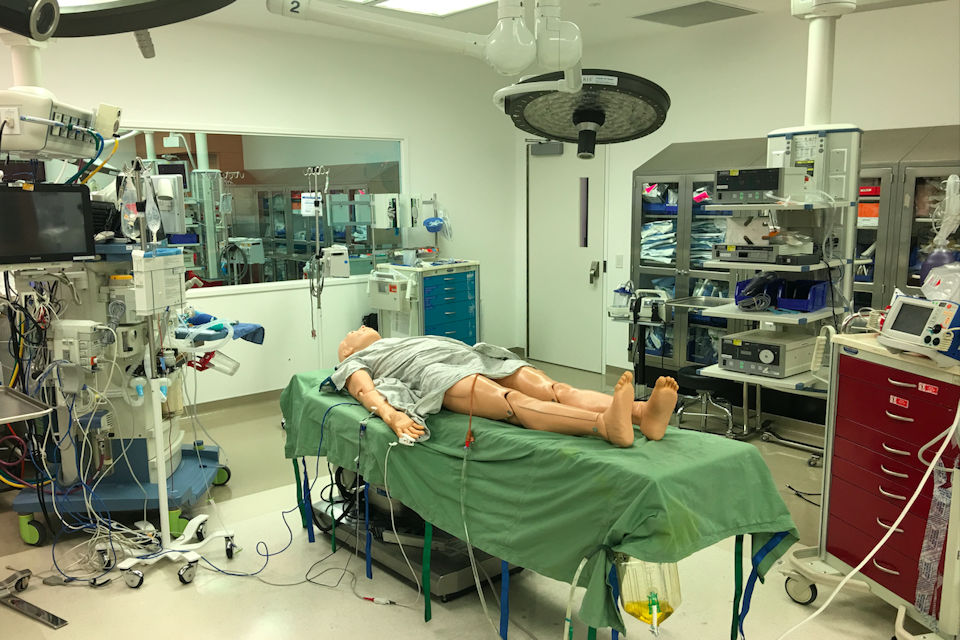
While visiting the Cedars-Sinai Medical Center in Los Angeles, they had a tour of its Simulation Center for Advanced Clinical Skills, an immersive environment equipped with the latest in human patient simulators and medical devices. Here, General Deverell took part in a simulated operation on a lifelike mannequin patient. He then met representatives from the Cedars-Sinai Health System accelerator, which aims to help technology innovators turn their ideas into practical solutions that can improve the lives of patients around the world.

CedarsSinai Simulation Center for Advanced Clinical Skills.
CedarsSinai Simulation Center for Advanced Clinical Skills. Crown Copyright 2018.

In Silicon Valley, they met with the Defense Innovation Unit Experimental (DIUx), a United States Department of Defense organisation focused on accelerating commercial technologies to the US military. Here they were briefed on DIUx’s approach to developing innovation, including how its innovation ecosystem benefits from strong links that have been developed with investors.

General Deverell also met with tech startup companies, including Pilot AI, Shield AI and Orbital Insight.
Pilot AI has developed a platform to provide artificial intelligence to devices with low computing power, sufficient to detect people, vehicles, buildings and weapons.

Shield AI, have developed Hivemind, an artificial intelligence platform that enables robots to see, reason about and search the world. Shield AI’s first product, Nova, is a Hivemind powered drone that searches buildings, whilst simultaneously streaming video and generating maps.

With more data than ever before being generated by satellites, drones, balloons, and other unmanned aerial vehicles (UAVs), Orbital Insight builds software that interprets this data to help businesses and governments to make better business and policy decisions.

Speaking about JFC’s appetite for innovation, General Deverell said:

Joint Forces Command aims to provide the UK Armed Forces with an edge over adversaries for wars in the information age. This trip to one of the world’s innovation capitals helps us secure advantage for the joint force.

He added:

By speaking to individuals who are already developing some of the most advanced technology in the world, we are closer to understanding how this can be applied in a military setting. We are preparing JFC and wider UK Defence for a future that counts technology such as AI, machine learning and autonomy as part of our armoury, both to deter our enemies and to protect our people.

The jHub, was created to enhance and improve the operation of the UK armed forces through innovation. This trip has reinforced my view that innovation is fundamental to Joint Force Advantage.

DIUx is an impressive player in the innovation ecosystem, so the jHub will forge closer bonds with them through a new liaison officer position.

JFC’s jHub is keen to speak to companies who have solutions which could be adapted and adopted by the military customer in months rather than years. If you would like to get in touch with the jHub, please email jhub@official.mod.uk