Reitox Development Framework

For more than 20 years, the European information network on drugs and drug addiction (Reitox), has been the cornerstone of the European drug monitoring and reporting system, to which it contributes by collecting, analysing, interpreting and disseminating data at national level, as well as by defining the tools for monitoring. The EMCDDA 2025 strategy, endorsed in 2016, aims at contributing to a healthier and more secure Europe. In this context, Reitox is currently defining the new strategic goals for the network as a whole and how these will be operationalised and achieved.


Outermost regions are a land of opportunities for the European Union

Unanimous support to the outermost regions in their call to keep a strong cohesion policy after 2020 at COTER’s seminar in Tenerife

The Commission for Territorial Cohesion Policy and EU Budget (COTER) of the European Committee of the Regions met in Tenerife to discuss the challenges and opportunities for the economic, social and territorial development of the EU’s outermost regions. The message is clear: the potential of the outermost regions is still untapped and more investments are needed to convert overseas territories into innovation hubs that foster growth and jobs while they reinforce EU’s strategic position globally. The COTER seminar has been hosted by the president of the Canary Islands Fernando Clavijo (ES/ALDE) as a follow up to the adoption of the CoR opinion Towards full implementation of the renewed European Strategy for the Outermost Regions last January for which he was the rapporteur.

‘The outermost regions are a land of opportunities for the European Union’, said president Fernando Clavijo in his opening speech in Tenerife. ‘It is essential that we keep a strong cohesion policy after 2020 to overcome the remoteness and territorial isolation of our communities and to give our citizens the same opportunities in education, employment and prosperity as other European citizens’, added president Clavijo. In relation to the EU’s renewed strategy, president Clavijo, who currently holds the Presidency of the Conference of Presidents of the Outermost Regions, reiterated his commitment to ‘follow its implementation closely to ensure it matches the needs and expectations of the outermost regions’.

Petr Osvald (CZ/PES), president of the COTER commission and Member of the Plzeň City Council declared: ‘Cohesion policy has been and should remain the most powerful tool of the European Union to invest in our regions and bring prosperity for all citizens. We need a strong cohesion policy in the next EU budget, in order to provide outermost regions with the necessary means to bridge the inequality gap and maximise their growth potential. In this respect, I am proud that more than 4000 elected representatives, institutions and associations have already given their support to the Cohesion Alliance’.

Rodolphe Alexandre, president of the French territory of Guiana stressed: ‘Cohesion policy is a vital tool for the development of Guiana and for the rest of the EU’s outermost regions. It is the main investment tool in the outermost regions and has greatly contributed to create growth and jobs in our territories. Maintaining and reinforcing cohesion policy after 2020 is our absolute priority’.

Spanish Deputy Prime Minister Soraya Sáenz de Santamaría addressed the COTER members in the closing session underlining that ‘The Spanish government is committed to defend a strong cohesion policy as a key element in the future of the European Union’.

Representatives discussed the best ways to put the EU’s renewed strategy for the outermost regions into practice. The COTER seminar included a first session focusing on the implementation modalities to boost sustainable development and social inclusion and reduce territorial disparities with EU mainland territories. The importance of connectivity and transport infrastructures as a tool for territorial cohesion was the focus of the second session. The potential for the outermost regions to become test stations for innovative projects was the main topic of the third session.

The EU’s outermost regions are governed by the article 349 of the Treaty on the Functioning of the European Union which foresees specific measures to be undertaken in favour of the outermost regions due to remoteness, insularity, difficult topography and climate or economic dependence which severely restrain their development.

Additional information:

Last 31 January 2018, the European Committee of the Regions unanimously adopted the CoR opinion, rapporteur Fernando Clavijo (ES/ALDE), president of the Canary Islands, entitled ” Towards full implementation of the renewed European Strategy for the Outermost Regions .”

The outermost regions comprise six French overseas communities (French Guyana, Guadeloupe, Martinique, Mayotte, Réunion and Saint Martin), two autonomous Portuguese regions (the Azores and Madeira) and the Spanish autonomous region of the Canary Islands.

Outermost Regions Facts and figures, 24 October 2017, European Commission .

Between November 2017 and the end of 2018, the Canary Islands is holding the chair of the Conference of Presidents of the Outermost Regions (CPOR).

Communication from the Commission, 17 October 2017: A stronger and renewed strategic partnership with the EU’s outermost regions .

European Commission, 24 October 2017: The Outermost Regions: European lands In the world – A privileged, renewed and strengthened partnership .

European Parliament, 19 January 2018: Outermost regions of the EU: A stronger and renewed partnership .

The Cohesion Alliance

The Alliance was born on October 9, 2017 to support the continuity of the cohesion policy, which has more than 630,000 million euros for the period 2014-2020. This policy could be one of the items of the budget that is most affected by the hole left by the departure of the United Kingdom from the Union in March 2019 in the community accounts. Cohesion policy is an EU investment instrument to smooth imbalances between the different regions of the continent.

Contact:

David Crous
Tel. +32 470 88 10 37
david.crous@cor.europa.eu


Press release: Bridging payments delivered to 3,200 farmers

More than 96% of farmers in England signed up to the 2017 Basic Payment Scheme (BPS) have now received their full payments and the RPA is working to make the remaining 4% of payments which require more complex processing and therefore take longer to complete.

Over 18,000 2018 Basic Payment Scheme (BPS) applications have already been submitted since the application window opened in March. A record 90% of the applications made so far have been online, as farmers continue to make the switch from paper forms, with over 16,500 online entitlements so far.

RPA Chief Executive Paul Caldwell said:

We have made solid progress in delivering payments to farmers this year, with more than 96% now paid, and I am pleased so many of this final 4% have now received their bridging payments.

As always, there is more to do, and the RPA will continue working to make the final remaining payments. But now is also the time to get online to make sure your application for 2018 is in before the deadline closes in May.

Farming Minister George Eustice announced in January the commitment to provide a bridging payment to any farmer not paid by the end of March and highlighted how the burden of EU rules continues to be a barrier to processing some of the remaining claims. These bridging payments are worth 75% of their full allocated amounts.

The RPA is encouraging farmers to apply online now, to ensure that their application is submitted before the deadline of 15 May 2018. Applying online means farmers and agents can quickly check and update existing personal and business details, as well as view and transfer land and entitlements.

Throughout the application process, help and support is available through our online guidance, ‘How to’ videos and by telephone.

Online and paper applications

Anyone who applied online for the Basic Payment Scheme in 2017has been emailed all they need to apply online for BPS in 2017. Those who did not apply online in 2017 and did not use an agent have been sent a paper form and guidance on how to apply online.

Support available from the RPA

Farmers and anyone helping them with their claim can find step-by-step guides on transferring land, transferring entitlements and a general overview of how to apply online in useful ‘How to’ videos. Further guidance and scheme rules can be found on GOV.UK.
On-screen help is also available, going through the application process screen by screen. A copy of this on-screen guide is also available for download or print.

The application deadline for BPS 2017 is midnight on 15 May 2018. Late applications will be accepted until 9 June but will incur a penalty. More information on how to claim or amend applications in the penalty claim period can be found in the Key Dates section of the 2018 guidance.

Mapping queries

This is the first year that hedges are shown in online digital maps. For those that want to use hedges as part of their application it’s important that they read our guidance on ‘How to check and change your hedge information’. This guidance explains how to check the information we hold about hedges, whether applicants need to tell us about changes and what to do if changes do need to be made.

Where an RLE1 form is necessary as part of a BPS 2018 application, farmers should submit their main application first and on time (by 15 May 2018). They can then submit any queries and send the RLE1 form to the RPA with the sketch map before 6 July 2018. This is to reduce the burden on applicants and allow them more time to complete the extra information required.


Indicative programme – General Affairs Council of 17 April 2018

Your request will be handled by the Press Office of the General Secretariat of the Council in accordance with the provisions of Regulation (EC) No 45/2001 on the protection of individuals with regard to the processing of personal data by the Community institutions and bodies and on the free movement of such data.

Your data will be stored in the database until you unsubscribe from the service.

Certain data (name, e-mail address, preferred language, media name, media type) may be disclosed to the press offices of the European institutions, the Permanent Representations of the Member States and to European Union agencies, under the conditions laid down in Articles 7 and 8 of Regulation 45/2001.

If there is data which you would not like to be stored, please let us know at: press.office@consilium.europa.eu


News story: UK reaffirms African military commitments after five-nation visit

The reaffirmation was made by Mark Lancaster following a week-long visit to the continent that took in a wealth of projects in Rwanda, Somalia, Kenya, South Sudan and Ethiopia.

Minister for Armed Forces, Mark Lancaster, said:

From tackling terrorist threats in Somalia, to the role we have played alongside our UN partners in South Sudan, I have been extremely proud to see the way Britain’s global influence is being exerted to support our partners in east Africa.

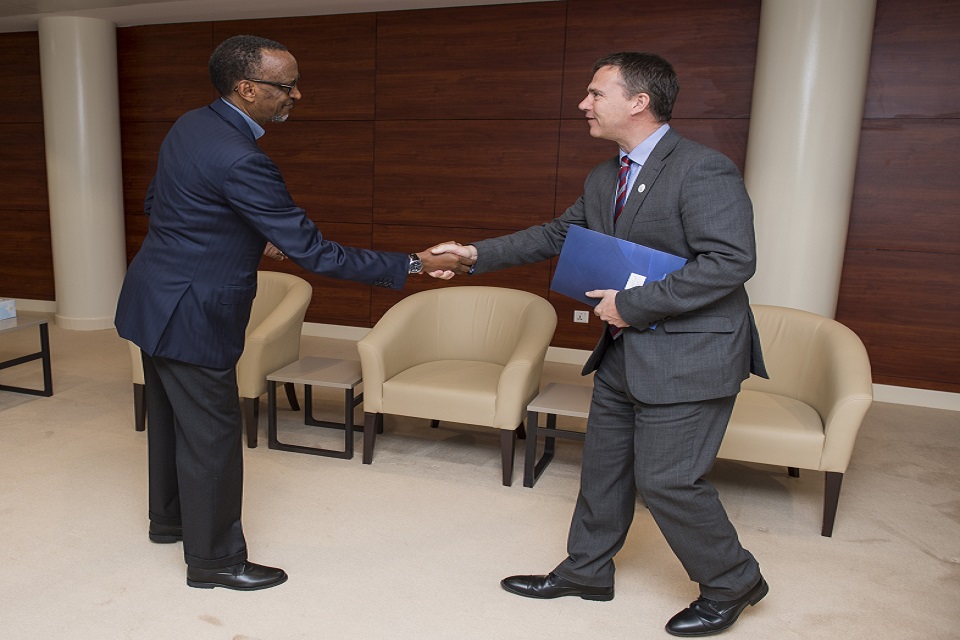
At the start of the visit, in Rwanda, Mr Lancaster met with President Paul Kagame, to find out how UK aid – which has helped to lift almost two million people out of poverty since 2005 – can continue to support continued growth and prosperity.

The Minister for Armed Forces, Mark Lancaster, shaking hands with the President of Rwanda, Paul Kagame. Crown Copyright.
The Minister for Armed Forces, Mark Lancaster, meets the President of Rwanda, Paul Kagame. Crown Copyright.

He also paid his respects at a genocide memorial event in Kigali, which marks the start of 100 days of mourning for the hundreds of thousands killed in the mass slaughter of 1994.

The Minister then travelled to Mogadishu to examine the work being done towards the African Union Mission in Somalia, to which the UK is the third-largest donor, tackling the threat posed by Al-Shabaab and rebuilding stability in the country.

During the next leg of the trip, to Kenya, the Minister held talks with Cabinet Secretary for Defence Raychelle Omamo and senior Kenya Defence Force Officers.

He also visited the British Army Training Unit Kenya, where he observed UK troops conduct training, and met the staff of Permanent Joint Headquarters’ East Africa Support Node, which provides support to our troops in Somalia and South Sudan.

The Kenyan leg finished with a brief from the British Peace Support Team (BPST), who coordinate much of the UK’s military training with African countries, including work to stop the illegal wildlife trade. The BPST also supports the Women, Peace and Security agenda and helps to counter sexual and gender-based violence on peacekeeping missions.

Whilst in Malakal, South Sudan, he met members of the UK Task Force who are building accommodation and helicopter landing sites for the UN Mission in South Sudan (UNMISS), to which the UK has pledged continued assistance until at least April 2020.

In Bentiu, the Minister met personnel operating a UK-run field hospital for UN aid workers, where British medics deal with the complex range of injuries and illnesses that UN operations in this area might face.

After meeting Mr Lancaster, UN Special Representative of the Secretary General David Shearer said:

I admire the way UK troops in the UN mission in South Sudan have integrated themselves and that they are now fully part of the UNMISS team delivering excellent engineering and medical aid and supporting the UNMISS Headquarters too.

In Juba the Minister met with the South Sudanese Minister of Defence Kuol Manyang Juuk where they discussed how peace could be brought to South Sudan and where Mr Lancaster reaffirmed the UK commitment to bringing an end to the violence in the country.

The final leg of the visit, in Ethiopia, included a meeting with the Chief of The Defence Staff, General Samora Younis and a visit to The Ethiopian Peace Support Training Centre.

Each provided an opportunity to reinforce the UK’s continued support to the Ethiopian National Defence Forces with training for peacekeeping support operations.