Statement By First Vice-President Timmermans, Vice-President Dombrovskis and Commissioner Jourovà on the adoption by the European Parliament of the 5th Anti-Money Laundering Directive

” We welcome the adoption by the European Parliament of the 5th Anti-Money Laundering Directive. These new rules will bring more transparency to improve the fight against money laundering and terrorist financing across the European Union.

We want to thank the two co-rapporteurs, Mr Kariņš and Mrs Sargentini, and the shadow rapporteurs for their strong support and valuable expertise, which have hugely contributed to this result.

With its vote, the Parliament concludes an ambitious round of negotiations initiated two years ago. In July 2016, in the aftermath of the terrible terrorist attacks that struck the EU and the vast financial dealings uncovered by the “Panama Papers”, the Commission decided to take urgent counter-measures. The revised directive is part of that action plan.

We can be proud of the new measures, which will substantially improve the existing rules. We are today marking an important step in fighting against financial crime. But our work is not over. Fighting effectively against financial crime needs proper implementation of these rules and strong coordination amongst the different authorities.

We commit to helping all Member States put them in place and to monitor their implementation.

We want all EU Member States to uphold high standards in the fight against money laundering and terrorist financing across the EU.”

Background

The proposal was presented by the Commission in July 2016 in the wake of terrorist attacks and the revelations of the Panama Papers scandal, and is part of the Commission’s Action Plan of February 2016 to strengthen the fight against terrorist financing. It sets out a series of measures to better counter the financing of terrorism and to ensure increased transparency of financial transactions.

The 5th Anti-Money Laundering directive will:

  • enhance the powers of EU Financial Intelligence Units and facilitating their increasing transparency on who really owns companies and trusts by establishing beneficial ownership registers;
  • prevent risks associated with the use of virtual currencies for terrorist financing and limiting the use of pre-paid cards;
  • improve the safeguards for financial transactions to and from high-risk third countries;
  • enhance the access of Financial Intelligence Units to information, including centralised bank account registers.
  • ensure centralised national bank and payment account registers or central data retrieval systems in all Member States.

For more information

Factsheet on the main changes of the 5th Anti-Money Laundering Directive

Directive on the use of financial and other information for the prevention, detection, investigation or prosecution of certain criminal offences


Daily News 19 / 04 / 2018

Renforcer la compétitivité du secteur européen du commerce de détail

Aujourd’hui, la Commission publie un ensemble de bonnes pratiques destinées à soutenir l’action des États membres pour rendre le secteur du commerce de détail plus innovant et productif. Ce secteur est l’un des plus importants de l’économie européenne: près d’une personne sur dix travaille dans une des 3,6 millions d’entreprises du secteur. Il connaît une mutation rapide avec l’expansion du commerce en ligne et du modèle omnicanal combinant le commerce en ligne et dans des magasins physiques mais recèle un potentiel d’amélioration de ses performances. Le vice-président de la Commission chargé de l’emploi, de la croissance, de l’investissement et de la compétitivité, Jyrki Katainen, a déclaré à ce propos: «La Commission a répertorié des bonnes pratiques qui pourront guider les États membres dans leur action en faveur de l’innovation, de la productivité et de la compétitivité dans le secteur du commerce de détail dans l’Union. Les distributeurs européens pourront ainsi renforcer leur présence sur le marché mondial et les nombreuses PME seront soutenues lorsqu’elles s’efforcent de tirer parti de l’évolution technologique. Tout cela permettra de créer des emplois et de stimuler la croissance économique». Elżbieta Bieńkowska, commissaire pour le marché intérieur, l’industrie, l’entrepreneuriat et les PME, a indiqué pour sa part: «L’avenir du secteur du commerce de détail européen – et notre économie en général – dépend de sa capacité à mettre au point des modèles innovants et à tirer le meilleur parti des nouvelles possibilités, comme le commerce électronique, par exemple. Pour ce faire, il doit pouvoir bénéficier d’un environnement des affaires favorable». La Commission a identifié l’établissement des commerces de détail, les restrictions au fonctionnement quotidien des magasins et les solutions pour soutenir la vitalité des centres-villes comme des domaines où les États membres peuvent agir. Vous pouvez trouver en ligne notre communiqué de presse et notre FAQs ainsi que la Communication et le Guide. (Pour plus d’informations: Lucía Caudet – Tél.: +32 229 56182; Maud Noyon – Tél. +32 229-80379; Victoria von Hammerstein – Tél.: +32 229 55040)


Breakthrough discovery in cancer research funded by the EU

Researchers at the Université libre de Bruxelles (ULB), funded by grants from the European Research Council (ERC), have taken a big leap forward in cancer research. The research team led by Professor Cédric Blanpain defined for the first time tumour growth phases during cancer progression and identified the types of tumour cells causing metastases in skin and breast cancer. Skin cancer is the most frequent cancer worldwide and breast cancer is the most frequent cancer in women. Commissioner for Research, Science and Innovation Carlos Moedas said: “I am extremely pleased to hear that once again ERC researchers have found a way to solve a – let me call it – research mystery. The fight against cancer is a paramount mission of the scientific community. This discovery underlines the importance of curiosity-driven research and how much it contributes to our society.” Over the last ten years, Professor Blanpain received ERC grants worth €4 million directly supporting his work in cancer research and these breakthrough results. The findings, published by Nature magazine, show that researchers were able to identify at least seven different types of tumour cells and demonstrated that they are not all functionally equivalent and equally metastatic. This discovery will have major implications for the diagnosis, prognosis and therapy of cancer patients. See press release from the ULB. (For more information: Lucía Caudet – Tel.: +32 229 56182; Maud Noyon – Tel. +32 229-80379; Victoria von Hammerstein – Tel.: +32 229 55040)

Publication of latest agri-food trade figures: positive trade balance for the EU

The latest monthly trade report published today shows that the EU trade balance in February 2018 for agri-food products increased to a surplus of €1.7 billion, compared to a surplus of €1.3 billion in February last year. Highest increases in monthly export values were recorded for Turkey, Brazil and Singapore. By sector, the highest export growth was achieved in sugar, wine and infant food among others. When looking back at the past 12 months, EU agri-food exports reached a value of €138 billion corresponding to an increase of 4.1% in value terms. This monthly report again provides a table presenting the trade balance and its development by product category since March 2016. The largest gains in net exports were achieved in wine, while exports of wheat decreased. At the same time net imports increased most for other cereals and decreased most for cocoa beans. (For more information: Daniel Rosario – Tel.: +32 229 56185; Clémence Robin – Tel: +32 229 52509)

State Aid: Commission concludes Danish waste water fee system involves no aid

The European Commission has found that the reduction in waste water charges introduced in Denmark by Law No 902/2013 does not involve State aid. Under the Danish “staircase model”, an increasing discount on waste water charges is granted to larger users based on a three steps system. Following a complaint from representatives of the meat industry, the Commission assessed whether this tariff system confers an advantage to certain companies over others. In particular, the Commission looked at whether a market economy operator subject to the same pricing constraints as the Danish waste water utilities would apply increasing discounts such as those provided by the staircase model. The Commission found that keeping the larger users – typically those benefiting from the highest discount of the staircase model – as customers of the waste water treatment plants contributes decisively to the profitability of these plants. In particular, it allows them to attract the larger users capable of treating their own waste water and who, without the higher discounts, would consider leaving the municipal waste water system. Furthermore, the charges paid by these larger users still cover the costs incurred by the waste water treatment plants for the service. More information will be made available on the Commission’s competition website, in the State aid register under the case number SA.37433 once any confidentiality issues have been resolved. (For more information: Ricardo Cardoso – Tel.: +32 229 80100; Maria Sarantopoulou – Tel.: +32 229 13740)

14th European country to join the eHealth cooperation for data sharing to personalise healthcare

Bulgaria will become today the 14th country to sign the European Declaration on linking genomic databases across borders that will improve understanding and prevention of disease, allowing for more personalised treatments, in particular for rare diseases, cancer and brain related diseases.The signature will take place this afternoon in Sofia at theShaping Europe’s Digital Futureconference that is dedicated to High-Performance Computing. The Declaration on linking genomic databases across borders is an agreement of cooperation between the countries that are committed to collaborate to provide secure and authorised access to national and regional banks of genetic and other health data. Enhanced cooperation between Member States will help to overcome lack of interoperability and fragmentation of initiatives across the EU, while guaranteeing highest European standards for personal data protection. This will also keep the EU at the forefront of personalised medicine globally, fostering scientific output and industrial competitiveness. The Declaration was originally launched on 10 April 2018 during the Digital Day and signed by the Czech Republic, Cyprus, Estonia, Finland, Italy, Lithuania, Luxembourg, Malta, Portugal, Slovenia, Spain, Sweden and the UK. Read more about European digital health initiative here and in our recent press release. (For more information: Nathalie Vandystadt – Tel.: +32 229 56172; Inga Höglund Tel.: +32 229 55040)

Mergers: Commission clears acquisition of joint control over Soundwave Holdings by Spectris and Macquarie

The European Commission has approved under the EU Merger Regulation, the acquisition of joint control over the newly created joint venture Soundwave Holdings Pty Ltd by Macquarie group, both of Australia, and Spectris group of the UK.  Soundwave Holdings will provide environmental monitoring services to businesses and will be a full-function joint venture operating on the market autonomously. Macquarie is active in the market of asset management and finance, banking, advisory and risk and capital solutions across debt, equity and commodities. Spectris, which is contributing part of its business to the joint venture, is active in the manufacture and supply of productivity-enhancing instrumentation and controls for technically-demanding industrial applications. The Commission concluded that the proposed acquisition would raise no competition concerns, given the transaction’s limited impact on the market structure. The transaction was examined under the simplified merger review procedure. More information is available on the Commission’s competition website, in the public case register under the case number M.8807. (For more information: Ricardo Cardoso – Tel.: +32 229 80100; Maria Sarantopoulou – Tel.: +32 229 13740)


Mergers: Commission clears acquisition of joint control of NGT by StandardLifeAberdeen, Neptune and PensionDanmark

The European Commission has approved under the EU Merger Regulation the acquisition of joint control of NOORDGASTRANSPORT B.V (“NGT”) of the Netherlands by StandardLifeAberdeen and Neptune, both of the UK, and PensionDanmark of Denmark. NGT owns and operates a subsea transportation system for natural gas on the Dutch continental shelf and a gas treatment station in the Netherlands. StandardLifeAberdeen is a global investment company. Neptune is an oil and gas investment vehicle. PensionDanmark is a Danish non-profit, labour-market-related, life-insurance limited company. The Commission concluded that the proposed acquisition would raise no competition concerns because StandardLifeAberdeen, which is entering into the shareholding, is neither engaged in business activities in the same markets where NGT is active, nor in markets which are upstream or downstream to it. The relationships arising with the other shareholders have been assessed by the Commission in the past. The transaction was examined under the simplified merger review procedure. More information is available on the Commission’s competition website, in the public case register under the case number M.8817. (For more information: Ricardo Cardoso – Tel.: +32 229 80100; Maria Sarantopoulou – Tel.: +32 229 13740)

Eurostat: EU Member States granted protection to more than half a million asylum seekers in 2017

The 28 Member States of the European Union (EU) granted protection status to 538 000 asylum seekers in 2017, down by almost 25% from 2016. In addition to these, the EU Member States received nearly 24 000 resettled refugees. The largest group of beneficiaries of protection status in the EU in 2017 remained citizens of Syria (175 800 persons, or 33% of the total number of persons granted protection status in the EU Member States), followed by citizens of Afghanistan (100 700 or 19%) and those of Iraq (64 300 or 12%). The number of decisions granting protection status to Syrian citizens has dropped since 2016 (when they accounted for a share of 57% of all grants) however, they remained the largest group granted protection status in eighteen Member States in 2017. Of the 175 800 Syrian citizens granted protection status in the EU, more than 70% received protection status in Germany (124 800). A Eurostat press release is available here. (For more information: Natasha Bertaud – Tel.: +32 229 67456; Tove Ernst – Tel.: +32 229 86764; Markus Lammert – Tel.: +32 229 80423)

STATEMENTS

Statement by First Vice-President Timmermans, Vice-President Dombrovskis, Commissioner Jourovà on the adoption by the European Parliament of the 5th Anti-Money Laundering Directive

“We welcome the adoption by the European Parliament of the 5th Anti-Money Laundering Directive. These new rules will bring more transparency to improve the fight against money laundering and terrorist financing across the European Union. We want to thank the two co-rapporteurs, Mr Kariņš and Mrs Sargentini, and the shadow rapporteurs for their strong support and valuable expertise, which have hugely contributed to this result.  With its vote, the Parliament concludes an ambitious round of negotiations initiated two years ago. In July 2016, in the aftermath of the terrible terrorist attacks that struck the EU and the vast financial dealings uncovered by the “Panama Papers”, the Commission proposed urgent counter-measures. The revised directive is part of that action plan. We can be proud of the new measures, which will substantially improve the existing rules. We are today marking an important step in fighting against financial crime. Our work is not over. Fighting effectively against financial crime requires proper implementation of these rules and strong coordination amongst the different authorities. We commit to helping all Member States put them in place and to monitor their implementation. We want all EU Member States to uphold high standards in the fight against money laundering and terrorist financing across the EU.” The full statement is available here. The Commission’s proposal for a 5th Anti-Money Laundering Directive was presented in July 2016 in the wake of terrorist attacks and the revelations of the Panama Papers scandal, and is part of the Commission’s Action Plan of February 2016 to strengthen the fight against terrorist financing. A factsheet summarising the main changes introduced by the Directive is available here. (For more information:Christian Wigand– Tel.: +32 229 62253; Mélanie Voin – Tel.: +32 229 58659)

ANNOUNCEMENTS


Commissioner Gabriel in Bulgaria to discuss digital agriculture and skills at two high-level conferences

Tomorrow, Mariya Gabriel, Commissioner for Digital Economy and Society, will attend the conference “Educate to Create: from Digital Consumers to Digital Creators” and the “High-Level Forum Together for Strong Digital Agriculture” in Sofia to speak about EU’s efforts to improve digital skills for young citizens and support digital transformation of agriculture in Europe. Both events are organised in collaboration between the Bulgarian Presidency of the European Council and the European Commission. At 8:15 (GMT+3), the Commissioner Gabriel will deliver an opening speech at the “Educate to Create” conference. She willhighlight the importance of fostering digital skills and related competences for young people to improve their employment opportunities and boost the economic growth in the digital era. At 9:00 (GMT+3), Commissioner Gabriel will give a short opening speech at the high-level forum “Together for Strong Digital Agriculture,” talking about the significance of digital technology in Europe’s agricultural sector. (For more information: Nathalie Vandystadt – Tel.: +32 229 56172; Inga Höglund Tel.: +32 229 55040)


Upcoming events of the European Commission (ex-Top News)



Strengthening the competitiveness of the European retail sector

The retail sector is one of the biggest sectors in the EU economy, with almost one in ten people working in over 3.6 million retail companies. The sector is changing rapidly with the development of e-commerce and multi-channel retailing, and has the potential to perform better. This is why the Commission is helping Member States and operators to overcome the current challenges by addressing an accumulation of restrictions in the retail sector.

Jyrki Katainen, Vice-President for Jobs, Growth, Investment and Competitiveness, said “The Commission has identified very concrete and effective best practices to guide Member States’ efforts in increasing the innovation, productivity and competitiveness of our retail sector. This will allow European retailers to strengthen their global presence and help our many SME retailers – often family businesses – in their efforts to embrace technological change. All of this will help create jobs and boost economic growth.”

Elżbieta Bieńkowska, Commissioner for Internal Market, Industry, Entrepreneurship and SMEs, said: “The future of the European retail sector – and our economy at large – depends on its ability to develop innovative business models and maximise new opportunities such as e-commerce. This requires a favourable business environment. That is why we are offering advice to Member States on how best to apply EU rules and follow the example of tried-and-tested reforms in other EU countries.”

What are the main areas where Member States can make further progress?

  • Facilitating retail establishment: The rapid setting up of a new shop is crucial for retailers to access the market, thereby fostering productivity and innovation. By improving compliance with the Services Directive, Member States can make establishment easier without putting at risk public policy interests, such as town and country planning, protection of the environment and consumers. National, regional and local authorities are encouraged to reduce undue or disproportionate burdens, making retail establishment procedures simpler, shorter and more transparent.

  • Reducing restrictions to daily operations of shops: These may become a significant burden for businesses and affect their productivity, which is why the Commission has identified best practices on sales promotions and discounts, specific sales channels, shop opening hours, retail specific taxes, purchasing of products in other Member States and contractual practices of modern retail. The aim is to ensure a level playing field in retail as well as fair and efficient supply chains, while not restricting the freedom to pursue justified public policy objectives.

  • Adopting new approaches to promote vitality of city centres: The Commission has also published today a guide on fostering the revitalisation and modernisation of the small retail sector. The guide gives public authorities practical suggestions on how to help small retailers embrace technological change and meet the challenges of the future. Each solution is underpinned by practical real-life examples, gathered from best practices across the EU, which can be transferred to the local setting. The guide identifies success stories from which Member States can draw inspiration for example, on how to build retail communities to help bring consumers to city-centres.

Additionally, the Retail Restrictiveness Indicator (RRI) provides a useful snapshot of the state of play of retail in Member States. It helps to identify best practices as well as areas for possible reforms. The RRI is also a dynamic monitoring tool to measure Member States’ efforts in reducing retail restrictions and the impact of such reforms on market performance including productivity, prices and innovation, as well as spill-over effects on other sectors.

In addition to today’s guidance for Member States’ reforms and priority-setting for enforcement policy in the retail sector, the Commission will continue to monitor the evolution of the relevant regulatory frameworks and economic trends.

Background

Retail is the second largest EU service sector after financial services, generating 4.5% of the value added in the EU economy and providing 8.6% of all jobs in the EU. EU households spend up to one-third of their budgets in retail shops. Retail is also a major driver for innovation and productivity. Through its interactions with other economic sectors, a better performing retail sector can trigger positive spill-over effects for the entire economy. Fewer restrictions in retail mean higher productivity in manufacturing. A more efficient retail sector can offer consumers lower prices which creates more demand and steers producers towards more innovative goods. 

In the 2015 Single Market Strategy, the Commission committed to address excessive restrictions on establishment of shops and day-to day shop operations. Today’s Communication on retail is the last deliverable of the Single Market Strategy. It complements other initiatives such as proposals to make it easier for companies to sell products across the EU, a Start-up and Scale-up Initiative, measures to give a fresh boost to the services sector, measures for an efficient and professional procurement and the protection of Europe’s know-how and innovation leadership, steps to enhance compliance and practical functioning of the EU Single Market and the trading of safe products across Europe. It also goes hand in hand with Commission’s efforts to create an EU Digital Single Market, in particular with initiatives on geo-blocking, cross-border parcel delivery, modernisation of the VAT and digital contracts rules

For More Information  


Integration of the Western Balkan countries guarantees security and stability in the region and should remain a top EU priority

EU accession remains a key motivation for reforms in the countries of the Western Balkans

The enlargement of the EU, and in particular the spread of its democratic values and legal standards to the Western Balkan region, is in the interests of both the Western Balkan countries and the EU, insists the European Economic and Social Committee in its opinion on the Economic and social cohesion and European integration of the Western Balkans, adopted at its plenary session on 19 April.

It is crucial that the accession of the Western Balkans remains one of the priorities of the EU,” said Andrej Zorko, rapporteur for the EESC’s opinion. “Promoting EU values in the region guarantees security and stability, enhances social and economic development, as well as democracy and the rule of law in these countries. And this in turn means stability and security to the EU. In this process, an active role by civil society, including social partners, is of great importance.

Corruption, the impact of organised crime, the general weakness of state institutions and the rule of law and discrimination against minority groups are some of the problems that the Western Balkan countries are facing. Their economies continue to grow but, despite that, the six countries remain among the poorest in Europe. It is estimated that full convergence with EU living standards could take as long as 40 years. Therefore the EESC is convinced that the European Commission should develop specific programmes for faster social and economic convergence of the Western Balkans. The EESC welcomes the Commission’s new strategy for the Western Balkans set out earlier this year and is ready to engage with civil society from the region to promote specific measures in the areas of rule of law, security and migration, socio-economic development, connectivity, digital agenda and reconciliation and good neighbourly relations. Offering young people from the Western Balkans more opportunities for education and work and clear prospects for their future would also stem the brain drain and labour migration which is still a dominant issue.

The EESC notes that the EU accession process remains a key motivation for reforms in the countries of the Western Balkans,” insisted Dimitris Dimitriadis, co-rapporteur of the EESC opinion. “The EESC points out the lack of attention given to the economic and social effects of the reforms carried out, considering the major differences in people’s economic and social security between EU Member States and candidates for membership. Therefore, the EESC recommends that social, economic and territorial cohesion be assessed when evaluating the fulfilment of EU membership criteria.”

According to the EESC, respect for the rule of law and minority rights is of paramount importance for the democratic, economic and social development of the countries of the Western Balkans. Education and a free and independent media also have a big role to play in overcoming the disputes of the past and enhancing democratic values in the region. 

The EESC welcomes the summit of EU-Western Balkans heads of states and governments, to be held on 17 May in Sofia. Ahead of the summit the EESC will also co-organise on 15 May , together with TAIEX (Technical Assistance and Information Exchange Instrument of the European Commission), a joint civil society conference with representatives of civil society organisations from the EU and the Western Balkans under the title “Economic and social cohesion in the Western Balkans – a civil society point of view”. The Conference is planned as an opportunity for organised civil society to contribute to the EU-Western Balkans Heads of State Summit. The EESC strongly believes that social partners and other civil society organisations, both at EU and national level, must be meaningfully involved in the entire process of the EU integration of the Western Balkan countries. It proposes that the EU institutions should consider having a functioning social and civil dialogue at national level as one of the criteria for EU membership.


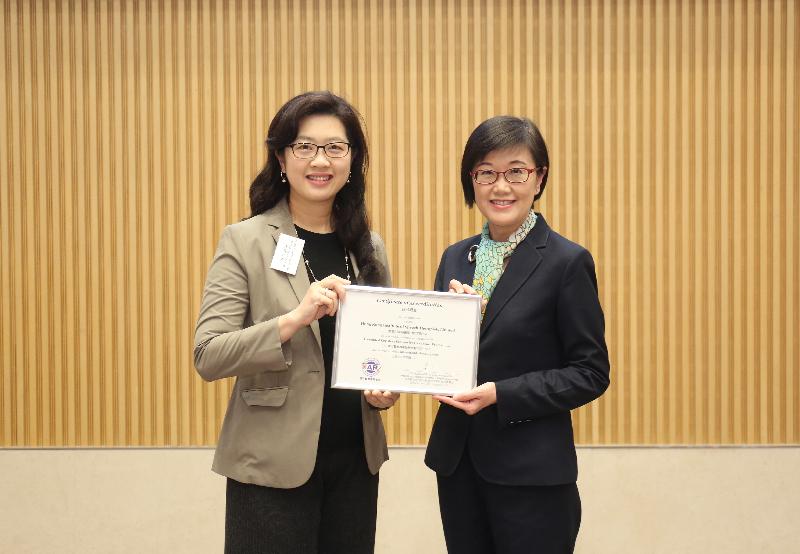
Speech therapy profession accredited under Pilot Accredited Registers Scheme for Healthcare Professions (with photos)

     The Secretary for Food and Health, Professor Sophia Chan, announced today (April 19) that a full accreditation status has been granted to the Hong Kong Institute of Speech Therapists (HKIST) under the Pilot Accredited Registers Scheme for Healthcare Professions (AR Scheme), authorising the institute as the accredited healthcare professional body responsible for administering a register for the speech therapy profession. Speech therapy is the first profession accredited under the Pilot AR Scheme.

     Speaking at a reception held for healthcare professions, Professor Chan recognised the importance of the AR Scheme in ensuring the professional standards of healthcare professionals and protecting the well-being of the public by providing information for them to make informed decisions.

     “Under the principle of professional autonomy, the Government launched the AR Scheme, which aims to enhance the existing society-based registration arrangements of healthcare professions currently not subject to statutory registration, with a view to promoting good service standards for the professions and providing more information to members of the public,” Professor Chan said.

     According to the assessment of the independent Accreditation Agent of the Pilot AR Scheme, the Jockey Club School of Public Health and Primary Care of the Chinese University of Hong Kong (JCSPHPC), the HKIST has met the accreditation standards covering governance, operational effectiveness, risk management and quality improvement, standards for registrants, educational and training requirements, and management of the register. Upon recommendation of the JCSPHPC, the Department of Health (DH) granted full accreditation status to the HKIST.

     As the accredited healthcare professional body, the HKIST is authorised by the DH to use an Accreditation Mark on its website and issues Certificates of Registration to its members for easy identification by the public. Members of the HKIST can use the title “Member of Register of Speech Therapists accredited by Department of Health” on their name cards.

     In addition to administering a register for the profession, the HKIST is also responsible for improving the professional competency of the speech therapist profession and handling complaints against its members.

     To ensure continuous enhancement of operation, the HKIST will be reviewed by the Accreditation Agent at the end of the first year of accreditation on its implementation actions for recommendation to continue with full accreditation status for three years.

     More information about the HKIST and its register of members is available on the websites of the HKIST (www.hkist.org.hk) and the DH (www.ars.gov.hk).

     Under the Pilot AR Scheme, four other healthcare professions, namely audiology, clinical psychology, dietetics and educational psychology, have also been preliminarily assessed to meet the criteria for an accreditation survey to be conducted in phases. The JCSPHPC has been providing training for these professions and the accreditation process is expected to commence in phases in 2018, depending on the readiness of each profession.

     The Government will continue to forge ahead with the Scheme with a view to paving the way for mapping out a statutory registration regime for these professions.

Photo  Photo  Photo